
Whale Wallet Tracking: Turning On-Chain Signals into Trade Ideas
What Whale Wallets Tell Us About Market Direction
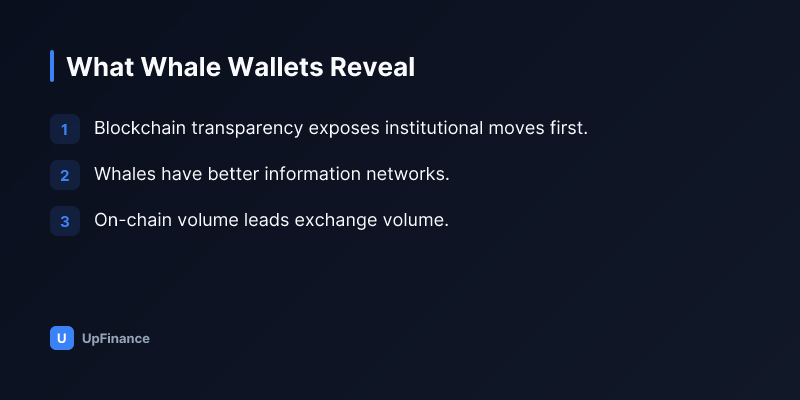
In traditional finance, institutional investors move markets through size and information edge. In crypto, that dynamic is radically transparent. Every wallet transfer, every accumulation pattern, every dump is recorded permanently on the blockchain—visible to anyone willing to look. The gap between when whales move capital and when retail traders react creates a profitable information arbitrage.
A whale is typically defined as a wallet holding significant cryptocurrency—usually in the top percentile by value. But whale-ness is relative to the asset. For Bitcoin, holdings above 100 BTC might qualify. For mid-cap altcoins, 1 million tokens could make you a whale. For emerging tokens in Southeast Asian markets or newly listed assets on Korean exchanges like Upbit or Bithumb, even smaller holdings command outsized influence.
The reason whale tracking matters goes beyond simple copycat investing. Whales often have better information networks, deeper research capabilities, and longer time horizons than algorithmic traders. When a whale begins accumulating before a regulatory announcement in Singapore, or starts moving coins to exchange wallets ahead of a Korean listing, those movements precede public knowledge. By the time a retail trader on Reddit notices the pattern, the move has already priced in partially.
The most successful crypto traders don't just watch price charts. They watch wallets. They notice when a whale that dumped tokens six months ago suddenly re-enters. They track whether accumulation is happening at support levels or in a frenzy near resistance. They understand that on-chain volume often leads on-exchange volume.
Understanding On-Chain Signals Worth Following
Not every whale transaction is meaningful. Whales move coins for many reasons: taking profits on scheduled vesting, rebalancing between exchanges, moving to cold storage for security, or simply rotating between assets. The skill is distinguishing signal from noise.
Exchange Inflow vs. Outflow
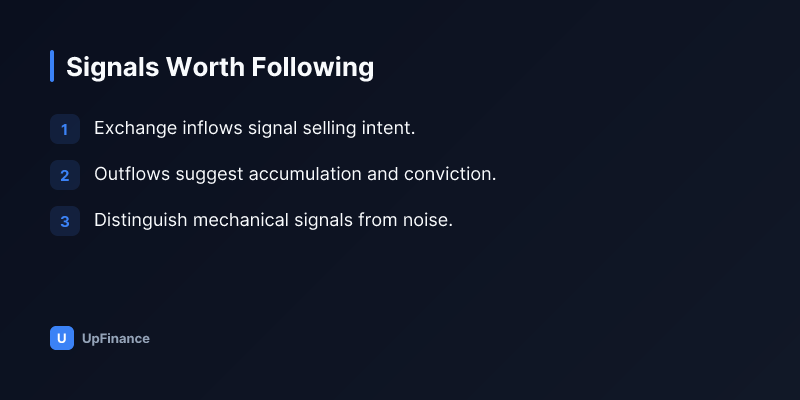
One of the cleanest on-chain signals is large transfers to and from major exchanges. When a whale moves coins onto an exchange, it typically signals intent to sell—preparing liquidity. When a whale moves coins off an exchange into private wallets or cold storage, it suggests accumulation and conviction. This distinction is powerful because it's mechanical and hard to fake.
For example, in early 2025, whales began consistently moving Bitcoin off exchanges despite a bull market narrative online. This signal preceded a pullback by weeks. Conversely, in emerging markets like Thailand and Vietnam, where retail adoption accelerates monthly, tracking which tokens whales move to local exchanges (Binance.VN, local DEXs) reveals where institutional interest is flowing.
Cluster Analysis and Accumulation Zones
Advanced whale tracking doesn't just flag individual transfers—it clusters related wallets and tracks accumulation behavior over time. A whale that has been buying at every dip between 20,000 and 21,000 USD (for Bitcoin) is signaling confidence in that support level. When that same whale suddenly shifts buying behavior to higher prices, or stops accumulating entirely, the signal has flipped.
This is especially useful in Asian markets where whale behavior is more concentrated. Korean exchanges see heavy retail participation, but the top 50 wallets often control 30-40% of certain altcoins' circulating supply. Tracking these whales on Upbit or Bithumb—where KRW-denominated trading volumes are substantial—provides earlier signals than Western exchange data.
"On-chain data is the closest thing crypto has to institutional positioning data. A whale moving one million dollars in Bitcoin is the equivalent of an institutional fund filing a 13F in traditional markets, except it happens in real-time and can't be delayed or obscured." — Blockchain researcher, Coin Metrics
Whale Profit/Loss Indicators
When a whale acquired an asset matters. If a whale bought Ethereum at 800 USD and the price is now 2,500 USD, their decision to sell is a profit-taking signal, not a panic exit. Conversely, if they bought at 2,400 USD and are selling at 2,500 USD, the signal is different—possibly they received bad information or their investment thesis shifted. On-chain tools that track average acquisition price for major wallets reveal the psychology behind each transaction.
This becomes especially valuable during volatility. During the 2023 crypto recovery, whales who had held through the FTX collapse and 2022 bear market began selling at specific price points. By tracking their average acquisition costs, traders could distinguish between "taking profits after real pain" and "exiting because fundamentals broke."
Large Transaction Velocity
The speed at which whales move assets also conveys information. A single 500 BTC transfer is different from 500 BTC moved across 10 transfers in 10 minutes. Rapid, fragmented movements suggest urgency—either intense selling pressure or rapid rebalancing. Slow, methodical movements suggest planning and conviction. During regulatory crackdowns (like Korea's 2025 reporting requirements), you often see fragmented outflows—whales moving assets to avoid being flagged.
Building a Whale-Tracking Intelligence System
Systematic whale tracking requires combining multiple data sources and automation. Manual observation of whale wallets is impossible at scale. Instead, successful traders use a layered approach.
Step 1: Identify Relevant Whale Wallets
Start by defining which whales matter for your trading thesis. If you're trading Solana, track the top 50 Solana whale wallets by holdings. If you're focused on Ethereum DeFi tokens, track wallets that hold meaningful positions across multiple DeFi protocols. Use tools like Glassnode, IntoTheBlock, or Nansen to filter wallets by:
- Total holdings value
- Average transaction frequency
- Asset concentration (single-asset vs. diversified)
- Historical profitability (how often they buy before rallies)
For regional markets, this requires local exchange data. Upbit and Bithumb publish whale wallet data through their APIs, allowing traders in South Korea and globally to track top holders of Korean-listed tokens. This creates an asymmetry: whales on regional exchanges are less visible to global traders, making their signals more valuable.
Step 2: Set Up Automated Alerts
Use APIs from on-chain intelligence platforms to trigger alerts when:
- A tracked whale wallet transfers coins off an exchange (accumulation signal)
- A tracked whale wallet transfers coins onto an exchange (distribution signal)
- A tracked whale moves more than X BTC/ETH in a single transaction
- A tracked whale's average acquisition price crosses below current price (profit-taking risk)
- Multiple tracked whales perform similar actions within 48 hours (consensus signal)
Automation is critical because whale transactions happen at all hours. A 2 AM transfer on a Saturday might represent outsized opportunity, but only if you catch it before market open.
Step 3: Cross-Reference with Exchange Order Book Data
On-chain signals matter most when they match exchange microstructure. If a whale transfers 100 BTC onto Coinbase, but Coinbase order books show zero large sell orders appearing, the whale may not be selling immediately—they might be staging a position. The combination of on-chain intent and exchange readiness creates higher-conviction signals.
This is where AI-driven platforms like UpFinance add value. By combining on-chain data, exchange order book snapshots, and historical pattern recognition, you can identify high-probability scenarios where whale movements precede detectable price action.
Step 4: Validate Signals Against Fundamentals
Not every whale trade is correct. Whales make mistakes, face forced liquidations, and sometimes misread markets. Always cross-reference whale signals against fundamental developments. If a whale suddenly dumps a token the same day negative news breaks, that's confirmation. If they're accumulating despite bad news, that suggests they have private information suggesting recovery.
For Asian markets, this requires monitoring local news and regulatory calendars simultaneously:
- Korean exchanges must comply with Real Name Verification (실명계좌) rules—sudden whale wallet movements often coincide with KYC deadline resets
- Japanese Bitcoin holdings are heavily influenced by tax events (April fiscal year boundaries)
- Southeast Asian whales often move to stablecoins ahead of local currency volatility or political events
Real-World Whale Tracking Examples
The Bitcoin Bull Run Setup (2025)
In early 2025, whales began accumulating Bitcoin below 42,000 USD with unusual consistency. By tracking inflows to cold storage wallets associated with major institutions, traders could see that:
- Accumulation was happening across multiple major whales simultaneously
- None of the accumulated Bitcoin was being moved to exchanges
- Average acquisition prices clustered around 38,000-40,000 USD
This whale consensus—before any bull market narrative dominated financial media—suggested institutional conviction. By the time Bitcoin reached 48,000 USD, those early signals had signaled a 20% move in advance. Traders who tracked whales entered positions weeks before the move became obvious to chart watchers.
The Altcoin Rug-Pull Prevention Signal
A mid-cap altcoin listed on Upbit (KRW volume >50 billion daily) began attracting retail traders in Korea. Whale tracking revealed that the top 5 holders—who collectively held 35% of circulating supply—had recently split their wallets and slowly begun moving tokens to exchange wallets over a two-week period. The pattern suggested planned distribution.
Traders who recognized this signal exited positions before the rug pull occurred. Whales aren't always right, but coordinated distribution patterns are rarely wrong.
The Ethereum Staking Shift
When Ethereum Shanghai upgrade enabled ETH staking withdrawals, whales holding staked ETH faced a decision: sell into the likely dip from early withdrawal activity, or hold for long-term staking rewards. By tracking which major Ethereum whales moved ETH off staking contracts into exchange wallets, traders could predict selling pressure and time short-term positions accordingly.
Whales who held through withdrawals were signaling conviction that long-term staking yields justified the short-term volatility—a bullish signal for longer-dated calls.
Common Whale Tracking Mistakes to Avoid
Confusing Correlation with Causation
Just because a whale moved coins before a price move doesn't mean they caused it. Sometimes whales are reacting to the same information as everyone else—they just have more capital deployed. Track whether whale movements precede price moves or follow them. A whale who dumps after a 50% rally is profit-taking, not prescient.
Ignoring Market Regime Changes
A whale accumulation pattern that worked perfectly in a bull market (2021) might be a disaster signal in a bear market (2022). Update your whale tracking rules based on current market conditions. During downtrends, whale accumulation might signal desperation, not conviction.
Assuming All Whales Are Smarter
Some whales have institutional backing, research teams, and information advantages. Others are early Bitcoin millionaires making emotional decisions. Don't automatically copy every whale trade. Cross-reference patterns and confirm signals through multiple whales before acting.
Overlooking Exchange-Specific Dynamics
A 500 BTC outflow from a small Asian exchange is more significant than the same outflow from Binance—fewer total holders mean each whale move has larger percentage impact. Similarly, a whale moving tokens to a regional Korean exchange (Upbit) signals different intent than moving to Kraken. Regional nuances matter.
Neglecting Tax and Regulatory Events
Whale movements spike around April (Japanese tax year-end), December (US tax year-end), and after regulatory announcements. A whale moving large positions after a Korean Financial Services Commission ruling on crypto reporting isn't necessarily bearish—they might be reacting to compliance requirements. Always check the regulatory calendar.
Tools and Platforms for Whale Tracking
Blockchain Explorers with Whale Alerts
Etherscan and BTC.com have built-in whale transaction flagging. Set up email alerts for wallets you're tracking. Free tier covers most needs for serious traders.
Dedicated On-Chain Analytics
- Glassnode: Enterprise-grade on-chain metrics. Best for aggregated whale behavior, not single-wallet tracking
- Nansen: Query-based wallet tracking with good UI. Excellent for identifying emerging whale patterns
- IntoTheBlock: Machine learning classification of wallet types. Good for separating whale from bot activity
- Arkham Intelligence: Transparent blockchain data with wallet labeling. Growing coverage
Exchange APIs
Binance, Kraken, and other major exchanges publish real-time order book and trade data. For Korean markets, Upbit and Bithumb offer similar APIs with KRW pair data—essential for regional whale tracking.
Aggregated Signals (AI-Driven)
Platforms like UpFinance combine on-chain data, exchange microstructure, and AI pattern recognition to surface whale-driven trade ideas. Rather than manually comparing dozens of whale wallets, AI systems score whale transactions by likelihood of preceding price moves—saving research time.
Converting Whale Signals into Trade Ideas
The final step is execution. Whale tracking is only valuable if it leads to profitable trades.
Strategy 1: Front-Running Major Whale Moves
When a whale begins accumulating, retail traders who notice early can establish positions ahead of the likely subsequent move. This requires:
- Real-time whale monitoring (not day-old data)
- Position sizing smaller than the whale's stated move
- Exit plans if the whale reverses course
This works best in less liquid assets where whale moves are larger relative to average daily volume. For Bitcoin or Ethereum, whale moves are already priced in by the time you see them.
Strategy 2: Confirmation Through Cluster Analysis
Don't trade single whale signals. Instead, use whale activity as a confirmation layer. If your technical analysis suggests a support level is strong, and whales are accumulating at that exact level, that's higher conviction than either signal alone.
Strategy 3: Contrarian Whale Positioning
Sometimes whales are early to trends that fail. Track whales who frequently get stopped out, and consider fading their moves. Conversely, identify consistently profitable whales and follow them closely. Not all whales are equal.
Strategy 4: Micro-Cap and Regional Opportunity
The whale tracking edge is largest in less-researched markets. Korean altcoin listings on Upbit, Southeast Asian tokens on regional DEXs, and emerging Layer 2 tokens see less institutional coverage. Whales moving positions in these markets are less visible—creating real alpha for patient traders who monitor these spaces.
This content is produced for marketing purposes by MIG Korea Group and is not investment advice. Crypto investing carries the risk of losing your principal; investment decisions are your own responsibility. UpFinance is the AI fintech service of MIG Korea Group.
Related posts
Start AI investing with UpFinance — free
Start free →Smart investing with UpFinance
AI-powered market analysis, automated portfolio rebalancing, and risk alerts.
We make crypto markets simple — without dumbing them down.