
Grid Trading in Sideways Markets: A Strategy That Actually Holds Up
The Case for Grid Trading When Markets Won't Commit
Most traders hate sideways markets. Momentum chasers see consolidation as opportunity cost. Mean-reversion traders get whipsawed. Swing traders sit idle, their capital locked in cash, waiting for the next directional move that may never come.
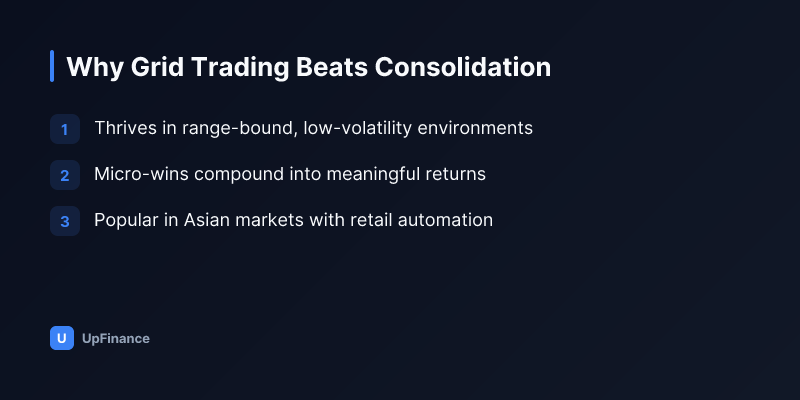
Grid trading thrives precisely where others struggle: in range-bound, low-volatility environments.
The strategy is deceptively simple. Instead of betting on direction, you place a series of buy and sell orders at predetermined intervals within a price range—a "grid." When price bounces between the top and bottom of your range, each bounce triggers a small profit. Over weeks or months, these micro-wins compound into meaningful returns without requiring you to predict whether Bitcoin goes to $80,000 or $40,000.
This approach has exploded in popularity across Asian crypto exchanges—particularly in South Korea and Japan—where retail traders manage billions of won and yen in accounts with UpFinance-style automated tools. The reason is practical: Asian markets feature heavy retail participation, frequent ranging periods, and lower regulatory friction around bot trading compared to Western venues.
Understanding Grid Trading Mechanics
Grid trading works by exploiting the volatility within a defined price range. Here's the core logic:
-
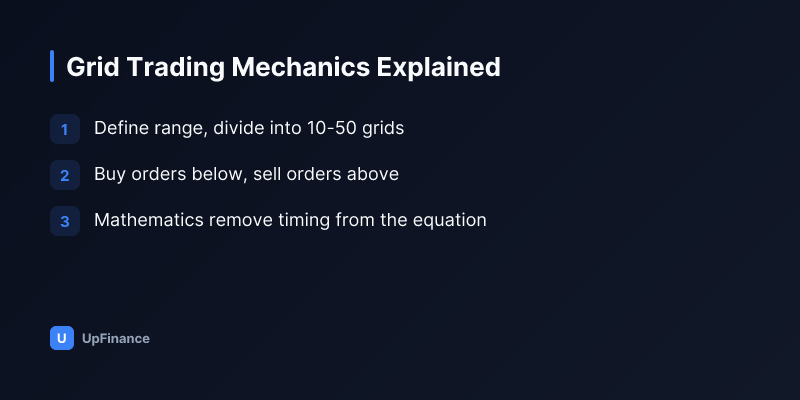
Define your range. Set an upper and lower price boundary based on technical analysis, support/resistance levels, or recent high/low prices.
-
Divide into intervals. Split that range into 10, 20, or even 50 evenly spaced "grids." If Bitcoin trades between $65,000 and $67,000, and you create a 20-grid system, each grid represents $100.
-
Place buy orders below mid-price. Every $100 down, you buy a fixed amount of Bitcoin. Each purchase anchors you lower, ready to sell higher.
-
Place sell orders above mid-price. Every $100 up, you sell the Bitcoin you accumulated on the way down. Each sale locks in profit.
-
Repeat. As price oscillates, your grid automatically captures gains. If it breaks above your range, you've sold most holdings at profit. If it drops below, you've accumulated more at lower cost.
The beauty lies in the mathematics: you don't need to time entries or exits. The market does the work for you.
Consider a concrete example from the Korean won perspective. Suppose you're trading Bitcoin on Upbit or Bithumb, with 100 million KRW (roughly $75,000 USD). You observe Bitcoin ranging between 65 million and 67 million won for the past month. You set:
- Upper grid: 67 million won
- Lower grid: 65 million won
- Grid spacing: 10 grids × 200,000 won per grid
- Capital allocation: 5 million KRW per buy order
Every time price drops 200,000 won, you buy. Every time it rises 200,000 won above the midpoint, you sell. Over a month of 8-10% range volatility, you've executed 30-40 round-trips, capturing roughly 2-3% per round-trip—translating to 60-120% annualized return within that range.
Why Asian Markets Are Ideal for Grid Trading
Asian cryptocurrency and stock markets have structural features that make grid trading particularly effective:
High Retail Participation and Frequent Volatility
South Korea and Japan host some of the world's most active retail trading populations. The average Upbit user or Binance Japan trader is far more likely to day-trade than their US counterpart. This retail activity creates continuous micro-volatility—price swings of 1-3% intraday—that grid systems exploit perfectly.
Regulatory Environment Favors Bots
Unlike the US, where spot trading bots on major exchanges face increasing scrutiny, and Europe, where MiFID II rules complicate algorithmic trading, Asian regulators have been more permissive. South Korea's Financial Services Commission and Japan's Financial Instruments Dealers Association allow bot trading on registered exchanges with minimal restrictions. This means your grid bot can run 24/7/365 without legal headwind.
Lower Slippage and Tighter Spreads
Korean exchanges like Upbit and Bithumb maintain order books with 1,000+ levels of depth for major pairs. Japanese exchanges similarly offer tight spreads on liquid pairs like BTC/JPY and ETH/JPY. Tight spreads mean your grid orders fill closer to target prices, reducing slippage and maximizing per-round-trip profit.
KRW and JPY Volatility Patterns
The Korean won and Japanese yen are notoriously volatile against the US dollar, but relatively stable in terms of local crypto valuations. This creates a sweet spot: while global Bitcoin price may trend sideways in USD, its KRW or JPY price oscillates predictably. A trader targeting the won/Bitcoin pair can profit from local volatility even if global Bitcoin is stuck.
Integration with AI Tools
Platforms like UpFinance have built intelligent grid systems atop Asian exchange APIs. Machine learning models can dynamically adjust grid spacing, upper/lower bounds, and capital allocation in real-time based on volatility metrics, volume patterns, and order book imbalance—something a static grid cannot do.
Practical Implementation: Step-by-Step
Step 1: Choose Your Pair and Timeframe
Select a liquid pair with recent ranging behavior. For Asian traders, BTC/KRW, ETH/KRW, or established alts on Upbit are ideal starting points. Analyze the past 2-4 weeks:
- Identify the highest and lowest price.
- Measure volatility. Calculate standard deviation of daily returns. Pairs with 2-5% daily volatility are sweet-spot candidates.
- Confirm no major catalysts pending. Earnings, regulatory news, or macro events can break your range violently.
Step 2: Set Your Grid Parameters
Work backward from your capital:
- Total capital allocated: Start conservatively (20-30% of your portfolio). This isn't a capital-efficient strategy—you're deploying capital across multiple buy levels.
- Number of grids: 10-50 depending on expected volatility. Fewer grids = larger moves between orders. More grids = more frequent fills but smaller profits per fill.
- Range width: Use Bollinger Bands (2-3 std dev) or Keltner Channels to define upper/lower bounds. Or use recent support/resistance.
Example (ETH/KRW on Upbit):
- Capital: 50 million KRW
- Recent range: 2.8 million – 3.0 million KRW
- Grids: 20
- Per-grid spacing: 10,000 KRW
- Per-buy order: 2.5 million KRW
Step 3: Execute and Monitor
Deploy your grid on an exchange that offers grid trading directly (Binance Futures, Bybit, OKX, Upbit) or via a bot like UpFinance. Set:
- Buy orders at every 10,000 KRW below 2.9 million (the midpoint)
- Sell orders at every 10,000 KRW above 2.9 million
Monitor weekly:
- Are fills happening symmetrically? (If only buys execute, price is falling out of range.)
- Is volatility increasing? (Expanding volatility may warrant widening your grid.)
- Has price broken the range? (Cancel remaining orders, reassess.)
Step 4: Iterate
After 2-4 weeks, review:
- How many round-trips completed?
- What was average profit per round-trip?
- Where did fills cluster? (Edges vs. center of range?)
- Did any adverse moves cause losses?
Adjust grid width, spacing, and range bounds based on observed behavior.
The Hidden Risks and When Grid Trading Fails
Grid trading is not a free lunch. Several failure modes warrant serious attention:
Range Breakouts
If price decisively exits your defined range—say Bitcoin suddenly rallies 15% on a geopolitical shock—your grid will find itself underwater. Your capital gets trapped at unfavorable prices with no offsetting sells to lock profits.
Mitigation: Use strict stop-losses or dynamic range-tightening when volatility spikes. UpFinance's AI module, for instance, can tighten ranges in real-time if volatility expands beyond 2 standard deviations.
Funding Costs (Futures vs. Spot)
If you're using leveraged grid trading on futures (common on Bybit, OKX), you'll incur daily funding costs. A 0.01% daily funding rate looks trivial until you realize it's 3.65% annually—a meaningful drag on marginal profits.
Stick to spot grid trading in sideways markets. Leverage amplifies losses without amplifying the sideways-market edge.
Opportunity Cost
Suppose you deploy 50 million KRW into a ranging Bitcoin pair expecting 60% annualized returns. Six months in, Bitcoin enters a sustained bull market (+40%). Your grid has captured perhaps 15-20%, but you've forgone the 40% upside. The 15-20% looks meager in hindsight.
This is philosophical, not mathematical. But it's real. Grid trading is optimal for uncertain, ranging environments—not bull or bear markets. Misidentifying market regime is the #1 reason traders abandon grid systems.
Slippage and Fees
On lower-liquidity pairs, grid orders may fill at worse prices than expected, eroding profits. On exchanges with high maker/taker fees (rare in Asia, but not zero), fees accumulate across 100+ monthly fills.
Upbit's taker fee is ~0.25%; Binance is ~0.1%. Over 100 fills per month, a 0.25% fee is 25% of a 1% per-round-trip profit. Factor fees into your target return.
Real-World Performance: What to Expect
Based on public data and case studies from UpFinance users trading on Korean and Japanese exchanges:
In a healthy ranging market (2-5% daily volatility):
- 0.5-1.5% profit per complete round-trip
- 20-40 round-trips per month
- Monthly return: 10-60%
- Annualized return: 120-720% (on capital deployed to grids)
This sounds absurd—and it is, relative to buy-and-hold. But recall: only 20-30% of your portfolio is deployed to the grid. The remaining 70-80% sits in cash or other strategies. On total portfolio, a 15% monthly grid return translates to 3-4.5% monthly portfolio return, or 36-54% annualized.
When volatility drops below 1% daily:
- Round-trips slow drastically (5-10 per month)
- Profits compress to 0.2-0.5% per round-trip
- Monthly return: 1-5%
When volatility spikes above 8% daily:
- Range breakouts become likely
- Many grid orders are filled at unfavorable prices before breakout
- Expected return: negative 5-15% (losses)
"Grid trading during the 2024-2025 consolidation in Bitcoin was genuinely lucrative for disciplined traders. But when volatility resurged in Q2 2026, many grids got liquidated. The winners were those who tightened ranges daily and kept stops tight." — Quantitative trader, Seoul fintech firm.
Grid Trading Tools and Platforms in Asia
Several platforms natively support grid trading for Asian users:
Binance: Offers "Grid Trading" in Spot and Futures. Supports KRW-denominated pairs. User-friendly interface; 0.1% taker fee.
OKX: Strong presence in Asia; advanced grid parameters. Supports JPY and KRW pairs. API access for custom bots.
Bybit: Popular in Southeast Asia. Futures grid trading with auto-leverage adjustment. Lower fees (~0.02%) but funding costs apply.
Upbit: Korea-native exchange. Integrating more bot-friendly APIs. No native grid UI yet, but feasible via third-party bots.
UpFinance: AI-driven grid platform with dynamic parameter adjustment. Supports Upbit, Bithumb, Binance. Real-time ML re-optimization of ranges and grid spacing. Designed for Asian market patterns.
Conclusion: Grid Trading in Your Portfolio
Grid trading is not a replacement for directional conviction or trend-following. It's a specialized tool for uncertain, range-bound markets where traditional momentum or mean-reversion strategies churn whipsaws instead of profits.
For Asian traders with access to retail-rich, highly liquid exchanges and permissive bot regulations, grid trading is particularly viable. Combined with AI-powered dynamic optimization (as offered by UpFinance), you can remove much of the manual rebalancing burden and let algorithms capture micro-volatility 24/7.
The right mental model: Think of grid trading as volatility harvesting—you're getting paid for price movement without needing to predict direction. In sideways markets, that's a genuinely powerful edge.
This content is produced for marketing purposes by MIG Korea Group and is not investment advice. Crypto investing carries the risk of losing your principal; investment decisions are your own responsibility. UpFinance is the AI fintech service of MIG Korea Group.
Related posts
Start AI investing with UpFinance — free
Start free →Smart investing with UpFinance
AI-powered market analysis, automated portfolio rebalancing, and risk alerts.
We make crypto markets simple — without dumbing them down.