
AI Trading Bots Explained: How They Work and Where They Fail
What Are AI Trading Bots and Why They Matter
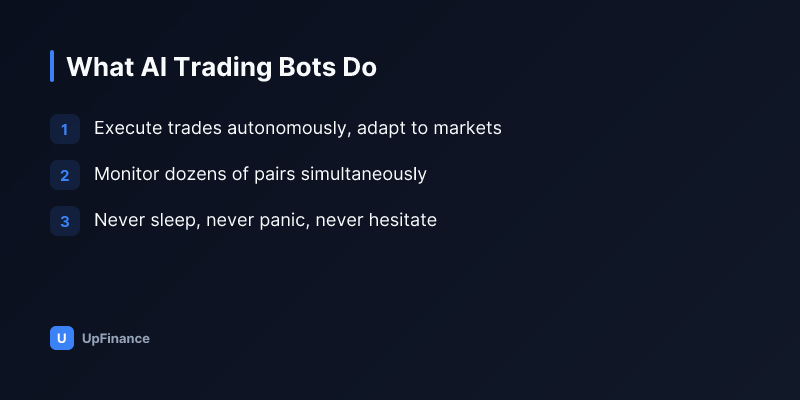
AI trading bots are software programs designed to execute buy and sell orders autonomously based on predetermined rules and machine learning models. Unlike traditional algorithmic traders that follow fixed if-then logic, modern AI bots adapt to market conditions, learn from historical patterns, and optimize their strategies in real time. For retail investors in the US, EU, and Southeast Asia, understanding these systems is no longer optional—they now move billions of dollars daily across equities, forex, and cryptocurrency markets.
The appeal is straightforward: humans sleep, get emotional, and make mistakes. Bots don't. A well-designed AI trading bot can monitor 50 different currency pairs simultaneously, execute microsecond trades on the Korean won (KRW) futures market, and rebalance a portfolio based on overnight news from Asian markets before US markets open. For someone trading on Upbit or Bithumb (Korea's largest crypto exchanges), or managing positions across BitMEX and Coinbase, a bot can mean the difference between catching a flash crash and missing it entirely.
"The difference between a human trader and a bot isn't intelligence—it's consistency and speed. A bot never gets tired, never second-guesses its thesis, and never panic-sells at 3 a.m. when Elon tweets." — Fintech analyst observation
Yet this consistency is a double-edged sword. Bots fail in ways humans wouldn't, amplify systemic risks, and can turn a small market inefficiency into a catastrophic loss in milliseconds. This post explores the mechanics of AI trading bots, how they succeed, and most importantly, where and why they crash.
How AI Trading Bots Actually Work
The Architecture: From Data to Execution
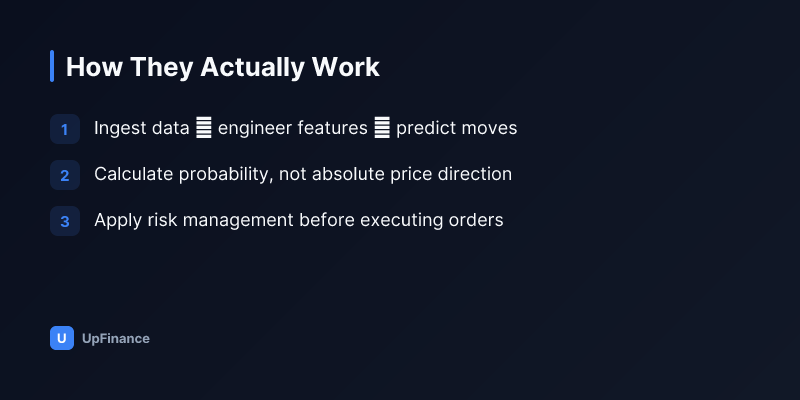
Modern AI trading bots operate on a pipeline architecture:
-
Data Ingestion: Real-time price feeds, order book data, news sentiment, and macroeconomic indicators flow into the bot continuously. For crypto traders, this means pulling candle data from exchanges via REST APIs (Coinbase, Kraken, Upbit) or WebSocket connections for lower latency.
-
Feature Engineering: Raw price data is transformed into features—moving averages, relative strength index (RSI), Bollinger Bands, volatility measures, and for sophisticated bots, alternative data like social media sentiment or on-chain metrics (for crypto).
-
Model Prediction: The AI model (typically a neural network or gradient-boosted decision tree) predicts the next price movement—up, down, or sideways. The prediction is rarely about absolute price; it's about relative probability. A model might say "75% chance this pair moves up 0.5% in the next 5 minutes."
-
Risk Management Layer: Before any order is placed, position sizing, stop-loss placement, and portfolio constraints are applied. A bot might predict a bullish move but reject the trade because portfolio leverage is already at 2.5x.
-
Order Execution: Finally, the bot sends orders to the exchange. For high-frequency strategies on centralized exchanges like Upbit or OKX, this can happen thousands of times per second. For slower strategies, orders go out every few minutes.
-
Post-Trade Monitoring: The bot tracks open positions, updates its models with new data, and adjusts or closes positions based on real-time performance.
Training and Backtesting: The Illusion of Certainty
Most AI trading bots are trained on historical data—perhaps 5 years of daily closes on EUR/USD, or 2 years of hourly candles on Bitcoin. A bot showing 45% annualized returns on backtested data feels like a sure thing. It almost never is.
Here's why: training data is free from black-swan events, flash crashes, regulatory shocks, and the friction of real execution. When a bot is trained on Bitcoin data from 2020–2023 (a bull market), it learns to recognize bull-market patterns. Feed it 2024-2026 data and it starts bleeding money because the regime has shifted. In Japanese markets, the Nikkei's historic strength through 2023–2024 trained many bots to favor long positions; bots that didn't adapt suffered when volatility spiked in early 2025.
Core Advantages: Why Bots Win in Specific Scenarios
Speed and Arbitrage Detection
The most obvious edge: bots execute faster than humans and can detect tiny price discrepancies across exchanges.
A concrete example from Korean crypto markets: Bitcoin might trade at 85,000,000 KRW on Upbit but 84,950,000 KRW on Bithumb due to liquidity differences or regional demand. A bot equipped with low-latency connections to both exchanges can buy on Bithumb, sell on Upbit, and pocket the 50,000 KRW per Bitcoin (roughly $37 USD at 2026 rates) in under 100 milliseconds. Scale that across 100 BTC and you've made 5 million won risk-free. A human trader would be researching the discrepancy while the bot has already closed the position.
Pattern Recognition at Scale
A bot trained on sufficient data can recognize subtle patterns that humans miss. If Bitcoin's price correlates with Fed fund futures, Japanese yen weakness, and Ethereum's on-chain transaction volume in a specific combination that predicts price moves 3-5 minutes ahead, a human won't spot it. A neural network trained on years of this multivariate data can.
Emotion-Free Risk Management
Humans hold losing positions hoping they'll recover. Bots execute stop-losses mechanically. This seems basic, but it's where most retail traders bleed money. A bot following disciplined position sizing—risking 1-2% per trade—will outperform a trader using 5-10% position sizes even if both have identical win rates. Over 100 trades, the bot's compound returns will be dramatically higher.
24/7 Operation Across Time Zones
For traders managing positions across US equities, European forex, and Asian crypto markets, human attention is impossible. A bot works while you sleep. This is particularly valuable in crypto, where Asian exchanges (Upbit, OKX, Binance.com) often set the tone for US-focused markets the next morning.
Where AI Trading Bots Fail: The Critical Weak Points
Model Overfitting and Regime Change
The most insidious failure mode is overfitting: the bot learned to profit from patterns in historical data that don't repeat.
A bot trained extensively on 2017's crypto bull run might have learned that "volume spike followed by RSI > 70 equals 72-hour rally." This pattern was real in 2017. But when fed 2018-2019 bear market data where that same signal predicted crashes, the bot lost money consistently. Unfortunately, you don't discover overfitting until it's costing you real money in live trading.
Regime change is the broader concept: the market's underlying statistical properties shift. Japan's stock market from 1985–1995 (bubble burst) followed completely different rules than 1995–2005 (deflation era) or 2013–present (Abenomics). A bot trained only on the Abenomics bull run will be blindsided by the next deflationary shock.
The Korean market offers another example: the 2017 crypto bubble was driven by retail FOMO and unregulated exchanges. By 2021–2022, the same market had real institutional participation, tighter regulations from the Financial Services Commission (FSC), and different price discovery mechanisms. Bots trained on 2017 patterns would fail in 2021.
Liquidity Evaporation and Slippage
Backtests assume your order executes at the exact price you see on the chart. Real trading is messier.
Imagine a bot decides to buy 50 Bitcoin on Upbit based on a signal. On paper, it looks like a 10 billion won trade. But when the bot's algorithm splits this into 50 separate market orders to reduce slippage, each order moves the price slightly higher. By the time 50 BTC are purchased, the average fill price is 200,000 KRW higher per coin—that's 10 million won in total slippage, instantly erasing profit.
For less liquid pairs (altcoins, emerging-market forex), slippage is catastrophic. A bot trained on average-case liquidity conditions suddenly faces 2-5% spreads when market stress hits and retail traders flee.
Flash Crashes and Cascading Failures
On May 6, 2010, the S&P 500 crashed nearly 10% in minutes, then recovered. The culprit was partially attributed to algorithmic traders using stop-losses and momentum-following bots, which cascaded into each other—each bot's selling triggered others' stop-losses.
When one bot panics and liquidates a large position, it can trigger a cascade of other bots' stop-losses, amplifying the crash and destroying liquidity. In crypto's unregulated environment, this happens more frequently and without circuit breakers. A single large liquidation on BitMEX or Bybit can spiral into a 10% price drop in seconds, wiping out bots that were perfectly profitable milliseconds earlier.
The 2024 crypto crash saw exactly this: a large liquidation on a leveraged long position sparked a cascade of automated margin calls and stop-losses, pushing Bitcoin down 5% in under 60 seconds before recovery.
Data Quality and API Failures
Bots are only as good as their data and connectivity.
Real-world exchanges have bugs. A feed disconnect lasting 500 milliseconds is an eternity in algorithmic trading. Upbit, despite being a professional exchange, has experienced API latency spikes and occasional data feed delays. When this happens, a bot might be working with stale price data, making decisions based on 2-minute-old information while thinking it's current. Over-leveraged bots can be liquidated during these disconnects.
Furthermore, exchanges tweak their APIs, cancel historical data subscriptions, or change data schemas. A bot running for months suddenly breaks because the exchange changed the JSON structure in a minor API update. This sounds trivial, but it's how bots fail in production.
Regulatory and Black Swan Events
A bot trained on historical regulatory data will have zero built-in anticipation for a sudden shift in policy. When South Korea's FSC announced stricter crypto exchange regulations in 2021, many trading bots—especially those using leverage—saw margin requirements spike unexpectedly, forcing liquidations.
Similarly, no backtest can predict a black swan like a pandemic, a geopolitical crisis, or a major exchange hack. In March 2020, many "profitable" bots got crushed as correlations broke down (everything sold), vol spiked, and liquidity vanished. The bot that worked in 2019 became a money-losing machine.
Real-World Bot Categories and Their Trade-Offs
Market-Making Bots
These bots place both buy and sell orders around the current price, profiting from the bid-ask spread. They work beautifully in calm, liquid markets.
Advantages:
- Consistent, small wins across many trades
- Lower correlation to directional market moves
- Profitable even in sideways markets
Failures:
- Loses money when volatility spikes (gets caught holding inventory in crashes)
- Depends entirely on tight spreads (fails in illiquid pairs)
- Regulatory risk in some jurisdictions (US and EU regulators question whether bots qualify as "market makers")
Trend-Following Bots
These bots identify directional moves and ride them. They typically use moving averages, momentum indicators, or neural networks trained on past trends.
Advantages:
- Can capture large moves during bull or bear markets
- Simple logic often survives regime changes better than complex bots
Failures:
- Whipsaws heavily in choppy, sideways markets (buys the dip after a small rally; gets stopped out)
- Lags the move (by the time the bot confirms a trend, it's already underway; you buy after the first 30% of the move)
- In crypto, trend-following bots all use similar indicators, leading to synchronized cascades
Mean Reversion Bots
These assume that extreme price moves will revert to the average. If an asset is up 20% in a day, the bot bets it falls back down.
Advantages:
- Profitable when volatility is high but temporary
- Captures whipsaws that trend-followers miss
Failures:
- Catastrophic when a trend truly begins. A bot shorting Bitcoin at $25,000 expecting reversion to $20,000 gets liquidated as it rallies to $70,000
- Requires extremely tight risk management; one wrong mean-reversion bet can wipe out months of gains
- In 2024, mean-reversion bots struggled as trending moves were sustained
Sentiment and Alternative Data Bots
Advanced bots ingest social media sentiment, on-chain metrics (for crypto), news feeds, and other alternative data to make predictions.
Advantages:
- Can front-run news sentiment
- Captures behavioral patterns humans miss
Failures:
- Garbage in, garbage out: if sentiment data is manipulated (bot-driven tweets, coordinated pump-and-dump groups), the model learns false correlations
- Extremely sensitive to data source disruptions
- Regulatory risk if bots appear to be trading on insider information
The Role of UpFinance and Modern Platforms
Professional AI trading platforms like UpFinance have automated much of the bot deployment and risk management process for retail traders. Rather than coding a bot from scratch and managing API keys, infrastructure, and backtesting, a trader can use UpFinance's interface to:
- Design bot logic through a visual editor or API
- Backtest against 10+ years of data
- Paper-trade to verify before going live with real capital
- Set hard position limits and stop-losses at the platform level (preventing bot bugs from causing catastrophic losses)
This abstraction layer is crucial for risk management. A badly written bot running on a trader's home laptop with direct exchange access can lose $100,000 in 60 seconds. The same bot on a professional platform with circuit breakers and position limits loses $5,000 and automatically halts.
How to Evaluate an AI Trading Bot (Before You Lose Money)
1. Scrutinize Backtest Results
Ask: Is the backtest realistic?
- Does it account for slippage (1-5% depending on liquidity)?
- Does it model spread costs and exchange fees?
- Does it include a market crash period (2008, 2020, 2022)?
- How does it perform in the most recent 6 months of data?
If a bot shows 50% annual returns in backtest but zero live trading history, assume it's overfit.
2. Check Live Track Record (Not Paper Trading)
Paper trading is useless. A bot can dominate in simulated trading because it never faces slippage, execution delays, or market impact. Demand to see real money results. Even 6 months of live trading (good or bad) beats 5 years of backtested returns.
3. Understand Leverage and Drawdown
A bot returning 40% per year but experiencing 60% peak drawdowns is riskier than a bot returning 20% per year with 10% drawdowns. Max drawdown tells you: if you started with $100,000, what's the worst this bot would do to your account? If it's 50% or more, a market crash will wipe you out.
4. Verify Exchange and Regulatory Compliance
In the US and EU, trading bots must comply with MiFID II (Europe) and SEC regulations. In South Korea, the FSC has specific rules around algorithmic trading and leverage. A bot that sounds amazing but operates outside regulatory frameworks is a tax and legal liability.
5. Test with Small Capital First
Even if a bot looks solid, trade it with 1-5% of your portfolio for 3-6 months. This tests:
- Whether the live data feeds work
- How the bot behaves during actual volatility
- Slippage and execution quality you actually receive
- Your emotional tolerance for watching it lose during downturns
The Future of AI Trading Bots: Where the Industry is Headed
The trend is toward hybrid models combining machine learning with explicit risk controls. Instead of pure neural networks that optimize for returns, newer bots optimize for returns subject to hard constraints on leverage, drawdown, and correlation.
We're also seeing more integration with alternative data sources—satellite imagery of ports and shipping, shipping cost futures, social sentiment from decentralized sources. Bots that correlate real-world economic indicators with financial prices outperform those using only price data.
In crypto specifically, on-chain analysis (tracking whale wallet movements, exchange inflows/outflows, transaction volumes) is becoming more sophisticated. A bot that can read the blockchain state and anticipate exchange liquidations has an edge over bots that only read price charts.
Finally, regulatory pressures will force more transparency. In 2024-2026, major exchanges are implementing rules requiring traders to disclose bot activity and prove that algorithms don't manipulate markets. This shifts the advantage toward well-capitalized, regulated bots (like those available through platforms and exchanges) and away from completely unmonitored bots.
Conclusion: Bots Are Powerful—But Not Magic
AI trading bots work. They can outperform buy-and-hold strategies, capture opportunities humans can't, and operate at speeds that make money in ways unavailable to manual traders. But they're not magic money machines, and treating them as such is how fortunes are lost.
The bots that fail are those that:
- Overfit historical patterns
- Assume smooth markets and reliable liquidity
- Skip risk management
- Run without regulatory oversight
- Never adapt to regime changes
The bots that survive are those that:
- Backtest rigorously and skeptically
- Include realistic costs and slippage
- Trade real money with strict position limits
- Operate within regulatory frameworks
- Monitor live performance and adjust or halt when performance diverges from expectations
If you're exploring algorithmic trading—whether in US equities, European forex, Korean crypto, or Japanese futures—start small, verify results against live data, and never trust a bot more than you trust your own risk tolerance.
This content is produced for marketing purposes by MIG Korea Group and is not investment advice. Crypto investing carries the risk of losing your principal; investment decisions are your own responsibility. UpFinance is the AI fintech service of MIG Korea Group.
Related posts
Start AI investing with UpFinance — free
Start free →Smart investing with UpFinance
AI-powered market analysis, automated portfolio rebalancing, and risk alerts.
We make crypto markets simple — without dumbing them down.