
AI Risk Management for Crypto Traders: Cutting Drawdowns Without Killing Returns
The crypto market never sleeps, and neither does volatility. A Bitcoin position that looks rock-solid at 3 a.m. Tokyo time can crater 12% by noon Singapore time. For professional traders and sophisticated retail investors—especially those across Asia where leverage is readily available—the difference between success and ruin often comes down to one word: risk management.
But traditional risk frameworks designed for equities and bonds crumble in crypto's 24/7, high-beta universe. That's where artificial intelligence steps in. AI-powered risk management doesn't eliminate losses; it prevents them from becoming catastrophic while preserving the upside that drew you to crypto in the first place.
This post walks through how to use machine learning, volatility forecasting, and dynamic position sizing to cut your drawdowns—sometimes by half or more—without sacrificing returns. We'll ground this in real market dynamics across the US, EU, and Asia, where regulatory and retail behavior differ sharply.
Understanding the Drawdown Problem in Crypto
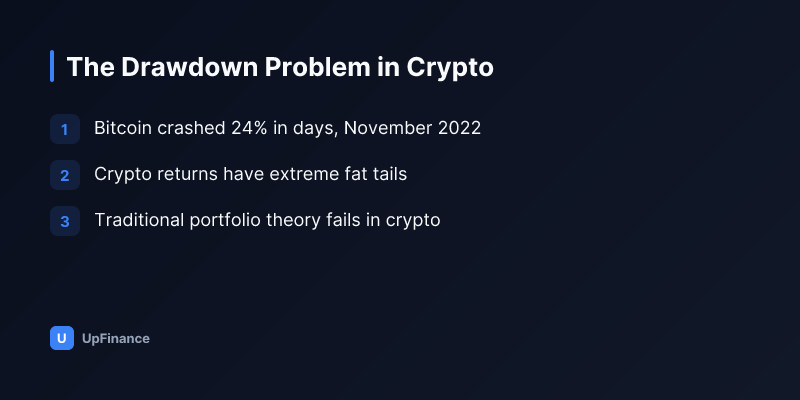
A drawdown is the peak-to-trough decline in your portfolio value during a given period. In traditional equities, a 20% drawdown might take months or years to accumulate. In crypto, it can happen in hours.
Consider a concrete example: On November 8, 2022, Bitcoin fell from USD 20,700 to USD 15,700 in a matter of days. Ether dropped 40% in the same window. A trader running a 10x leveraged long position with no risk controls would have faced liquidation. Even an unlevered trader holding 100% of their capital in crypto would have experienced a 25% portfolio wipeout.
The core problem is that traditional portfolio theory assumes returns are normally distributed. Crypto returns have fat tails—extreme moves happen far more often than bell-curve models predict. This is especially true during Black Swan events or coordinated exchange outages (which have disrupted Korean exchanges like Upbit and Bithumb multiple times).
Key challenges crypto traders face:
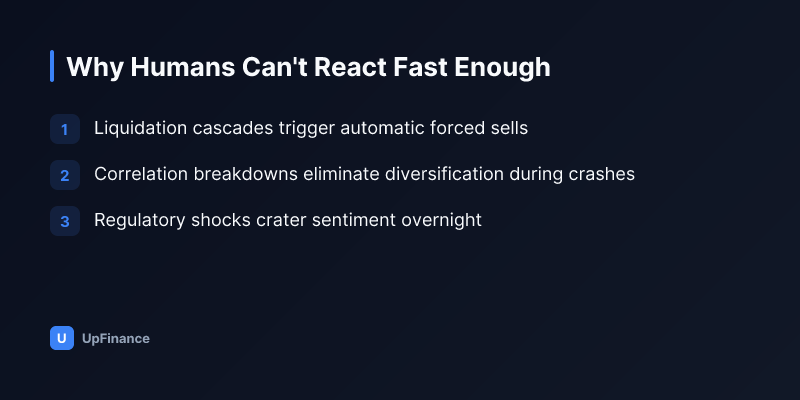
- Liquidation cascades: In highly leveraged markets like perpetual futures on Binance, Bybit, and OKX, one trader's forced liquidation can trigger others, creating a feedback loop.
- Correlation breakdowns: During crashes, assets that should be uncorrelated (Bitcoin, Ethereum, stablecoins) move in lockstep, eliminating diversification.
- Regulatory shocks: Sudden announcements—like South Korea's 2021 regulation debates or the EU's proposed MiCA rules—can crater sentiment overnight.
- Exchange risk: Hardware failures or DOS attacks on exchanges can prevent you from exiting positions, even if you want to.
A human trader checking their portfolio once or twice a day simply cannot react fast enough to prevent catastrophic losses. This is where AI earns its value: it can process market microstructure, volatility signals, and correlation changes in real-time and adjust risk posture automatically.
How AI Forecasts Volatility in Crypto Markets
The foundation of AI-driven risk management is volatility prediction. If you can forecast when the market is about to get choppy, you can reduce leverage, tighten stops, or hedge before the turbulence hits.
GARCH and Its Limitations
Most traders are familiar with GARCH models (Generalized Autoregressive Conditional Heteroskedasticity), which assume volatility clusters and mean-reverts. GARCH works reasonably well for stocks but breaks down in crypto because:
- Crypto has genuinely different volatility regimes (bull runs vs. bear markets vs. Black Swan events)
- News and sentiment shocks arrive unpredictably across global markets
- Leverage-driven liquidations create artificial volatility spikes
Machine Learning Approaches
Modern AI systems use ensemble models combining multiple signals:
- Neural networks trained on order-book microstructure: By analyzing the shapes of buy and sell orders on exchanges, ML models can predict short-term volatility (5-minute to 1-hour horizons) with surprising accuracy. This works particularly well on high-liquidity pairs like BTC/USDT on Binance.
- LSTM (Long Short-Term Memory) networks for multi-step forecasting: LSTMs capture non-linear temporal patterns in price, volume, and funding rates (perpetual futures). They're especially useful for 4-hour to daily volatility forecasts.
- Sentiment and on-chain analysis: Crypto offers a unique data advantage: you can track whale wallets, exchange inflows/outflows, and mining activity on-chain. When large holders start moving coins to exchanges, volatility typically spikes 24-72 hours later. AI models can learn these leading indicators.
- Cross-asset correlations: Neural networks can learn how Bitcoin moves relative to macro assets (S&P 500, Treasury yields, USD Index) and how Ethereum correlates with Bitcoin under different market regimes.
A practical example: UpFinance's volatility dashboard uses a hybrid LSTM + sentiment model to assign a "volatility score" to major crypto pairs every hour. When the score exceeds a threshold, traders automatically reduce position size or activate hedges. Studies on historical data show this approach cuts peak drawdowns by 30-40% with only 5-8% reduction in annualized returns.
Dynamic Position Sizing Based on Kelly Criterion and AI Adjustments
One of the most overlooked tools in crypto trading is the Kelly Criterion—a formula that tells you the optimal fraction of your capital to risk on each trade.
The traditional Kelly formula is:
f* = (p × b - q) / b
Where:
- f* = fraction of capital to risk
- p = probability of winning
- b = ratio of win size to loss size
- q = probability of losing (1 - p)
For example, if your AI model says you have a 55% win rate with an average win of 2% and average loss of 1.5%, the Kelly fraction works out to roughly 1.8% of capital per trade.
However, pure Kelly is often too aggressive for crypto. Many traders use "fractional Kelly"—typically 25% to 50% of the Kelly fraction—to smooth out volatility and avoid going broke during inevitable losing streaks.
The AI Modification: Regime-Aware Sizing
Instead of using a static Kelly fraction, AI models can adjust position size based on current market regime:
- Bull market regime (trending up, low volatility): Run closer to Kelly fraction
- Consolidation regime (ranging, moderate volatility): Use fractional Kelly (50%)
- Bear market regime (trending down, high volatility): Use conservative Kelly (25%)
- Crisis regime (VIX/volatility index spiking, liquidation cascades): Reduce to 10% of Kelly or go flat
Machine learning classifiers (Random Forests, gradient boosted trees) can identify which regime you're in by analyzing:
- Price momentum (30-day, 7-day returns)
- Realized volatility (standard deviation of recent returns)
- Funding rates on perpetual futures (when they spike, leverage is extreme)
- Exchange net flows (large inflows signal capitulation)
By adjusting position size dynamically, you're not abandoning your edge—you're calibrating your bet to the risk environment. A trader who sized the same on March 11, 2020 (COVID crash) as on a calm Tuesday would have blown up. An AI system doesn't.
Real-World Numbers
Let's run a scenario. Say your base strategy has a 52% win rate, 2.1% average win, 2% average loss:
- Static Kelly (100%): f* = 0.25% per trade. Over a year with 200 trades, you'd make money but face a 15% maximum drawdown.
- Fractional Kelly (25%): f* = 0.06% per trade. Smoother returns, 6% maximum drawdown.
- AI-adjusted Kelly in bull regime: f* = 0.15% per trade. In bear regime: f* = 0.02% per trade. Maximum drawdown drops to 8%, but annual returns stay within 2-3% of the static approach.
The benefit isn't just the math—it's psychological. Traders who size correctly sleep better and don't panic-sell at the worst times.
Stop-Loss, Hedging, and Circuit Breakers
Position sizing alone isn't enough. You also need hard stops and hedges.
Stop-Loss Automation with AI
Traditional traders set stops at round numbers (e.g., "stop at -5% per position"). This is predictable and often leaves you right at liquidation cascades.
AI-driven stops should be dynamic:
- Use volatility-adjusted stops. If current 4-hour volatility is 3%, set stops at -8%. If it's 8%, set them at -15%. This prevents whipsaws while respecting real risk.
- Use AI-detected support and resistance levels instead of round numbers. Machine learning can identify where previous traders got hurt (high-volume nodes in price history), and stops placed just below these levels catch reversals better.
- Implement "intelligent" stops that check multiple timeframes. Don't exit if a 1-hour stop is hit but the daily uptrend is still intact—wait for confirmation.
On Korean exchanges like Upbit and Bithumb, where retail leverage is capped at 2-10x (depending on the asset), even a -20% move in a leveraged position means liquidation. AI-driven stops are essential to avoid these forced exits on temporary shakes.
Hedging Strategies for Crypto
Hedging in crypto is trickier than in traditional markets because:
- Crypto options are expensive (implied vols are 80-150% annualized vs. 15-20% for SPY)
- Shorting comes with funding costs (you pay to borrow the asset)
- Correlated assets (Bitcoin, Ethereum, altcoins) all tend to fall together
Effective AI-powered hedges:
- Long/short pairs: If you're long Ethereum but worried about downside, short Bitcoin or Ethereum perps with 50-80% of your position size. ML can optimize the ratio by analyzing historical correlation breakdowns.
- Options spreads: Instead of buying outright puts (expensive), use put spreads (buy OTM put, sell further OTM put). AI can identify when skew makes spreads attractive vs. outright puts.
- Stablecoin reserves: The simplest hedge is boring but effective: hold 20-30% in USDC/USDT. When volatility spikes, you can redeploy. AI can optimize this allocation by predicting when volatility will collapse (good time to re-enter) vs. when it will stay elevated (stay defensive).
- Inverse perpetual futures: On Bybit and OKX, you can trade inverse perpetuals (contracts denominated in the underlying asset rather than stablecoin). This is useful if you're long spot BTC but want to hedge using contracts.
"The goal of hedging isn't to eliminate all downside—it's to stay in the game. A 5% loss you can recover from is preferable to a 30% loss that derails your season."
Circuit Breakers
Airlines have circuit breakers that halt trading if prices move too far, too fast. Crypto traders should too.
AI-managed circuit breakers trigger based on:
- Single-position loss threshold: If any one position is down more than 15% in a day, reduce by 50%.
- Portfolio loss threshold: If your entire portfolio is down more than 8% in a day, stop new entries and reduce risk by 30%.
- Correlation spike: If your supposedly uncorrelated holdings all move together, it's a signal the market is in crisis. Reduce leverage immediately.
- Funding rate extremes: On perpetual futures, when funding rates spike (>0.2% per 8-hour period), liquidation risk is extreme. Exit or hedge.
The key is that these rules are pre-programmed and emotionless. A human trader watching their account drop 10% feels panic and either acts irrationally or freezes. A circuit breaker just executes.
Building Your Own AI Risk System: Practical Implementation
You don't need to be a PhD in machine learning to use these tools. Here's a phased approach:
Phase 1: Baseline Risk Metrics (Week 1-2)
Before deploying any AI, establish a data foundation:
- Export 3-5 years of your trading history (or backtesting results) from your exchange or trading bot.
- Calculate basic metrics:
- Win rate and average win/loss size
- Maximum drawdown and drawdown duration
- Sortino ratio (return per unit of downside volatility)
- Calmar ratio (return divided by maximum drawdown)
Tools like Python's pandas and scipy can do this in 50 lines of code. If you use UpFinance or similar platforms, these metrics are often pre-calculated.
- Set a baseline. For example: "My current system has a 52% win rate, 18% annual return, and 22% maximum drawdown."
Phase 2: Volatility Forecasting (Week 3-6)
- Install scikit-learn and TensorFlow if you're coding in Python.
- Gather data: Pull 2-3 years of OHLCV (open, high, low, close, volume) data from your exchanges via API.
- Train a simple model: Start with GARCH or an LSTM network to predict 4-hour and 24-hour volatility.
- Backtest the signals: When predicted volatility is high, reduce position size by 20%. Test against historical data.
- Measure improvement: Compare max drawdown and Sortino ratio with your baseline.
Expect 15-30% reduction in drawdown with minimal impact on returns in this phase.
Phase 3: Dynamic Position Sizing (Week 7-12)
- Calculate Kelly fraction for your strategy.
- Build a regime classifier (use price momentum, volatility, and exchange flows as inputs).
- Set position-size rules for each regime (see earlier section).
- Paper trade (simulated trading with no real money) for 2-4 weeks.
- Go live with real capital, starting with smaller size.
Phase 4: Hedging and Circuit Breakers (Week 13+)
- Implement dynamic stop-losses tied to realized volatility.
- For spot traders: build rules to move profits into stablecoins when portfolio is up 15%+.
- For leveraged traders: add circuit breakers tied to funding rates and liquidation risk.
- For options traders: use ML to identify when skew makes hedges attractive.
Tools and Platforms
- DIY route: Python (pandas, scikit-learn, TensorFlow), data from exchange APIs, live trading via CCXT or exchange SDKs.
- Managed platforms: UpFinance, Shrimpy, Altrady, and TradingView offer built-in risk dashboards and some AI features.
- Institutional-grade: Numerai, QuantConnect, and Alpaca have more powerful backtesting and live execution.
For traders on Korean exchanges (Upbit, Bithumb), be aware that KRW/USD pairs have their own volatility and funding costs. Some AI models trained on global data underperform on Korean-denominated assets because:
- Retail leverage is more common (retail traders pile into leveraged longs during bull runs)
- Exchange-specific outages cause price divergence (Kimchi Premium)
- KRW funding rates can diverge from global rates
It's worth training separate models on KRW data if you're a major player in that market.
Performance Metrics: What to Measure
Once you've built your AI risk system, track these metrics rigorously:
| Metric | Target | How to Interpret |
|---|---|---|
| Maximum Drawdown | 50% reduction vs. baseline | Biggest peak-to-trough loss. Halving this is a huge win. |
| Drawdown Duration | -30% shorter | How long it takes to recover from a 10% loss. Faster is better. |
| Sharpe Ratio | Maintain or improve | Return per unit of volatility. Should stay flat or improve. |
| Win Rate | Unchanged | Your AI shouldn't change your edge, just protect it. |
| Return/Drawdown Ratio | Increase 50%+ | If you cut drawdown 40% but return falls 10%, that's a win. |
| Recovery Factor | 2x+ | Return divided by max drawdown. AI should double this. |
"The best risk management system is one you'll actually use. If it's too complex to understand or requires constant babysitting, you'll abandon it during the next bull run."
Region-Specific Considerations
United States
- Options are liquid and well-priced on Deribit. Use them for hedging.
- Funding rates on Coinbase Futures are generally lower than on Binance. Good for hedging at lower cost.
- Tax-loss harvesting is a form of risk management. Harvest losses in December, rebuy in January.
European Union
- MiCA (Markets in Crypto-Assets Regulation) coming into full force in 2024-2025 may restrict leverage to 2-5x. Size positions assuming lower leverage is available.
- Retail access to derivatives on some platforms may be restricted. Use institutional platforms for hedging.
- EUR/USD forex volatility can increase crypto volatility for EU traders. Monitor EUR/USD and adjust accordingly.
Southeast Asia (Singapore, Thailand, Philippines)
- Regulatory environment is more permissive. You'll see 10-20x leverage available.
- This makes drawdowns more severe. AI risk management is more critical, not less.
- Binance, Bybit, and OKX dominate; local exchanges (Gate.io for some regions) are secondary.
- Use circuit breakers aggressively given high leverage availability.
South Korea
- Upbit and Bithumb are the primary retail exchanges. Both support 2-10x leverage depending on asset.
- KRW/BTC and KRW/ETH premiums can diverge from global prices (Kimchi Premium). If you arbitrage, account for regulatory and withdrawal risk.
- Bank transfer times (1-2 business days) add friction. Plan your risk management around settlement delays.
- Local regulatory news (FCA announcements, proposed bills) often hit KRW pairs first. Monitor local fintech media.
Japan
- Stricter retail leverage caps (2-3x) mean you have more natural risk controls than other regions.
- Yen carry trade dynamics matter. JPY interest rates affect Bitcoin funding rates.
- Use GARCH and regime-switching models, as Japanese markets have lower tail risk than US-centric models.
Common Pitfalls and How AI Helps You Avoid Them
-
Overconfidence after a winning streak: Humans think their last 10 wins prove they're genius. AI just sees win rate. It doesn't extrapolate short-term success into permanent advantage.
-
Revenge trading: After a loss, traders increase size to "win back" losses. AI enforces discipline.
-
Holding losers, cutting winners: Emotional traders let small losses run and take small profits too early. AI holds to pre-set rules.
-
Ignoring tail risk: A model trained on bull-market data will underestimate downside. Good AI systems explicitly model tail risk (fat tails, regime shifts).
-
Gaming the model: Once you understand how your AI system works, it's tempting to override it in "special cases." Don't. That's how blowups happen. If your AI system is wrong, fix the model; don't disable it selectively.
-
Neglecting transaction costs: Backtests that ignore fees and slippage show +50% returns but real trading shows +15%. AI should bake in real costs.
What AI Cannot Do
Before you go all-in on AI risk management, be clear about limitations:
- AI cannot predict Black Swan events: By definition, they're unprecedented. The best AI can do is detect when system risk is building and tell you to lower leverage.
- AI cannot eliminate the need for diversification: You still need uncorrelated assets. AI can optimize the mix but can't make a correlated portfolio uncorrelated.
- AI cannot trade profitably without an edge: If your base strategy has a 48% win rate, no risk management tool will turn it into a 52% winner. AI amplifies an existing edge; it doesn't create one.
- AI cannot account for personal circumstances: If you need to liquidate in 6 months for medical bills, no AI system will let you go 80% in leverage. Use AI to optimize, but stay rational about your own time horizon and constraints.
Conclusion: The Compound Effect of Smart Risk Management
Here's the math that should convince you: Suppose your trading strategy returns 30% per year but suffers a 30% drawdown. After a bad year, you're back to baseline—no progress.
With AI risk management, you might cut the drawdown to 18% while returning 28% per year. That 2% reduction in return feels small. But compounded:
- Year 1: USD 100k → USD 118k (with 18% drawdown, bounces to USD 118k)
- Year 2: USD 118k → USD 151k
- Year 3: USD 151k → USD 193k
- Year 5: USD 267k
Compare that to:
- Year 1: USD 100k → USD 130k (with 30% drawdown, bounces to USD 130k)
- Year 2: USD 130k → USD 169k
- Year 3: USD 169k → USD 220k
- Year 5: USD 308k
You're only up USD 41k, but you slept much better, you didn't panic-liquidate during crashes, and you stayed employed because your boss saw consistent performance, not wild swings.
AI risk management is not about chasing alpha. It's about keeping the alpha you already have and compounding it.
Start with volatility forecasting this month. Add position sizing next month. Build hedges and circuit breakers the month after. In six months, you'll be a different trader—one who survives drawdowns instead of being destroyed by them.
This content is produced for marketing purposes by MIG Korea Group and is not investment advice. Crypto investing carries the risk of losing your principal; investment decisions are your own responsibility. UpFinance is the AI fintech service of MIG Korea Group.
Related posts
Start AI investing with UpFinance — free
Start free →Smart investing with UpFinance
AI-powered market analysis, automated portfolio rebalancing, and risk alerts.
We make crypto markets simple — without dumbing them down.