
On-Chain Analytics 101: Reading Whale Wallets Like a Pro
What Makes Whale Watching Essential in Crypto Markets
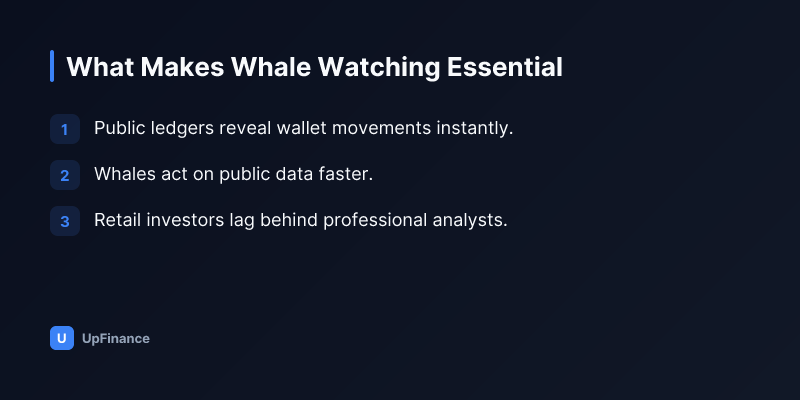
The cryptocurrency market moves on information asymmetry. While traditional equities have regulatory filings, earnings calls, and analyst reports, blockchain markets operate differently. The most transparent asset class in history is also the most opaque in real time—unless you know where to look.
When a wallet holding millions in Bitcoin suddenly moves funds to an exchange, it signals intent. When Ethereum accumulates into dormant addresses, it suggests conviction. These movements play out in real time on public ledgers visible to anyone with the right tools. Yet most retail investors never see them until prices have already moved.
Whale watching—the practice of monitoring large wallet movements—has evolved from a niche curiosity into institutional infrastructure. Crypto fund managers, exchange trading desks, and sophisticated hedge funds now employ dedicated analysts to track on-chain behavior. The asymmetry isn't that whales have secret information; it's that whales act on public information faster and more efficiently than retail participants.
This guide teaches you how to think like those professionals. We'll walk through the data sources, interpretation frameworks, and risk factors that separate noise from signal. Whether you're in Singapore, Seoul, or San Francisco, the blockchain speaks the same language.
Understanding On-Chain Data Sources and Tools
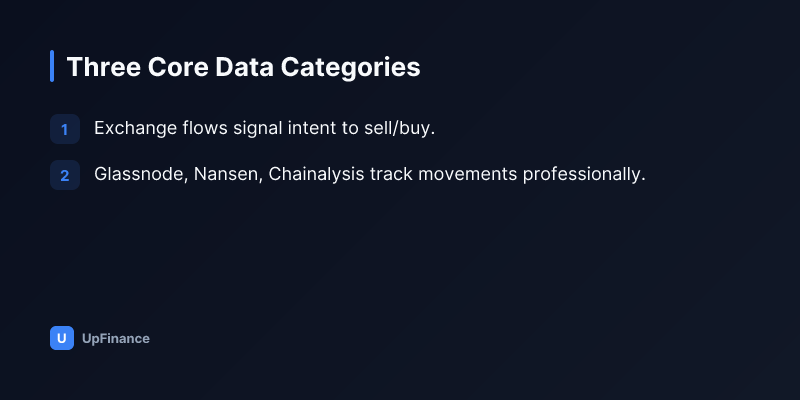
The foundation of whale watching rests on three categories of data: exchange flow analysis, wallet behavior monitoring, and transaction pattern recognition.
Exchange Flow Analysis
Exchange inflows and outflows represent the most direct signal of trader intent. When large amounts move into exchanges, it typically precedes selling pressure. When they move out, it suggests either long-term conviction (moving to cold storage) or preparation for buying.
The key is understanding the source and destination of those flows. A 500 BTC transfer from a whale's known cold wallet to Kraken (major EU and US exchange) means something different than 500 BTC moving to a mixer. The former signals potential liquidation; the latter, privacy consciousness.
Major platforms for tracking this data include:
- Glassnode - Institutional-grade on-chain metrics with transaction-level granularity. Strong for tracking exchange netflows in real time.
- Nansen - Portfolio tracking and wallet labeling. Excellent for identifying which known entities (exchanges, funds, whales) are behind certain addresses.
- Chainalysis - Compliance-focused but offers valuable categorization of wallet types and risk scoring.
- Etherscan and Blockchain.com - Free, real-time data. Less polish than paid tools but essential for verification.
The Korean and Japanese markets have added complexity here. South Korea's major exchanges (Upbit, Bithumb, Coinone) maintain different liquidity profiles and regulatory treatment than global venues. A large KRW-denominated deposit to Upbit signals different market conditions than the same Bitcoin amount moving to Coinbase, partly because Korean retail has different trading patterns and leverage access than US participants.
Smart money moves often precede retail money by 24-72 hours on Asian exchanges. This lag exists partly due to capital controls (though relaxed in recent years) and partly because Korean and Japanese institutional flows move through different banking rails than global crypto infrastructure.
Wallet Labeling and Entity Identification
Not all whales are created equal. A dormant address that last moved in 2017 carries different implications than an active trader's hot wallet.
The most useful whale categories:
- Early adopter wallets (2011-2013): Tend to hodl through cycles. Movement here signals major life events or philosophy shift.
- Institutional accumulators (dark pools, genesis block funds): Slow, steady buying. Movement outward is notable; inward accumulation is background noise.
- Exchange-linked wallets: Movement into exchange wallets frequently precedes volatility.
- Wash trading / mixer wallets: High movement, low predictive power for price. Noise to filter out.
Tools like Nansen attempt to label these, but the most valuable intelligence comes from combining multiple sources and cross-referencing public knowledge. When the Grayscale Bitcoin Trust moved holdings, news broke publicly. When Michael Saylor's MicroStrategy bought Bitcoin, filings preceded on-chain movement. Connecting these dots matters more than raw data.
Transaction Pattern Recognition
Beyond simple inflows/outflows, patterns in transaction timing, size clustering, and destination address behavior reveal strategy.
For example, a whale accumulating steadily in small tranches ($2-5M at a time) over weeks suggests a disciplined DCA strategy. The same whale suddenly moving 50% of holdings to an exchange suggests emergency liquidation or strategic repositioning. Context matters enormously.
Reading the Signals: What Different Movements Mean
Interpreting on-chain data requires understanding base rates and confounding variables. A single large transaction means little; patterns mean everything.
Accumulation Signals
When whales move funds from exchanges to private wallets, it's called "accumulation." This typically happens when:
- An asset has recently corrected and smart money sees value.
- Regulatory news has caused panic selling, creating buying opportunities.
- Long-term conviction investors are "dollar cost averaging" into positions over time.
In 2024-2025, for instance, Bitcoin accumulation accelerated following the Bitcoin ETF approval in the US (January 2024). Large holders moved funds off exchanges not to sell, but to store long-term. You could see this in Glassnode's "Exchange Net Flow" metric—negative flows (out of exchanges) exceeded positive flows (into exchanges) by 2-3x for months.
The key differentiator: is the whale moving to a known cold storage address, or to an unknown address? Known cold storage (like Grayscale's publicly disclosed wallets) is less significant than movement to private addresses, which suggests new, undisclosed positions.
Distribution Signals
The inverse pattern—movement from private wallets to exchanges—suggests distribution. This often precedes price corrections, though not always.
In March 2023, following the banking crisis and SVB collapse, large holders moved Bitcoin to exchanges, depressing prices for 48-72 hours before recovery. Retail investors who saw on-chain data flagging heavy exchange inflows could have positioned defensively.
"The most valuable signal in on-chain analytics isn't the movement itself—it's the timing relative to price. A whale moving to an exchange during an uptrend is often more significant than the same movement during a downtrend."
Dormant Address Activation
Perhaps the most powerful signal: when a wallet that hasn't moved in years suddenly becomes active.
This happens rarely and usually for major reasons:
- Mt. Gox creditors receiving settlements (ongoing, affecting BTC price in 2023-2024)
- Early Bitcoin miners liquidating (signal of supply injection)
- Hackers moving stolen funds (regulatory red flag)
- Inheritance or legal settlement (unpredictable but material)
The Mt. Gox reimbursement process is illustrative. When creditors began receiving Bitcoin and Ethereum settlements in 2024, on-chain data showed dormant addresses suddenly routing those funds. Sophisticated investors flagged these transfers in real time, anticipating selling pressure and positioning accordingly.
Geographic and Regulatory Considerations: Asia's Unique Dynamics
On-chain data is globally consistent—Bitcoin is Bitcoin whether it's on Kraken or Upbit—but whale behavior differs dramatically by geography. Understanding these regional patterns is crucial for avoiding false signals.
Korean Market Specifics
South Korea remains the world's second-largest crypto trading hub by daily volume (Upbit and Bithumb combined process $10B+ daily). Korean whales operate under distinct constraints and behaviors:
-
Capital gains tax complexity: South Korea implemented 20% tax on crypto gains above 250 million KRW (~$190k USD) in 2023. This created observable patterns where whales moved holdings into exchange accounts in December 2024, liquidating strategically before year-end to manage tax burden.
-
Retail premium behavior: Korean retail traders show higher leverage appetite than global peers. This means whale movements trigger cascading liquidations more aggressively. A whale's 1000 BTC exodus from Upbit can trigger 3-4x that amount in liquidated leveraged positions.
-
Regulatory scrutiny on exchanges: The Korea Financial Services Commission (FSC) tightened AML requirements in 2023, requiring real-name verification for all accounts. This reduced large anonymous wallets accessing Korean exchanges, but increased the signal quality of those that do move large amounts on Upbit/Bithumb. When you see a 1000+ BTC move on Upbit, it's likely institutional or fully verified retail—less noise than equivalent moves on less-regulated venues.
Japanese Market Characteristics
Japan's approach differs fundamentally. Regulation is clear, taxes are high (55% capital gains for high earners), but institutional adoption is deep.
-
SQ and GMO mining activity: Japan's major tech companies (Square/SQ, GMO Internet) run significant mining operations. Movements of mined BTC from these entities follow predictable patterns tied to mining difficulty adjustments and power costs. Tracking these is almost commodity futures analysis rather than whale speculation.
-
Insurance company exposure: Japanese insurers and pension funds have begun accumulating crypto-linked assets (via Grayscale, purpose-built funds, etc.). On-chain movements here are slower but more directional.
-
Yen-denominated leverage: Japanese margin trading platforms (Bitbank, etc.) offer KRW-equivalent leverage on BTC pairs. A spike in KRW/JPY-denominated exchange inflows often precedes volatility in the 2-6 hour window before US market open.
Southeast Asian Dynamics
Singapore, Thailand, and Vietnam operate as regional hubs with different characteristics:
- Thailand: Centralized regulatory framework makes whale identification easier (fewer anonymous wallets). Binance maintains Thailand's largest on-chain ecosystem.
- Vietnam: High retail participation, younger demographic. Whale movements matter less; momentum matters more. On-chain analytics are less predictive here than in mature markets.
- Singapore: Institutional hub. Large movements on Singapore-based exchanges (Crypto.com regional hub) often precede global moves by hours.
For readers in these regions, the key insight: track regional exchange inflows/outflows separately from global data. Glassnode and Nansen allow this segmentation, but you must set it up deliberately.
Building Your Own Whale-Watching Framework
Rather than relying on a single data source or signal, professional traders use a multi-factor framework. Here's how to build one:
Step 1: Establish Baseline Metrics
Identify three key metrics for your trading timeframe:
- Exchange netflow momentum (24h, 7d, 30d)
- Dormant address activation rate (addresses inactive >1yr coming online)
- Whale transaction count (top 100 address activity over 7-day windows)
Set alerts when these deviate from rolling averages by 2+ standard deviations. Most noise disappears immediately.
Step 2: Cross-Reference with Macro Signals
Whale movements exist in context. A whale buying 500 BTC when the Fed just signaled rate cuts is different from the same whale buying when inflation data disappointed.
Overlay on-chain data with:
- US Treasury yield curves (proxy for risk appetite)
- USD strength index (affects crypto demand globally)
- Regulatory news (SEC filings, Commodity Futures Trading Commission announcements)
- Regional market opens (Korean, Japanese, EU, US)
This is where UpFinance's AI analytics advantage becomes clear—machine learning can identify these correlations faster than manual analysis.
Step 3: Monitor Exchange-Specific Liquidity
Not all exchanges are created equal. Coinbase, Kraken, and Gemini (US/EU regulated) have different whale behavior than Binance or OKX (decentralized governance but centralized exchange operations).
Track these separately:
- Coinbase whale inflows = institutional positioning in US market
- Kraken whale inflows = European institutional + retail-savvy traders
- Binance whale inflows = global retail + arbitrage traders
- Upbit whale inflows = Korean institutional positioning
Step 4: Build Time-Based Triggers
Whale movements have predictable lag effects:
- Immediate (0-4h): Momentum traders react
- Short-term (4-24h): Retail traders catch on
- Medium-term (24-72h): Market consensus shifts
- Long-term (72h+): Price stabilizes at new level
Your strategy should account for which timeframe you operate in. Day traders need sub-4h signals; position traders can wait 24-48h for confirmation.
Avoiding False Signals and Common Pitfalls
Whale watching is powerful but prone to misinterpretation. Here are the most common traps:
The Whale Whale Fallacy
Not every large on-chain movement is a whale trading decision. Sometimes it's:
- Address consolidation (multiple wallets combining, not reflecting new market positions)
- Exchange rebalancing (moving funds between hot/cold wallets)
- Wallet recovery (accessing funds that were locked or lost)
Solution: Always verify the source and destination. If both are exchange addresses (like Binance moving funds internally), ignore it.
Timing Luck vs. Signal
A whale moving funds that happen to precede a price move isn't causation. Test this rigorously:
- Does this whale's pattern predict price moves consistently?
- What's the success rate across different market conditions?
- Does it work in bull, bear, and sideways markets equally?
If you can't answer yes to all three, you've found correlation, not causation.
Regional Overgeneralization
The biggest mistake: assuming a signal from one exchange applies globally. A massive Upbit outflow (Korean whale selling) doesn't necessarily precede global selling. It might just be Korean tax-loss harvesting.
Conversely, a Coinbase outflow (US institutional accumulation) might not matter much in Asian markets where different liquidity pools dominate.
Ignoring Stablecoin Flows
One of the most overlooked signals: stablecoin movement. When whales move USDC or USDT to exchanges, they're preparing dry powder for buying. Large stablecoin outflows from exchanges are bearish; large inflows are bullish.
This is especially critical in Asian markets where stablecoin adoption runs deeper than in the West (partly due to native currency controls in some jurisdictions).
Practical Tools and Workflow
Rather than abstract discussion, here's what a working whale-watch workflow looks like:
Daily Setup (15 minutes):
- Open Glassnode and check BTC/ETH exchange netflow over past 7 days
- Check Nansen for any large dormant address activations (sorted by BTC amount)
- Note any whale transactions >$10M on Etherscan or Blockchain.com
- Cross-reference with macro: Fed comments, Treasury yields, regulatory news
Alert Thresholds:
- Exchange netflow deviates >2 standard deviations from 30d average: ACTION REQUIRED
- Dormant address activation >100 BTC from pre-2015 wallet: MONITOR
- Single transaction >$50M to unknown address: VERIFY SOURCE
Decision Framework:
- If whale is buying AND macro is improving AND technical confirms: BULLISH SIGNAL
- If whale is selling BUT macro is stable AND retail still buying: NOISE / DISTRIBUTION TEST
- If whale is moving to mixer: IGNORE (privacy, not trading signal)
Most professional traders supplement this with alerts from paid platforms (Nansen, Glassnode Enterprise), but the free tools provide 80% of the utility.
Conclusion: Integration with AI-Driven Investing
On-chain analytics excel when integrated with machine learning frameworks that can identify patterns humans miss. The future of crypto investing isn't whales vs. retail—it's algorithmic interpretation of what whales are doing, at scale.
This is where platforms like UpFinance create value. Rather than manual whale-watch workflows, AI systems can ingest on-chain data, macro feeds, and market microstructure simultaneously, identifying setups with minimal human intervention.
But understanding the fundamentals—what these movements mean, why they matter, what confounds them—remains essential. Even the best algorithms are tools for amplifying human judgment, not replacing it.
Start small: pick one exchange and one metric. Track it for two weeks. See if patterns emerge. Build from there. Whale watching is a skill, and like all skills, it improves with deliberate practice.
The blockchain's transparency is revolutionary. Most investors ignore it. That's your edge.
This content is produced for marketing purposes by MIG Korea Group and is not investment advice. Crypto investing carries the risk of losing your principal; investment decisions are your own responsibility. UpFinance is the AI fintech service of MIG Korea Group.
Related posts
Start AI investing with UpFinance — free
Start free →Smart investing with UpFinance
AI-powered market analysis, automated portfolio rebalancing, and risk alerts.
We make crypto markets simple — without dumbing them down.