
AI vs Human Traders in 2026: Where the Edge Has Moved
The Myth That AI Already Won
Walk into any fintech conference in 2026 and you'll hear the same refrain: artificial intelligence has conquered the markets. The narrative is seductive. By some estimates, algorithmic and AI-driven strategies now account for 60-75% of U.S. equity trading volume. In cryptocurrency, bots execute millions of transactions per second across decentralized exchanges in Southeast Asia. Yet the reality is messier, and far more interesting, than a simple AI victory lap.
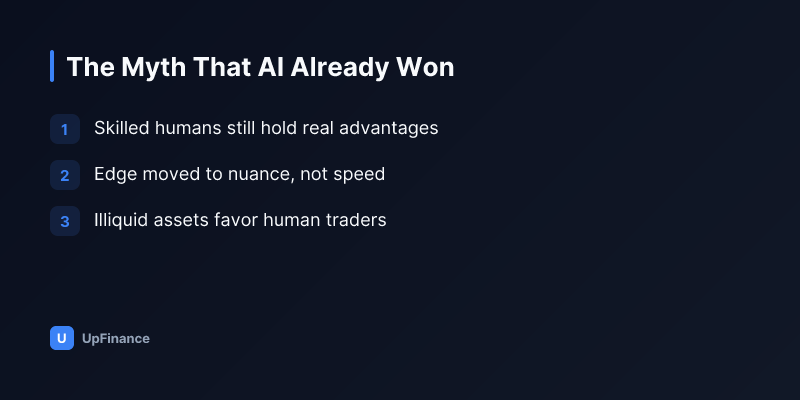
Human traders—at least the skilled ones—haven't disappeared. They've evolved. And in certain market conditions, particularly in illiquid assets, emerging markets, and during regime shifts, they retain advantages that no machine learning model has yet fully replicated.
The truth in mid-2026 is that the edge has moved, not vanished. It's moved away from raw speed and toward nuance. Away from symmetrical information and toward the asymmetrical. Away from following the crowd and toward understanding why the crowd is wrong.
This post explores where AI has genuinely dominated, where humans still hold ground, and what that means for traders and investors globally—from Seoul to Singapore to San Francisco.
Where AI Has Decisively Won
Speed and Scale Without Fatigue
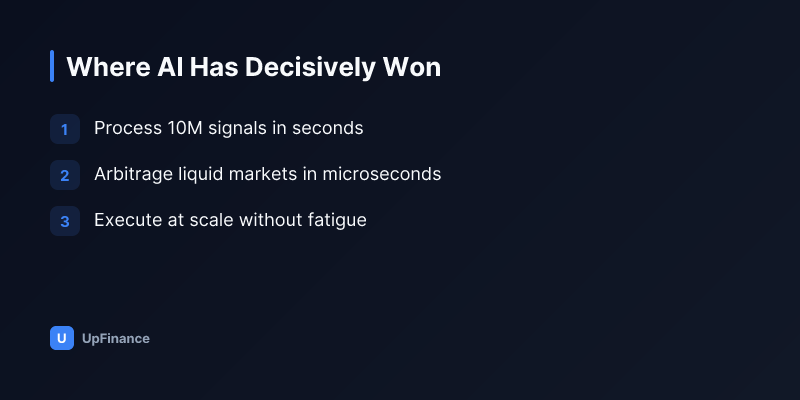
The first, and least controversial, advantage belongs entirely to machines. An AI system can process 10 million market microstructure signals in the time a human reads a news headline. It doesn't blink. It doesn't get tired. It doesn't panic.
In high-frequency trading (HFT) and latency-sensitive strategies, the game is over. Humans cannot compete. A Citadel Securities or Jump Crypto algorithm can detect a price discrepancy across exchanges in microseconds and execute a hedged trade before any human trader even registers the opportunity.
Key areas where AI dominance is absolute:
- Arbitrage in liquid markets — Cross-exchange spreads on BTC/USDT disappear within milliseconds on major exchanges (Binance, Bybit, OKX) before retail traders can even place an order.
- Market-making in high-volume assets — Automated market makers (AMMs) and algorithmic market makers now generate the majority of tighter spreads in major cryptocurrencies.
- Execution optimization — When a large institution needs to buy $500 million in equities without moving the market, AI systems slice orders into thousands of micro-transactions across venues and time periods that no human team could manually manage.
"The commoditization of trading speed means that by 2026, anyone still competing on latency alone is already dead. The winners are those who've moved the needle to something machines can't do." — Industry observer, Morgan Stanley Equity Research
Pattern Recognition at Scale
AI's second victory comes from its ability to recognize patterns in datasets so large that human pattern-matching breaks down. Consider:
- Sentiment analysis across global news — An AI system can ingest earnings calls, social media, news wires, and regulatory filings in 47 languages, extract sentiment, and correlate it with price moves in real-time. Humans cannot.
- Options pricing and volatility prediction — Deep learning models trained on decades of options data can forecast realized volatility with greater accuracy than the Black-Scholes models that dominated for 50 years.
- Cryptocurrency on-chain analysis — AI models trained on blockchain transaction patterns can identify whale accumulation, exchange inflows, and suspicious wash-trading patterns in seconds. This is now table stakes in crypto hedge funds.
In Asian markets specifically, AI has gained particular traction:
- Korean equity anomalies — Models trained on Korean retail behavior (which differs markedly from Western retail) can predict short-term reversals in KOSPI stocks with reasonable accuracy. Retail traders dominate Korean equities, creating exploitable behavioral patterns.
- Japanese option flow — Japanese institutional investors have distinctive hedging patterns. AI systems that learn these behaviors have an edge in Nikkei 225 options trading.
- Southeast Asian crypto adoption cycles — Machine learning systems trained on wallet growth patterns, exchange registrations, and peer-to-peer transaction volumes in Vietnam, Thailand, and the Philippines can predict regional liquidity events before they happen.
Where Humans Still Have an Edge
Regime Change and The Unknown Unknown
This is where AI's greatest weakness emerges: the models are trained on historical data, and history is prologue until it isn't.
When a black swan event hits—a geopolitical shock, a regulatory curveball, a financial crisis—the past becomes a poor guide. In March 2020, when COVID crashed markets, AI systems trained on "normal" market conditions failed spectacularly. Some hedge fund AIs liquidated at the worst possible times because their models had never seen a correlation matrix flip overnight.
Skilled human traders have something machines still lack: the ability to imagine futures that haven't happened yet. A trader who lived through 2008, who remembers dot-com, who understands the fragility of leverage—that trader has priors about how markets can break that no backtest can fully capture.
In 2026, we've seen this play out concretely:
- The Monetary Policy Shift (Early 2025) — When central banks surprised the market by holding rates higher for longer than algorithms predicted, human traders at firms like Millennium Management adjusted faster than systematic funds. They could reason about why the Fed might deviate from its signaling. Machines were slow to recalibrate.
- The Korean Won Crisis Scare (Late 2025) — Korean fintech investors with geopolitical knowledge knew that a USDKRW spike would trigger government intervention. They exited before the algos did. Models trained solely on FX data missed the political context.
Illiquid and Bespoke Assets
Whenever you move away from the most liquid, standardized assets, human judgment re-emerges. AI excels at finding patterns in datasets of size; it struggles with the small-sample problem.
Examples:
- Emerging market debt — A bond issued by a Vietnamese state enterprise, trading $20 million daily in an illiquid market, demands human judgment about default risk, political stability, and currency devaluation. AI can assist, but a seasoned credit analyst still wins.
- Private equity and secondary sales — The "market" for buying LP stakes in venture funds is tiny and highly bespoke. Humans negotiate because the data set is too small for machines to have learned the true valuation.
- Cryptocurrency derivatives in smaller exchanges — On Huobi, Bybit, or regional Asian exchanges, liquidity can evaporate. A trader with intuition about market microstructure can place orders that machines would panic-liquidate at bad prices.
Relationship and Information Asymmetry
There's one advantage humans will always have: access to private information through relationships. A seasoned trader with 20 years of connections can learn, through a phone call, that a major fund is about to unwind a position. A regulatory official might hint at an upcoming policy change. A company CFO might signal through tone whether earnings will meet guidance.
These information edges cannot be replicated by machines analyzing public data. In Asian markets, this is especially true:
- Korea — Chaebols operate through webs of relationship and hierarchy. A connected trader might know that Samsung is about to announce a spin-off 48 hours before it's public, because someone in the family office mentioned it.
- Japan — Institutional investors signal intent through subtle behaviors. A trader who has worked at MUFG for a decade knows when the bank is likely to be a buyer.
- Southeast Asia — Regulatory changes in Thailand or Vietnam often leak through informal channels before official channels. Traders plugged into the right circles have weeks of edge.
This is harder to prosecute as insider trading in these markets, and the regulatory environment is looser than in the U.S. or EU.
The Hybrid Model: Where the Real Money Is
By 2026, the most successful trading operations aren't purely AI or purely human—they're integrated. Humans use AI to process what they could never process alone. AI uses humans to sanity-check and override when the world breaks.
Leading hedge funds and proprietary trading firms now operate with this structure:
- AI as the first filter — Machine learning systems scan millions of potential trades, flag anomalies, and rank opportunities by risk-adjusted expected return.
- Human as the skeptic — A trader looks at the top 10 AI recommendations and asks: "Does this make sense? What could be wrong with this model? What is my machine missing?"
- Execution by algorithm — Once a human approves a trade thesis, algorithms handle execution to minimize market impact.
UpFinance's approach to this problem exemplifies the hybrid model. Rather than building a system that attempts to make trading decisions autonomously, UpFinance provides AI-augmented analysis that human traders and investors use to make better decisions. The AI surfaces patterns, correlations, and signals; the human provides judgment about whether those signals are real or statistical artifacts.
This philosophy extends to crypto markets, where UpFinance's tools help retail and institutional investors identify on-chain patterns, unusual whale behavior, and network effects that predict price movements—but always with the human retaining final decision authority.
Practical Implications for 2026 and Beyond
For Institutional Traders
If you're running a desk with $1 billion in AUM, your competitive edge in 2026 comes from:
- Superior data integration — Can you combine on-chain, off-chain, and alternative data sources better than competitors? Do you have APIs to every exchange, data warehouse, and blockchain in your strategy's opportunity set?
- Faster human-in-the-loop systems — How quickly can a human trader override an algorithm when market conditions shift? Can you go from "AI flagged this as odd" to "human approved and executed" in 30 seconds or 3 minutes?
- Specialized domain expertise — Do your traders understand the regulatory landscape of the markets they trade? Can they reason about geopolitics, central banking, and corporate strategy?
For Retail and Semi-Professional Traders
If you're trading your own account or managing capital for a small group, 2026's environment has both opportunities and risks:
Opportunities:
- Retail traders with strong pattern recognition in specific markets (a crypto trader who deeply understands Solana's ecosystem, or a Korean equity trader who knows chaebols) can still outperform.
- AI tools are now cheap and accessible. A $100/month subscription to a good market analysis platform gives a retail trader more analytical firepower than a quant desk had in 2015.
- Information asymmetries persist, especially in less-covered emerging markets and smaller cryptocurrencies.
Risks:
- Competing on speed is hopeless. If your strategy relies on being first to react to a data point, a machine will beat you 99.9% of the time.
- Overcrowding in liquid, widely-known anomalies means that by the time you hear about an "AI-identified" trading pattern, thousands of other traders have heard about it too. The edge is already gone.
- Overconfidence in AI tools. Many retail traders now use machine learning to make trading decisions without understanding what the model is doing or whether the backtest is realistic. This is a recipe for disaster when regimes change.
For Asian Market Participants Specifically
Asian markets in 2026 present unique dynamics that global traders should understand:
Korea:
- The Korean Won has been in a weakening trend, but government intervention remains a factor. An AI system trained purely on technical signals will miss these interventions. Traders with political connections get out ahead.
- Korean crypto exchanges (Upbit, Bithumb) have high retail volume and distinctive price patterns. AI models trained on Western exchange data do poorly; those trained on Korean behavior do well.
- Regulatory arbitrage remains alive. Korea's approval of spot Bitcoin and Ethereum ETFs in 2024 opened new trading opportunities that models trained on pre-2024 data missed.
Japan:
- Japanese institutional behavior in options markets is distinctive. Hedge ratios and rolling strategies differ from Western norms. Traders who understand this have an edge.
- The carry trade, long an edge for basis traders, became more fragile. Human traders spotted the vulnerabilities in 2024 before models caught up.
Southeast Asia:
- Regulatory fragmentation means that opportunities exist to arbitrage between, say, Thailand's more permissive stance on DeFi and Singapore's stricter rules. Human traders who navigate these regulatory nuances win.
- Retail adoption is still ramping in Vietnam and Indonesia. Traders who understand how retail behavior cascades through liquidity pools, spot exchanges, and derivatives can exploit these dynamics.
The Convergence: What Winning Looks Like in 2026
The winners in 2026—whether they're managing $50 million or $5 billion—share common characteristics:
-
They use AI as a tool, not a crutch. The machine handles what machines do best (processing, pattern recognition at scale, execution). The human handles what humans do best (judgment, navigation of uncertainty, intuition about regime change).
-
They specialize. Trying to beat the market everywhere is now a mug's game. The best traders are those who know one corner of the market deeply and exploit it ruthlessly. A trader who focuses exclusively on Korean equity micro-caps, understanding the governance, the retail behavior, the regulatory environment, can still outperform.
-
They manage risk with both machines and intuition. An AI system can calculate value-at-risk. A human knows that the tail risks aren't captured by historical volatility, and positions accordingly.
-
They iterate. They backtest, they paper trade, they go live with small positions, they watch closely, they adapt. Both humans and machines in the loop at each stage.
"By 2026, the question isn't 'Can AI beat humans?' The question is 'What does a human-AI team need to do to beat other human-AI teams?' That's the actual competition." — Quant researcher, Jane Street
Conclusion: The Edge Has Moved, Not Ended
Artificial intelligence has absolutely transformed trading. It has commoditized speed, scaled pattern recognition, and eliminated entire classes of trading jobs. That part of the narrative is correct.
But the story of humans versus machines is not a story of extinction. It's a story of evolution. The traders and investors who thrive in 2026 are those who've understood that the edge has moved from doing what machines do (but slightly better) to doing what machines cannot do at all.
That means:
- Using AI to see patterns you couldn't see alone
- Retaining judgment about when those patterns are real versus overfitted
- Maintaining an information edge through relationships and expertise
- Specializing deeply in markets or strategies where you have genuine advantage
- Understanding the regime-change risks that backtest data cannot capture
In Asian fintech and crypto specifically, there's particular opportunity. These markets are less efficient, less covered by algorithms, and more shaped by regulatory and geopolitical factors that AI struggles to model. For traders and investors who combine deep local knowledge with good AI tools, the next five years are genuinely wide open.
The machines won the game of "who is fastest." Humans are winning the game of "who is wisest." That's where the money is in 2026.
This content is produced for marketing purposes by MIG Korea Group and is not investment advice. Crypto investing carries the risk of losing your principal; investment decisions are your own responsibility. UpFinance is the AI fintech service of MIG Korea Group.
Related posts
Start AI investing with UpFinance — free
Start free →Smart investing with UpFinance
AI-powered market analysis, automated portfolio rebalancing, and risk alerts.
We make crypto markets simple — without dumbing them down.