
Korean Won-Bitcoin Premium: What the Kimchi Premium Tells Global Markets
The Kimchi Premium Explained: When Seoul Bitcoin Costs More Than New York
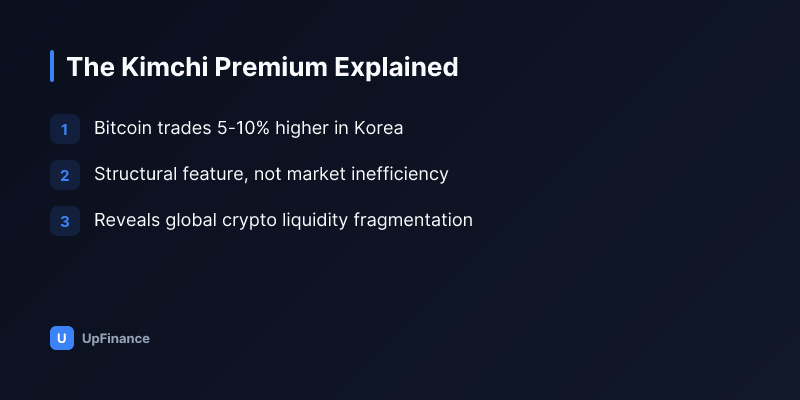
If you've followed cryptocurrency markets closely over the past five years, you've likely heard the term "Kimchi Premium." It refers to the persistent price gap between Bitcoin and other cryptocurrencies trading on South Korean exchanges versus their prices on global platforms like Coinbase or Kraken. On any given day, you might see Bitcoin trading at $42,500 on a US exchange while the same asset commands $43,200 on Upbit or Bithumb in Seoul. That premium—sometimes exceeding 5-10% during volatile periods—isn't a market inefficiency that will vanish overnight. It's a structural feature of how Korean fintech operates, and understanding it reveals crucial truths about global crypto liquidity, retail investor behavior, and the hidden costs of market fragmentation.
The phenomenon earned its whimsical name because South Korea's intense retail investment culture mirrors the country's culinary passion: concentrated, fiery, and unmistakably local. Just as kimchi is fermented in Korean kitchens according to regional recipes, Korean crypto prices ferment within domestic exchanges, creating a distinct flavor that global traders have learned to exploit—or accept as an unavoidable cost of doing business in one of Asia's most dynamic fintech hubs.
Why does this premium persist? The answer isn't simple arbitrage failure. Instead, it reflects regulatory design, capital controls, behavioral finance, and the structural limitations of how Korean retail investors access global markets. Unlike Europe or the United States, where retail crypto investing is fragmented across dozens of exchanges but ultimately integrated into relatively frictionless global markets, Korea's crypto ecosystem exists in a semi-isolated state—one that's highly liquid internally but faces significant friction at the border.
Capital Controls and the Won's Natural Barriers
South Korea's financial system has a long history of capital account restrictions. While modern Korea has liberalized significantly since the 1990s, real-time frictionless conversion between Korean won and foreign currencies, particularly for retail investors moving money into and out of crypto exchanges, remains operationally and legally complicated.
When a Korean retail investor wants to buy Bitcoin on Coinbase, they face a multi-step process:
- Convert won to USD through a domestic bank (with daily limits and fees)
- Transfer USD internationally (SWIFT fees, delays, sometimes requiring business justifications)
- Deposit USD to a foreign exchange
- Buy Bitcoin
- Reverse the entire process to cash out
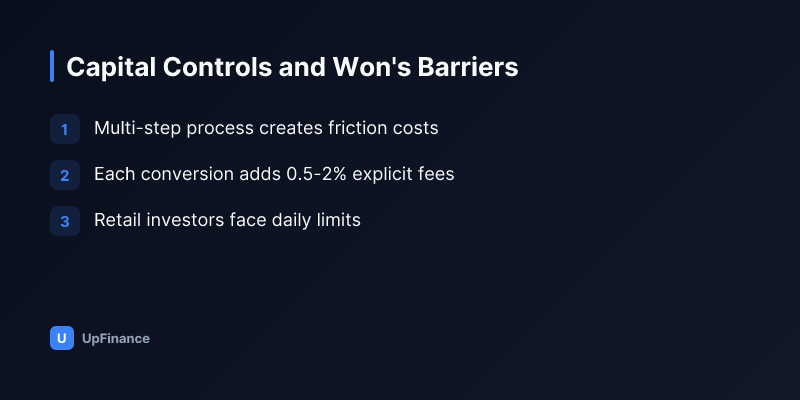
Each step incurs costs—explicit fees of 0.5-2% and implicit costs from FX spreads and time delays. For a Korean trader with ₩10 million (roughly $7,500 USD), these frictions might total $150-250 in direct costs, plus opportunity cost if the market moves during settlement.
Alternatively, a Korean investor can simply transfer won domestically to Upbit or Bithumb, buy Bitcoin instantly with one transaction, and operate entirely within the Korean won ecosystem. The premium compensates domestic exchange users for avoiding the pain of capital account friction. From the perspective of a Seoul-based trader, paying 3-5% more for Bitcoin on a Korean exchange is often cheaper than arbitraging the gap with foreign exchanges.
"The Kimchi Premium isn't a bug in Korean markets—it's a feature that reflects real economic constraints on how Korean capital moves. Understanding this distinction separates traders who profit from it versus those who chase phantom arbitrage." — UpFinance research on regional crypto liquidity
How Retail Behavior Amplifies the Premium
Beyond regulatory plumbing, Korean retail investor behavior is a crucial driver of the premium. South Korea has one of the highest retail investment participation rates globally—somewhere between 25-35% of the adult population actively trades stocks or crypto, compared to roughly 10-15% in the United States. This cultural appetite for investing, combined with high smartphone penetration and a sophisticated fintech infrastructure, creates a domestic market with enormous retail demand that's only partially satisfied by domestic supply.
When Bitcoin rallies 20% over three weeks (as it did in early 2024), Korean retail traders see the move on global news and CNBC, then immediately log into their Upbit app to buy. But because their available liquidity is constrained by won denominations and the friction of converting to dollars, they bid up domestic prices relative to global benchmarks. It's classic supply-and-demand dynamics, except the "supply" side is artificially constrained by capital controls.
The phenomenon also reflects something subtly different: Korean exchanges often have superior user experience and are integrated with Korean payment systems in ways that make trading frictionless. Upbit allows instant won deposits via Korean bank transfers; Bithumb integrates with card payments from KEB Hana Bank. This convenience premium attracts retail volume that would otherwise leak to international exchanges, further supporting domestic prices.
Additionally, Korean retail culture exhibits a specific pattern during bull markets: fear of missing out (FOMO) is intense, and domestic exchange platforms amplify this through notifications, community features, and social media integration. When Bitcoin is surging, Korean subreddits and KakaoTalk investment groups buzz with activity, creating a feedback loop where domestic prices climb faster than global benchmarks, temporarily exaggerating the premium.
Regulatory Environment and the FSC's Influence
South Korea's Financial Services Commission (FSC) maintains one of the world's most detailed regulatory frameworks for cryptocurrency exchanges. This isn't regulation by uncertainty (like the US approach pre-2023); it's regulation by prescription. Korean exchanges must meet specific capital requirements, conduct know-your-customer (KYC) protocols at levels comparable to traditional banks, and maintain reserve requirements that exceed most international standards.
This regulatory rigor has two opposing effects on the Kimchi Premium:
First, it creates confidence in domestic exchanges. Unlike exchanges in less-regulated jurisdictions, Korean platforms are audited regularly, subject to surprise inspections, and operate under clear rules. A Korean investor trusting their won to Upbit faces lower counterparty risk than someone using a Bahamas-registered exchange. This confidence supports higher valuations on domestic platforms—investors are willing to pay a premium for the security of regulatory oversight.
Second, regulatory compliance increases operational costs for Korean exchanges. They must maintain larger reserve pools, hire compliance officers, and pay for regular audits. These costs are partially passed to traders through wider bid-ask spreads and higher withdrawal fees. Korean exchange fees typically run 0.1-0.15% for makers and 0.1-0.2% for takers, compared to 0-0.05% on Coinbase Pro or 0.02-0.05% on Kraken. Over thousands of trades, these differences compound, creating another structural reason the premium persists.
Furthermore, the FSC's 2021 real-name account requirements meant that every crypto deposit and withdrawal must be tied to a registered Korean bank account in the investor's name. This prevents circular arbitrage: you can't deposit USD through a shell company, buy Bitcoin at a discount on a foreign exchange, and withdraw it to a Korean exchange under a different entity. Real-name verification closed many of the loopholes that might otherwise erode the premium.
The Premium as Economic Data: What It Signals About Global Markets
Here's where the Kimchi Premium becomes genuinely interesting for global investors: it functions as a leading indicator of retail investor sentiment in one of Asia's most sophisticated fintech markets. When the premium widens beyond 5%, it often signals that Korean retail money is flowing in faster than the market can absorb, suggesting broader bullish sentiment globally. When the premium contracts toward 0-1%, it may indicate capital flight from Korean retail—a warning sign that should not be ignored.
Consider what happened in November 2021, leading into Bitcoin's December peak. The Kimchi Premium expanded to nearly 15% in late November, signaling that Korean investors were flooding into the market ahead of a broader correction. The premium's expansion predicted—by about three weeks—the global market's January 2022 downturn. Savvy traders watching the premium could have seen that top forming in Korean retail sentiment before it manifested in global price action.
UpFinance's AI-driven market analysis has increasingly incorporated Kimchi Premium data as a variable in retail sentiment modeling, recognizing that Korean retail behavior often precedes or mirrors global retail cycles by 2-4 weeks. This lag exists because Korean market news disseminates on Korean schedules, and translation delays mean Korean-language fintech commentary often doesn't reach Western traders immediately.
The premium also reveals something about liquidity fragmentation costs. When the premium is high, it suggests significant potential profits for arbitrageurs—yet it persists, which proves that arbitrage costs (capital controls, taxes, settlement delays) exceed the apparent profit opportunity. This tells us that global crypto markets are less efficient than they appear, and that regional fragmentation creates real economic rents for local players.
Arbitrage Opportunities and Why They're Harder Than They Look
On the surface, the Kimchi Premium presents an obvious arbitrage opportunity: buy Bitcoin at $42,500 on Coinbase, sell it at $43,200 on Upbit, pocket the $700 difference. In practice, this is substantially more difficult than it sounds, and understanding why reveals important truths about market microstructure.
First, actually executing this trade requires you to have accounts on both exchanges, with capital already deposited on each side. This means locking up money on both platforms simultaneously—a capital inefficiency penalty. If you're arbitraging with $100,000, you've tied up the full amount across both exchanges just to capture a 1-2% spread.
Second, execution timing is tight. Bitcoin moves fast. By the time you've bought on Coinbase and initiated a withdrawal (which can take 10-60 minutes depending on the exchange), the premium may have evaporated. You could end up with Bitcoin bought at a discount that's worth less by the time you're ready to sell it on the Korean exchange. This timing risk effectively eats the profit.
Third, regulatory and tax complications create invisible costs. A Korean citizen buying Bitcoin on Coinbase and selling it on Upbit faces potential Korean tax authority questions about income source, foreign asset reporting requirements, and possible recharacterization of the transaction as a taxable event. In the US, the IRS considers such trades as sales triggering capital gains tax implications. Between the two countries' tax systems, your net profit after taxes might be 0.3-0.5%—barely above transaction fees.
Fourth, Korean exchanges have historically maintained withdrawal caps and restrictions. During periods of high demand (precisely when the premium is largest), Korean exchanges often throttle withdrawals of stablecoins to foreign exchanges, making it impossible to execute large arbitrage programs. This is partly regulatory compliance and partly risk management by the exchange operators.
That said, true arbitrage opportunities do exist for sophisticated players with large capital bases, direct banking relationships, and tax planning capability. Proprietary trading desks at Korean investment banks and some international hedge funds have captured small but consistent profits from the premium by:
- Maintaining persistent deposits across multiple exchanges
- Using sophisticated algorithms to detect micro-arbitrage opportunities
- Hedging currency risk through forward contracts on the won-dollar rate
- Timing large arbitrage programs around known settlement windows
For retail traders, chasing the Kimchi Premium is generally a losing proposition. The costs are too high, and the opportunity is too small.
The Kimchi Premium's Future in a More Integrated Asian Fintech Landscape
As of 2026, the Kimchi Premium has gradually narrowed compared to its 2017-2021 peak. Why? Regulatory harmonization, improved cross-border crypto payment infrastructure, and the rise of stablecoin-denominated trading venues have all reduced the friction that originally created the premium. Stablecoins like USDC and USDT can now be transferred between Korean and international exchanges with minimal friction, allowing traders to arbitrage more easily.
Additionally, Korea's central bank has been gradually liberalizing real-time gross settlement (RTGS) systems, and the FSC has started approving crypto-friendly payment processors that enable faster, cheaper international transfers. These structural changes are slowly eroding the economic moat that sustained the Kimchi Premium.
However, the premium isn't disappearing. It's merely normalizing. In 2026, a 1-2% premium on Korean exchanges during normal market conditions is considered healthy market equilibrium—it reflects the true cost of converting won to dollars, plus a modest retail sentiment differential. When the premium exceeds 3-4%, it's typically a signal to watch closely.
Looking forward, the Kimchi Premium's role as a global market indicator may actually increase in importance. As AI-driven market analysis becomes more sophisticated, algorithmic traders are explicitly monitoring Korean retail sentiment proxies like the Kimchi Premium as early warning signals for broader market moves. The premium has transformed from an arbitrage opportunity into a data point—a digital thermometer for measuring retail investor heat in one of the world's most active fintech markets.
Lessons for Global Investors: Reading the Korean Market Through the Premium
Whether you trade in New York, London, or Singapore, the Kimchi Premium offers important lessons:
-
Market fragmentation creates real costs: The persistence of the premium proves that global crypto markets are segmented by region, regulation, and infrastructure in ways that create predictable price differences. Sophisticated traders can exploit these differences; retail traders typically get caught in the friction costs.
-
Regulatory design shapes trading behavior: Korea's approach to crypto regulation—detailed, rules-based, and conservative—directly influences how Korean markets price assets differently from less-regulated jurisdictions. This isn't a bug; it's a feature that increases stability but reduces arbitrage efficiency.
-
Retail sentiment is localized, not global: Korean retail investors don't behave identically to US retail investors. Their access to capital, their time zones, their regulatory constraints, and their cultural attitudes toward risk create distinct patterns. The Kimchi Premium is visible evidence that global retail crypto markets are best understood as a collection of regional markets rather than a single integrated system.
-
Small premiums can persist indefinitely: Economics textbooks suggest arbitrage should eliminate all price differences, but the Kimchi Premium's two-decade persistence suggests that small (1-3%) premiums can survive indefinitely when transaction costs and friction exceed the arbitrage opportunity. This has profound implications for how we think about market efficiency.
For AI-driven investors and algorithmic traders, the lesson is concrete: monitor the Kimchi Premium as part of your broader sentiment analysis framework. When it widens beyond 4%, it's signaling that Korean retail money is flowing in aggressively. When it contracts below 0.5%, it suggests Korean traders are trimming exposure. These signals have historically provided 2-4 week leading indicators for global retail-driven market moves.
This content is produced for marketing purposes by MIG Korea Group and is not investment advice. Crypto investing carries the risk of losing your principal; investment decisions are your own responsibility. UpFinance is the AI fintech service of MIG Korea Group.
Related posts
Start AI investing with UpFinance — free
Start free →Smart investing with UpFinance
AI-powered market analysis, automated portfolio rebalancing, and risk alerts.
We make crypto markets simple — without dumbing them down.