
When Traditional Finance Meets Crypto: The Korean Bank Pilot Programs Worth Watching
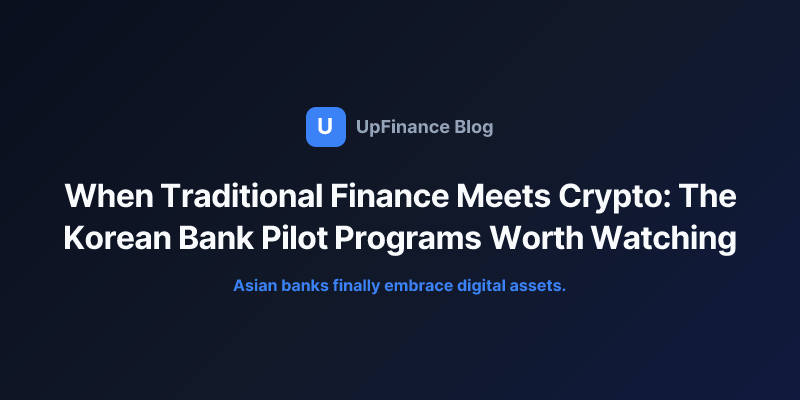
The Turning Point: Korean Banks Enter the Crypto Fold
For years, Korean banks maintained an uneasy distance from cryptocurrency. Regulatory uncertainty, reputational concerns, and technical complexity kept digital assets locked behind retail exchanges and unregulated venues. That posture is shifting.
In 2025-2026, major Korean banking institutions have begun running pilot programs to offer custody services, settlement infrastructure, and even limited direct crypto trading to institutional clients. This represents one of the most significant bridges between traditional finance and digital assets in Asia since El Salvador's Bitcoin gamble—and with far more sophisticated infrastructure behind it.
Why Korea? The country sits at the intersection of three compelling forces: a retail crypto user base exceeding 12 million people (roughly 20% of the adult population), a regulatory framework that has matured significantly since the 2017-2018 ICO craze, and a banking sector with excess capital and pressing needs to capture fee income from younger demographics.
The Korean won (KRW) is the third-largest fiat on-ramp to Bitcoin and Ethereum globally by trading volume, after the US dollar and the euro. What happens in Korean banks' crypto pilots will reverberate across Asia and influence institutional adoption timelines in markets from Singapore to Hong Kong to Tokyo.
"The Korean banking sector is not rushing into crypto because it believes in decentralization—it's doing so because it cannot afford to ignore where its customers are moving their money." — A Seoul-based fintech strategist
Why Now? The Confluence of Regulation, Capital, and Demand
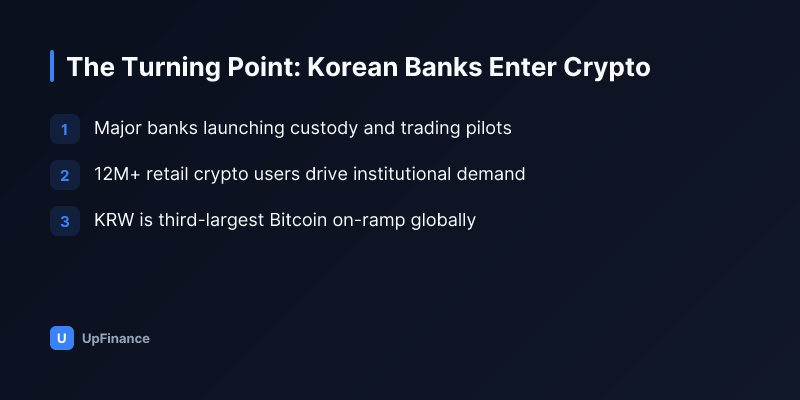
Korean regulators have spent the last three years building a sophisticated framework for crypto asset service providers. The Real Name Account System, rolled out in 2021, created a foundation for KYC (Know Your Customer) compliance that satisfied both banking regulators and crypto operators. By 2024, the Financial Services Commission (FSC) had clarified rules around custody, staking, and lending—creating legal pathways that hadn't existed before.
Simultaneously, Korean banks face margin compression. Traditional retail banking margins in Korea are among the tightest in the developed world, with net interest margins below 2% at major institutions like KB Financial, Shinhan, and Woori Bank. Deposit rates are rising, loan growth is stalling, and fee-generating businesses have become existential. Crypto services—custody, prime brokerage, settlement—could represent high-margin revenue streams if executed properly.
The demand signal is unmistakable. Upbit and Bithumb, Korea's two largest exchanges, process over 20 trillion KRW ($15 billion USD) in daily volume. Most of this traffic comes from retail traders using leverage and derivatives—a sign of both market sophistication and substantial risk exposure. Korean banks see institutional custody as a way to capture this flow while simultaneously reducing systemic risk by moving assets onto regulated balance sheets.
The Institutional Appetite
Korean pension funds, family offices, and insurance companies have been quietly accumulating Bitcoin and Ethereum for three years. However, they have had no legitimate way to custody those assets through a Korean financial institution. Most have resorted to:
- Offshore Singapore or Hong Kong-based custodians (costly and tax-complex)
- Direct self-custody (operationally risky and not permitted by some institutional mandates)
- Futures contracts on Korean exchanges (exposing them to counterparty and exchange risk)
Bank-offered custody removes all three friction points. It provides regulatory legitimacy, institutional-grade security, and tax clarity through a local entity. For a 100 billion KRW ($75 million USD) pension fund, the difference between paying 25 basis points annually to a Singapore custodian and 5 basis points to KB Financial is meaningful.
What the Pilots Actually Do (And Don't)
The first wave of Korean bank crypto pilots—launched in late 2025 by KB Financial, Shinhan, and Woori—are narrower in scope than Western observers might expect. They are not offering retail cryptocurrency trading or apps for consumers. That remains off-limits under current FSC guidance.
What Is Included
Institutional custody: Secure storage of Bitcoin, Ethereum, and (in some cases) Solana and Polkadot for qualified institutional clients. Infrastructure is typically either in-house cold storage or partnerships with established global custodians like Fidelity or Coinbase Custody, with the Korean bank serving as the local intermediary and KYC gatekeeper.
Settlement and reconciliation: Integration with Korean won payment rails so that institutions can deposit KRW directly from their bank accounts, execute trades on Upbit or Bithumb via the bank's API, and withdraw proceeds back to bank accounts—all without moving funds offshore.
Prime brokerage lite: Some pilots offer portfolio accounting, reporting dashboards, and integration with institutional clients' existing Treasury and risk systems. This is essentially repackaging exchange and custodian services into a banking interface.
Staking and yield services: A contentious but growing component. Shinhan's pilot explicitly includes staking services for Ethereum 2.0, where clients can earn 3.5-4% annual yield. The regulatory status of staking remains unclear in Korea, but the FSC has not prohibited it for institutional investors.
What Is NOT Included (Yet)
- Retail customer access
- Leverage trading or margin lending (even for institutions)
- Derivatives beyond simple spot holdings
- Altcoin exposure beyond the top 5 cryptocurrencies
This tiered approach mirrors how Japan's banking sector entered crypto custody after the 2017 boom and subsequent regulatory tightening. Japan's banks took 5-7 years to move from pilots to full institutional services. Korea is likely to follow a similar timeline, though with faster execution given more recent regulatory clarity.
The Regulatory Tightrope: FSC Guidelines and the Path Forward
Korean regulators are walking a careful line. The FSC wants to enable institutional crypto adoption without reopening the retail speculation frenzy that characterized 2017-2018. That era left scars: over 200,000 Korean retail investors lost money in ICO schemes, and public trust in crypto took years to recover.
The current regulatory framework rests on three pillars:
-
Institutional-only access: Only qualified institutional investors (defined as those with minimum 1 billion KRW or 50,000 USD in assets) can use bank custody services.
-
Exchange segregation: Banks cannot operate exchanges themselves. They must route orders through licensed exchanges (Upbit, Bithumb, Coinone) where price discovery happens and regulations are enforced.
-
Capital buffers: Banks offering crypto services must maintain separate capital reserves for crypto-related activities, effectively treating them as higher-risk business lines.
These rules are stricter than what exists in the EU (where MiCA regulations explicitly allow traditional financial institutions to offer crypto services to retail customers) or the US (where the regulatory pathway is murkier, but practice is more permissive). However, they are more liberal than the outright bans that Japan maintained until 2017.
The Tax Question
One regulatory detail that few Western observers understand: Korean crypto taxation is extraordinarily punitive. Capital gains on cryptocurrencies are taxed at 20% plus municipal taxes, and losses cannot be offset against other capital gains—a rule unique among developed markets. This makes long-term institutional holding less attractive than it might be.
However, the FSC is quietly considering a carve-out for institutional investors using bank custody. If that materializes, it could unlock massive inflows. Some estimates suggest that institutions are sitting on 5-8 billion USD in KRW-denominated crypto holdings specifically waiting for a favorable tax regime.
Competitive Dynamics: Banks vs. Exchanges
The entry of traditional banks into crypto services creates an interesting competitive tension with Korea's existing crypto exchanges. For two decades, Upbit and Bithumb operated in a regulatory gray zone, accumulating retail users and volume. Banks represent a threat.
However, banks also need exchanges. They cannot build order books or price discovery mechanisms independently. This creates symbiosis: banks will drive institutional volume to exchanges, which will profit from trading fees while banks profit from custody and settlement fees.
The likely outcome is a bifurcation of the Korean crypto market:
- High-volume, low-margin retail trading remains on Upbit and Bithumb
- Institutional flows migrate to bank-backed custody and settlement
- Derivative trading and leverage stays on exchanges (banks will not offer it)
One wildcard: Kakao's Upbit and Naver's strategic crypto interests. Both Korean tech giants have vested interests in crypto infrastructure. Naver, in particular, has been exploring LINE Token and blockchain payment systems. Banks moving into crypto could accelerate tech company strategies to defend their market position.
Global Implications: Institutional Capital Flows and Regulatory Arbitrage
The Korean bank pilots matter well beyond Seoul. Here's why:
Institutional capital is stateless. A Seoul-based insurance company can lend Bitcoin to Singapore, and a Tokyo family office can hold Ethereum through a Korean bank. The pilots unlock liquidity that has been trapped offshore.
By UpFinance's estimates, Korean institutional entities are sitting on 15-20 billion USD in crypto holdings that would migrate to bank custody within 12 months if the regulatory and tax environment improves. That's not massive at a global scale (institutional crypto AUM is roughly 800 billion USD), but it's enough to move markets and fund yields that will be attractive to US and European institutional investors.
Additionally, Korean bank pilots will influence regulatory thinking in Singapore, Hong Kong, and Japan. If Shinhan and KB Financial can successfully operate crypto custody services without systemic incidents, regulators in other Asian capitals will move faster to legalize similar services. Japan's Financial Services Agency, in particular, is watching closely—Japan's banks have been in crypto custody pilots since 2020 but have moved glacially. Korean success could be the political cover Japanese regulators need to accelerate.
Risk Factors and What Could Go Wrong
Despite the optimism, several risks loom.
Operational risk: Korean banks have invested heavily in cybersecurity, but crypto custody is a specialized domain. A single exchange hack or internal theft could sour public perception and trigger regulatory backlash. (Upbit experienced a 48 million USD hack in 2019 and recovered, but bank-level incidents would be far more damaging.)
Regulatory reversal: The FSC is not monolithic. Conservative voices within the agency and in the Korean legislature still view crypto as inherently risky. A major global crypto collapse or bank failure linked to crypto could trigger a regulatory clampdown.
Exchange concentration risk: Upbit and Bithumb control roughly 80% of Korean crypto volume. If either faced operational or regulatory troubles, bank pilots would be severely constrained. (This is less of a concern than it once was, as Coinone has gained market share, but concentration remains high.)
Integration complexity: Connecting bank systems to crypto infrastructure is harder than it sounds. Legacy banking infrastructure in Korea runs on Java and mainframe systems from the 1990s. Integration projects routinely encounter delays. Expect pilot timelines to slip by 6-12 months.
What to Watch in 2026-2027
Investors, fintech operators, and regulators should monitor these specific milestones:
-
Total assets under custody by end of 2026: If Korean banks manage to gather 2-3 billion USD in institutional crypto custody by end of 2026, that signals strong institutional demand and validates the business model.
-
Tax treatment announcement: The FSC and Ministry of Economy and Finance will likely issue guidance on institutional crypto taxation in mid-2026. This is a major inflection point.
-
Retail timeline: FSC hints suggest retail banking crypto services could be approved by 2027-2028. Watch for announcements on lending, staking, and possibly limited trading.
-
Regional expansion: Will Shinhan or KB Financial expand crypto services to their Southeast Asian subsidiaries? This would be a signal of confidence and could accelerate adoption in Thailand, Vietnam, and Indonesia.
-
Altcoin policy: Currently, pilots focus on Bitcoin and Ethereum. Expansion to 10-20 additional cryptocurrencies would indicate genuine institutional platform ambition rather than a compliance exercise.
The Bottom Line: Institutional Crypto Is Growing Up
Korean bank crypto pilots are not revolutionary—they are pragmatic. Traditional finance is not adopting crypto ideology; it is adopting crypto infrastructure. Banks see custody, settlement, and staking as boring, profitable services. Regulators see them as a way to manage systemic risk and capture tax revenue. Institutions see them as the final barrier to mainline crypto adoption.
For global investors and fintech operators, Korean banks are a canary in the coal mine. If sophisticated banking systems in a developed, well-regulated market can successfully integrate crypto services without systemic incident, that removes a major regulatory and operational barrier to institutional adoption worldwide.
The next 18 months will be telling. Watch the volume metrics, the regulatory guidance, and the moves by Japanese and Singaporean regulators to follow suit. The bridge between traditional finance and crypto is being built in real time in Seoul.
This content is produced for marketing purposes by MIG Korea Group and is not investment advice. Crypto investing carries the risk of losing your principal; investment decisions are your own responsibility. UpFinance is the AI fintech service of MIG Korea Group.
Related posts
Start AI investing with UpFinance — free
Start free →Smart investing with UpFinance
AI-powered market analysis, automated portfolio rebalancing, and risk alerts.
We make crypto markets simple — without dumbing them down.