
Building Your First AI Crypto Strategy: A Step-by-Step Walkthrough
The intersection of artificial intelligence and cryptocurrency has moved from hype to practical utility. If you've been sitting on the sidelines waiting for a clearer path into AI-driven crypto investing, now is the time to act. Building a systematic approach to crypto investing—one informed by AI insights—can help you navigate volatility while capitalizing on emerging opportunities.
This walkthrough is designed for anyone from Seoul to Singapore to San Francisco who wants to move beyond gut-feel trading and into data-informed decision-making. We'll break down the essential steps, highlight regional nuances, and show you how to get started without needing a PhD in machine learning.
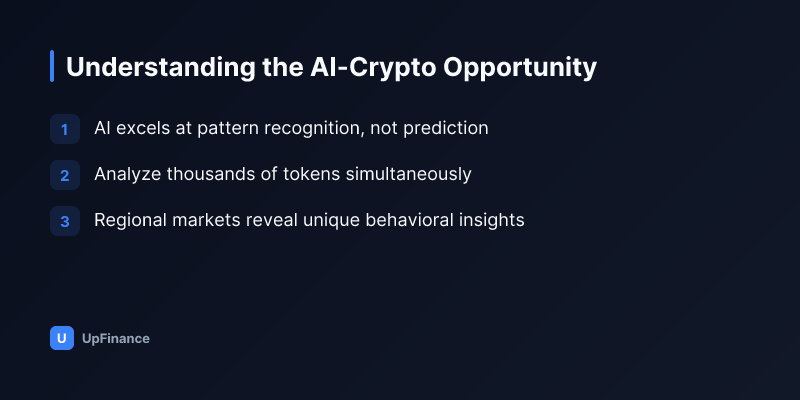
Understanding the AI-Crypto Opportunity
The crypto market has matured significantly since 2017. What once felt like pure speculation now supports billions in institutional capital, regulatory frameworks in major jurisdictions, and—most relevant to this guide—sophisticated AI models that can process blockchain data at scale.
The core advantage of AI in crypto investing isn't prediction; it's pattern recognition at speed. Machine learning models can analyze on-chain metrics, sentiment signals, and market microstructure across thousands of tokens simultaneously. For a human investor, that's impossible. For an algorithm, it's breakfast.
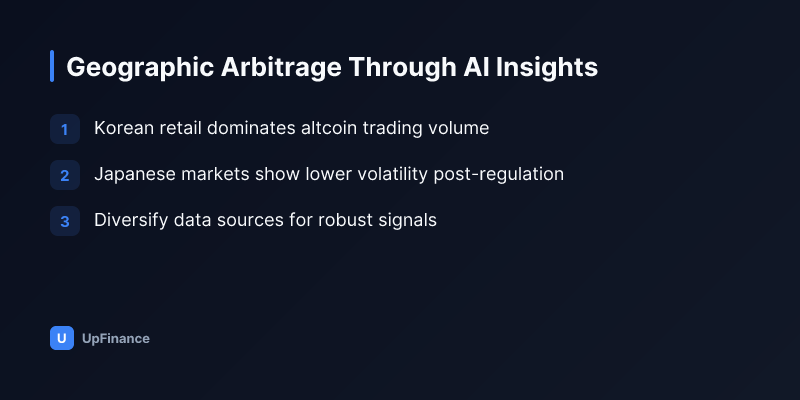
Consider the Korean crypto market as a case study. South Korea's retail investors represent about 15-20% of global crypto trading volume despite being less than 1% of global population. Korean exchanges like Upbit and Bithumb operate under strict regulatory oversight from the FSC (Financial Services Commission), which means they generate clean, auditable data. AI models trained on Korean exchange data can pick up on unique retail behavior patterns—like the preference for smaller-cap altcoins and the influence of celebrity endorsements—that wouldn't be visible in Western markets alone. This is arbitrage through insight.
Japan presents a different angle. After the 2018 Coincheck hack and subsequent regulatory tightening, Japanese crypto markets became more conservative. The FSC-regulated exchanges (like Bitflyer and GMO Coin) have higher compliance standards, which correlates with lower volatility but also lower returns. An AI system needs to account for this regime difference when comparing JPN-denominated versus USD-denominated trading pairs.
"The future of retail investing isn't choosing between AI and human judgment—it's learning to combine them. AI handles the pattern work; you provide the context."
For Western investors, the lesson is straightforward: diversifying your data inputs geographically and across exchange types gives your AI system a richer training set and more robust signals.
Step 1: Define Your Risk Profile and Time Horizon
Before you touch a single algorithm, you need to know what you're optimizing for. This sounds obvious, but most retail crypto investors skip it entirely.
Start by asking yourself three questions:
-
How much capital can I afford to lose? In crypto, the answer should never be "all of it." A common rule of thumb is to allocate no more than 5-10% of your total investable assets to crypto, and within that crypto allocation, perhaps 20-30% to experimental AI-driven strategies. That leaves 70-80% for more conservative holdings (Bitcoin, Ethereum, stablecoins).
-
What's my time horizon? Are you building for compounding over 5 years, or trading on daily signals? AI systems work very differently depending on this answer. Long-term strategies can afford to be more aggressive with signal noise; short-term systems need higher-confidence signals but execute faster.
-
What's my edge? This is the hard question. Do you have access to unique data? Do you understand a specific market niche? Do you have the technical chops to modify and backtest AI models? Your honest answer here determines what tools you should use and what you should outsource.
For Southeast Asian investors specifically: Currency risk matters more than it does for USD-based investors. If you're in Thailand or Vietnam and building a crypto portfolio, remember that returns are often quoted in USD but your real return includes the THB/USD or VND/USD exchange rate movement. AI systems should account for this—and most retail-friendly platforms don't. This is a gap you can exploit, or a gap you need to hedge.
Step 2: Choose Your Data Sources and AI Tools
You don't need to build everything from scratch. The crypto AI landscape now includes off-the-shelf tools ranging from free to enterprise-grade.
Free and low-cost options:
- CoinGecko and CoinMarketCap APIs: Historical price, volume, and market cap data. Good for simple moving-average or trend-following models.
- Glassnode: On-chain metrics (whale movements, MVRV ratio, exchange inflows). Free tier covers basic signals.
- Santiment: Sentiment analysis and social volume tracking. More granular than Glassnode for behavioral data.
- CCXT: Open-source library for pulling real-time data from 100+ exchanges. You'll need to write Python code, but it's worth learning.
Paid platforms tailored for retail AI investors:
- UpFinance offers AI-driven analysis across multiple asset classes including crypto, with signals calibrated for different regional markets. If you're not comfortable building from scratch, this is a sensible starting point.
- TradingView with Machine Learning integrations: Good for technical analysis plus simple ML models.
- Hugging Face Models: Pre-trained transformer models you can fine-tune on crypto data. For the technically inclined.
Critical point on data quality: Not all crypto data is equal. Binance data looks different from Korean exchange data because Binance has vastly higher volume but less retail participation. If you're building a model and training it on Binance data, it won't perform well on Upbit. This is why understanding your market of focus matters before you pick your data source.
For Japanese investors, Bitflyer data has fewer outliers but less volatility to trade. For Korean investors, Upbit has massive retail volume but also frequent "pump and dump" signals that aren't real. An AI model needs to be trained on the right data for the right market.
Step 3: Select a Strategy Framework
There are three broad categories of AI crypto strategies. Understanding them will help you choose which to build or adopt.
1. Sentiment-based strategies
These use NLP (natural language processing) models to analyze social media, news, and on-chain commentary to score sentiment. When sentiment shifts from negative to neutral, the model signals a buy. When it peaks, a sell.
Pros: Captures early meme momentum and retail behavior. Particularly effective in Korean and Southeast Asian markets where retail drives trading.
Cons: Easily gamed by coordinated social campaigns. Lagging indicator—sentiment often peaks after price has already moved.
2. On-chain analysis strategies
These track what whales and institutions are actually doing: wallet movements, exchange inflows/outflows, and long-term holder behavior. For example, if a large wallet hasn't moved Bitcoin in 5 years and suddenly moves it to an exchange, that might signal an intent to sell. An AI system looks for thousands of these micro-signals.
Pros: Harder to fake than sentiment. Reveals actual capital flows.
Cons: Delayed by 1-3 blocks. Requires sophisticated interpretation (moving BTC to an exchange could mean selling or moving to cold storage).
3. Statistical arbitrage and mean reversion
These models look for price deviations across exchanges, time-delayed correlations between tokens, or simple overbought/oversold conditions. When Bitcoin spikes 8% on Upbit but only 5% on Binance, the model might short the Upbit pair (if you can) or long Binance ahead of convergence.
Pros: Mechanical, testable, and relatively stable across market conditions. Works in bull and bear markets.
Cons: Requires tight execution and margin/leverage (risky). Edge erodes as more people use the same strategy.
For your first strategy, we recommend starting with a hybrid of #2 and #3: Track on-chain moves (whales and institutions), then use statistical signals to time entry/exit. This is less flashy than sentiment but more durable.
Step 4: Backtest Ruthlessly
This is where 90% of retail AI crypto investors fail. They get excited about a strategy, paper trade it for three days, see a 15% win, and deploy capital. Three weeks later, they're down 40%.
Backtesting rules:
-
Use at least 2-3 years of historical data. You need to see the strategy perform through at least one bear market. If you only test on 2023-2026 (a bull run), you'll be blindsided when volatility inverts.
-
Simulate realistic slippage and fees. Crypto markets aren't frictionless. If you're trading $10K positions, assume 0.2-0.5% slippage. If $100K, assume 0.5-1.5%. Exchange fees vary by region: Korean exchanges often charge 0.1% maker/taker, while Binance US is 0.1% but Binance Global might charge less. Build this into your model.
-
Test on different market regimes. Your strategy should ideally work in:
- Trending markets (March 2024 Bitcoin rally)
- Choppy sideways markets (June-August 2024)
- Crash scenarios (March 2020, November 2022)
-
Avoid overfitting. If your model has 50 parameters tweaked to fit historical data perfectly, it won't work on new data. A good rule: if you have X data points, you should have at most X/20 free parameters. Use walk-forward validation to test this.
Python libraries for backtesting crypto strategies:
- Backtrader: Beginner-friendly, flexible, supports live trading integration.
- VectorBT: Fast vectorized backtesting. Good for quick iteration.
- Freqtrade: Specifically built for crypto, with live exchange integration.
Step 5: Implement Position Sizing and Risk Management
This is the least exciting part of the strategy, and thus the most important. An AI model that makes perfect calls is worthless if one bad call wipes you out.
Kelly Criterion and fractional Kelly:
The Kelly Criterion mathematically tells you what percentage of your bankroll to risk per trade: f = (p*w - (1-p)*l) / w, where p is win rate, w is average win, and l is average loss.
If your model is 55% accurate and wins 2x what it loses, Kelly says risk 5% per trade. But Kelly is optimal only if you have perfect knowledge of your edge—you don't. So use fractional Kelly: 25% Kelly. That means 1.25% per trade.
For your first AI strategy, here's a safe framework:
- Allocate no more than 20% of your crypto portfolio to AI-driven trades
- Per trade, risk no more than 1% of your total capital
- Use stop losses at 2x your expected loss
- Cap your maximum drawdown at 15% before pausing and reassessing
Position size formula:
Position Size = (Risk % of Capital) / (Stop Loss % from Entry)
If you have 50K in capital and risk 1%, you're risking 500. If your stop loss is 5%, your position size is 500/0.05 = 10K.
Why this matters for Asian markets: Korean and Japanese crypto markets can gap on news (regulatory announcements, hacks, celebrity scandals). If your stop loss is 5% but the market gaps 20%, your stop doesn't execute. Set wider stops in these markets, or hedge with options if available.
Step 6: Deploy and Monitor
Backtesting is not live trading. When you move capital into a live strategy, unexpected things happen:
- Execution risk: Your order might not fill at the price you expected, especially in low-liquidity altcoins.
- Model drift: The patterns your model learned might have changed. Crypto markets are non-stationary.
- Liquidity shocks: A 2% position in a low-cap alt token might be 20% of the daily volume. Your entry alone moves the market.
Launch with 10-20% of your intended capital, not 100%. Run it for 4-8 weeks and compare actual performance to your backtest. If performance is within 20% of backtest, you're in good shape. If it's worse, debug.
Monitoring checklist:
- Daily: Win rate, Sharpe ratio (risk-adjusted returns), largest drawdown
- Weekly: Check if any positions have become illiquid (spread widened, volume dropped)
- Monthly: Recalibrate your model with the latest data. Crypto regime shifts quickly.
"The best AI crypto strategy is one you actually update and maintain. A model built in 2024 and left untouched will fail by 2026."
Regional considerations: If you're trading across Upbit, Bithumb, and Binance simultaneously, you need to account for latency differences and regulatory hold-ups. Korean exchanges process withdrawals slowly compared to Binance. Build this into your deployment timeline.
The Human Element: When to Override Your Model
Here's a secret that no AI vendor will tell you: the best crypto investors override their models regularly.
When should you do this?
- Regulatory news: If the SEC announces a new rule, historical patterns are useless. Your model trained on 2024 data won't know how 2026 rules change trading.
- Systemic risk: If a major exchange or lender is about to collapse, on-chain metrics won't tell you fast enough. But Twitter will.
- Your confidence is very low: If your model signals a buy with 51% confidence (barely above random), and you see something in the news that contradicts it, skip the trade.
Conversely, override against your model when:
- You have a true edge: You live in Seoul and notice retail behavior patterns a global AI model wouldn't catch.
- Risk/reward is dramatically asymmetric: Your model says 55% win rate, but if you win, you make 10x. If you lose, you lose 5%. The Kelly calculation changes.
The goal isn't to build an AI system you blindly trust. It's to build a system that augments your judgment and removes emotion from repeatable decisions.
Putting It All Together: A Concrete Example
Let's say you're a Thai investor with 100,000 THB (~$2,800 USD) to deploy into AI crypto strategy.
- Risk allocation: 50,000 THB to AI strategy, 50,000 THB to buy-and-hold Bitcoin/Ethereum
- Tools: You use UpFinance's sentiment + on-chain module (or equivalent), backtest on Freqtrade
- Strategy: Whenever on-chain whale movements signal institutional buying AND sentiment shifts from negative to neutral within 2 days, allocate 10% of the 50K
- Position sizing: 1% risk per trade, stop loss 5%
- Expected: You're aiming for 60% win rate, 1.5:1 risk/reward, which gives you 50% annualized returns in backtest
In reality: You'll likely see 30-40% annualized if executed well. You'll also see 2-3 month stretches where you're down 10-15%. This is normal.
Common Mistakes to Avoid
-
Not accounting for regional data differences. Korean retail traders behave nothing like US or European traders. Build region-specific models or weight your data appropriately.
-
Ignoring gas fees and slippage. On Ethereum layer 1, a single trade might cost 30-50 USD in gas. Your algorithm needs to be right by more than that, or it won't be profitable.
-
Overleveraging. The temptation to use 5x or 10x leverage is huge in crypto. Don't. Stick to 1-2x maximum, and that's only if you've backtested it extensively.
-
Too many indicators. An AI model with 100 signals isn't smarter than one with 5. More signals usually just mean more false positives. Keep it simple.
-
Not rebalancing. If your allocation was 50K to AI and 50K to buy-and-hold, and your AI strategy grows to 75K while buy-and-hold drops to 40K, rebalance. You've drifted from your risk profile.
Final Thoughts: Your Competitive Edge
The crypto markets reward people who understand their data and their edge better than they understand the technology. An AI model is just a tool. What matters is:
- Do you understand why your strategy works?
- Can you explain it to someone else?
- Can you adjust it when market conditions change?
If the answer to any of those is no, you don't have a strategy—you have a black box. And black boxes blow up without warning.
Start small. Test extensively. Monitor religiously. And remember: the goal isn't to beat the market by 1000%. It's to beat it consistently by 20-30% annually while sleeping at night.
This content is produced for marketing purposes by MIG Korea Group and is not investment advice. Crypto investing carries the risk of losing your principal; investment decisions are your own responsibility. UpFinance is the AI fintech service of MIG Korea Group.
Related posts
Start AI investing with UpFinance — free
Start free →Smart investing with UpFinance
AI-powered market analysis, automated portfolio rebalancing, and risk alerts.
We make crypto markets simple — without dumbing them down.