
Inside Japan's FSA Approach to Stablecoins and Crypto Exchanges
The FSA's New Stablecoin Framework: What Changed
Japan's Financial Services Agency (FSA) has quietly become one of the world's most precise regulators of stablecoins and crypto exchanges. Unlike the EU's sprawling Markets in Crypto Assets Regulation (MiCA) or the US regulatory fragmentation across the SEC, CFTC, and OCC, the FSA has built a coherent framework that treats stablecoins as payment instruments first, financial assets second.
In 2024–2025, the FSA introduced amendments to the Payment Services Act (PSA) that fundamentally redefined what a stablecoin is under Japanese law. Previously, the rules were vague; exchanges could operate gray-zone products as long as they registered as "crypto asset exchange service providers." Now, the FSA classifies stablecoins into two categories:
-
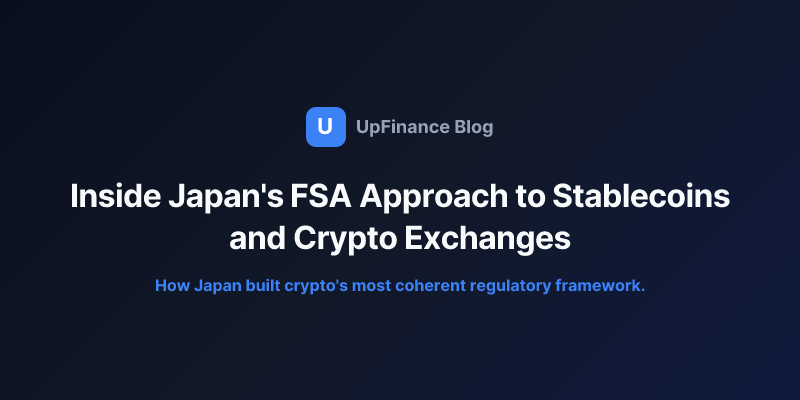
Specified Payment Tokens (SPTs): Stablecoins pegged to fiat currencies (USD, JPY, EUR) or baskets of assets. These require issuers to hold full reserve backing and obtain FSA approval before launch.
-
Other Crypto Assets: Everything else—including algorithmic stablecoins, yield-bearing tokens, and wrapped assets. These face lighter scrutiny but cannot market themselves as stable.
"The FSA's move toward reserve-backed stablecoins reflects a pragmatic bet that transparency beats prohibition. Japan learned this lesson after the Mt. Gox collapse in 2014—regulation by omission breeds catastrophe."
What makes Japan's approach distinct is mandatory reserve certification. Unlike the US, where Tether can claim backing without independent audits (at least historically), Japanese SPT issuers must:
- Deposit reserves with FSA-approved custodians (typically major banks like MUFG or Nomura Custody Services)
- Submit quarterly attestation reports from Big Four audit firms
- Maintain a minimum 100% reserve ratio verified monthly
- Ring-fence customer funds in segregated accounts
For retail investors in Tokyo or Osaka holding JPY-denominated stablecoins, this means significantly more institutional protection than trading USDC or DAI on unregulated platforms.
How the FSA's Exchange Licensing Works
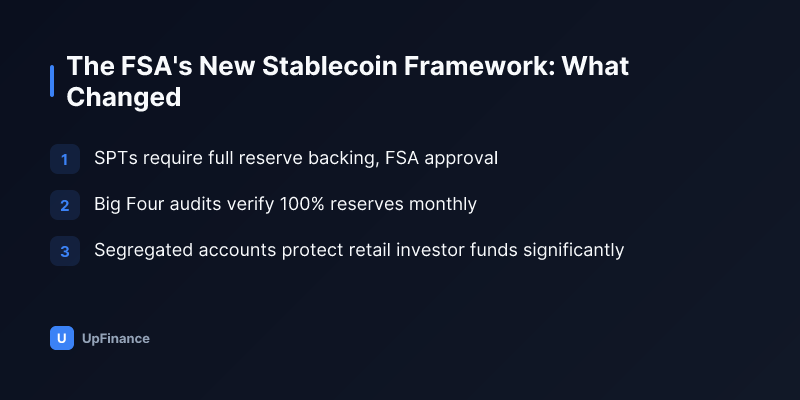
The FSA oversees crypto exchanges through a two-tier registration system that has become the de facto model for Asia. Tier 1 exchanges (Type I) can accept customer deposits, execute spot and margin trading, and custody customer crypto assets. Tier 2 exchanges (Type II) can facilitate peer-to-peer trading but cannot hold customer funds.
As of early 2026, Japan has 29 FSA-registered Type I exchanges, including household names like bitFlyer, GMO Coin, and Coincheck (acquired by Monex in 2018). The approval process typically takes 6–12 months and requires:
- Minimum 50 million JPY (~340,000 USD) in paid-in capital
- Dedicated compliance and risk management teams
- Customer asset segregation protocols (similar to stock brokerages)
- Anti-money laundering (AML) and know-your-customer (KYC) procedures compliant with Financial Action Task Force (FATF) standards
The Japanese exchange market is also uniquely dominated by retail traders in their 20s–40s, many of whom learned crypto through the bull market of 2017. Unlike South Korea, where crypto exchange competition has collapsed into a handful of mega-platforms (Upbit, Bithumb, Coinone), Japan maintains healthy competition. This is partly because the FSA caps leverage at 2:1 for spot margin trading, which reduces volatility-driven blow-ups and encourages longer-term retail participation.
Stablecoin Issuance: The Race to Launch JPY-Pegged Tokens
One of the FSA's implicit goals has been to build a Japanese digital currency ecosystem that reduces reliance on USD-based stablecoins. The agency views JPY-denominated stablecoins as infrastructure for Web3 adoption in Japan, similar to how Singapore positioned itself for USD USDC circulation.
Several major players have already launched or are in final approval stages:
- GMO Coin's GYEN (JPY-pegged): Launched in 2022, fully reserved and custody-managed by Crypto Custody GK. Over 2 billion JPY in circulation as of Q1 2026.
- SBI VC Trade's JPY Stable (in pilot): SBI Group, Japan's largest fintech conglomerate, is deploying a JPY stablecoin backed by on-chain verification of bank deposits.
- Nomura's SOON (multi-currency): The investment bank's stablecoin initiative, targeting institutional settlement. Currently awaiting final FSA sign-off.
For global investors, this matters because a robust JPY stablecoin ecosystem accelerates retail on-ramps into yen-denominated assets without forex friction. If you're trading AI tokens or DeFi protocols denominated in USD and want exposure to Japanese equities or bonds, holding GYEN or SBI's JPY token eliminates the need for a traditional currency exchange.
The FSA has also signaled support for cross-border stablecoin corridors, particularly with Singapore's Monetary Authority (MAS) and the Bank of Thailand. These bilateral agreements would allow regulated stablecoins to settle transactions across borders with minimal friction—a direct challenge to SWIFT's hegemony in remittances.
How This Differs from the US and EU Approach
To understand what makes Japan unique, it's worth comparing the FSA's framework to competing jurisdictions.
The United States has no unified stablecoin law. Stablecoins are treated as either commodities (CFTC), securities (SEC), or payment systems (OCC/Federal Reserve). This regulatory arbitrage has allowed Tether, USDC, and others to operate with minimal transparency until very recently. The SEC's position that stablecoins backed by commercial paper or short-term treasuries might be securities has deterred innovation in yield-bearing stablecoins.
The European Union's MiCA (effective December 2024) takes a harmonized but more heavyweight approach. All stablecoins must be issued by authorized entities, hold 100% reserves, and obtain approval before issuance. However, MiCA allows issuers far more flexibility in what constitutes backing (T-bills, corporate bonds, other stablecoins). It also introduces "stablecoin services" as a new category, creating compliance overhead for wallet providers and DeFi platforms.
Japan's FSA approach is lighter-touch but more prescriptive on reserves. The agency assumes that if you mandate transparency and segregation, you don't need to micromanage what assets back a stablecoin. This has allowed Japanese platforms to experiment with asset-backed tokens (collateralized by Japanese real estate or equities) in ways that would trigger SEC action in the US.
"The FSA essentially said: regulate the reserve, not the token. That's a meaningful philosophical shift that other regulators are starting to notice."
For platforms like UpFinance that track AI and fintech investment globally, this divergence matters enormously. A fintech fund holding exposure to Japanese crypto exchange equities (like GMO or SBI) faces dramatically less regulatory risk than a fund holding exchange equities in unregulated jurisdictions—but also less upside volatility.
Retail Market Dynamics and the Yen Connection
Japan's retail crypto market is surprisingly large but historically underreported in English-language fintech journalism. The country has roughly 3.5 million active crypto traders, representing about 2.8% of the adult population. Compare that to South Korea (10%), and you see Japan lags—but the quality of market infrastructure is higher.
One quirk of the Japanese market is the prevalence of yen carry trading in crypto. Because the Bank of Japan has maintained ultra-low interest rates (negative rates until 2024), retail traders borrow cheap yen, convert to USD, and deploy capital into high-yield DeFi or AI tokens. This creates recurring waves of yen-denominated liquidity into global crypto markets.
In early 2022, this dynamic contributed to crypto's bull phase. When the BOJ hiked rates (finally, in March 2024), we saw a corresponding contraction of yen-carry positions and a temporary 15–20% drawdown in crypto. The FSA has been cautious about extending margin caps specifically to address this systemic risk.
The Japanese retail trader demographic also skews toward longer-term hodling compared to the US or Korea. Data from bitFlyer shows that 64% of retail accounts hold positions for 6+ months, versus 38% in the US. This is partly cultural (patience, long-term savings mindset) and partly regulatory (the 2% leverage cap discourages day trading).
For crypto investors in Southeast Asia or Europe, this means the Japanese market offers relatively stable liquidity in major pairs (BTC/JPY, ETH/JPY) without the pump-and-dump volatility of less regulated exchanges.
Challenges and Future Directions
The FSA's framework is not without criticism. Stablecoin issuers complain that the 100% reserve requirement, while transparent, is capital-inefficient. Yield-bearing stablecoins (like Lido's wstETH or Compound's cUSDC) cannot be marketed as "stablecoins" under FSA rules, which has slowed adoption of productive crypto assets among Japanese retail investors.
There's also a looming question around decentralized stablecoins. The FSA has not yet ruled on whether DAI, FRAX, or other algorithmically-managed tokens can be listed on registered exchanges. Early signals suggest the agency will require an "issuer entity" for any stablecoin—meaning purely decentralized tokens may face restrictions.
The FSA is also grappling with the intersection of stablecoins and central bank digital currencies (CBDCs). The Bank of Japan is developing a digital yen (digital yen), and there's internal debate about whether private stablecoins should be allowed to coexist with a CBDC. Some FSA officials have hinted that the digital yen might displace private JPY stablecoins long-term, while others view private tokens as complementary to a CBDC for retail DeFi access.
Another frontier is cross-border settlement and the yen's role in decentralized finance. If the FSA successfully coordinates with MAS and BoT on stablecoin corridors, Japan could emerge as a regional hub for yen-denominated DeFi—something that would fundamentally reshape how AI and fintech startups raise capital across Asia.
Implications for Global Fintech Investors
For those tracking AI investing and fintech via platforms like UpFinance, the FSA's regulatory clarity has several second-order effects:
-
Exchange profitability: Regulated exchanges in Japan operate with lower legal risk and higher institutional credibility, making them attractive M&A targets for regional fintech giants.
-
Stablecoin adoption: A trusted JPY stablecoin ecosystem could accelerate adoption of yen-denominated crypto payments and lending protocols—an entirely new market segment.
-
Regional regulation: Japan's FSA framework is being studied by Singapore (MAS), Hong Kong (SFC), and Taiwan as a model. Success in Japan means the approach spreads across Asia.
-
Institutional entry: The reserve-backed stablecoin requirement has attracted traditional finance institutions (banks, insurance companies) into crypto custody and settlement—a secular trend favorable to regulated fintech incumbents.
The FSA has essentially made a bet that regulatory clarity beats prohibition, and transparency beats opacity. Whether that bet pays off—and whether other jurisdictions follow suit—will shape the next decade of global crypto infrastructure.
Conclusion
Japan's FSA approach to stablecoins and crypto exchanges represents a middle path between the US's regulatory fragmentation and the EU's regulatory maximalism. By mandating reserve transparency and exchange licensing while leaving room for innovation in token design, the FSA has created an environment where both institutional players and retail innovators can operate with confidence.
For global investors interested in crypto markets, fintech infrastructure, and AI-driven trading, understanding the Japanese regulatory playbook is essential. It's the clearest proof point we have that stablecoins and exchanges can be both secure and scalable—and it's only just beginning.
This content is produced for marketing purposes by MIG Korea Group and is not investment advice. Crypto investing carries the risk of losing your principal; investment decisions are your own responsibility. UpFinance is the AI fintech service of MIG Korea Group.
Related posts
Start AI investing with UpFinance — free
Start free →Smart investing with UpFinance
AI-powered market analysis, automated portfolio rebalancing, and risk alerts.
We make crypto markets simple — without dumbing them down.