
Global Crypto Regulation Heatmap: Strategies for Cross-Border Investors
The global cryptocurrency market has matured far beyond its libertarian origins. Today, the regulatory environment is more fragmented than ever, and it directly shapes where capital flows, which exchanges operate, and how institutional investors allocate risk. For anyone with exposure across multiple jurisdictions—whether you're a retail trader, a fintech founder, or managing a portfolio—understanding the regulatory landscape isn't optional. It's foundational.
This post walks you through the current regulatory heatmap: where restrictions are tightening, where innovation is welcomed, and—critically—how to structure your strategy across borders without running afoul of authorities in jurisdictions that matter to your portfolio.
The Three Regulatory Regimes: Permissive, Pragmatic, and Prohibitive
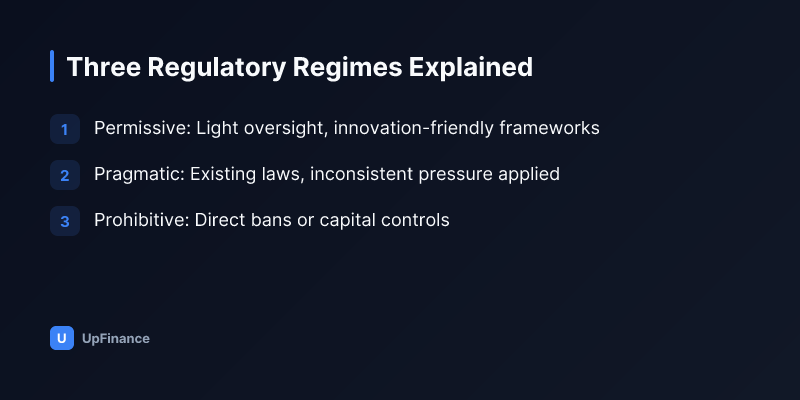
The global crypto regulatory environment clusters into three broad categories, though increasingly you'll find intermediate positions.
Permissive jurisdictions treat crypto as an asset class worthy of light-touch oversight or intentional innovation encouragement. These regions have rolled out crypto-specific frameworks, clear tax guidance, or both. Singapore, El Salvador, and Malta have built reputations here, though none are perfect.
Pragmatic regimes acknowledge crypto's existence and use—often substantial—but lack cohesive frameworks. They regulate through existing financial laws, apply pressure inconsistently, or wait for international guidance before moving. Most of the developed world sits here: the US, UK, EU, Japan, and South Korea.
Prohibitive jurisdictions restrict or ban crypto trading, mining, or custodianship, either through direct legal bans or suffocating capital controls. China remains the most visible example, though several smaller nations apply extreme restrictions too.
The critical insight: pragmatic regimes are where most capital concentration and regulatory risk now sits. The US, which hosts the world's largest crypto exchanges and wealth, remains deeply unsettled on core questions: Should crypto be regulated like securities, commodities, money, or something entirely new? The EU has moved faster with MiCA (Markets in Crypto Assets Regulation), which went live in January 2024, creating the world's first comprehensive crypto rulebook. But even MiCA leaves gaps and phase-ins.
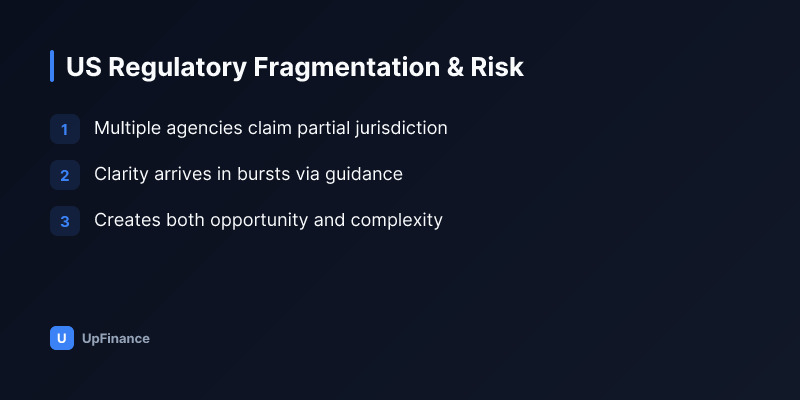
For cross-border investors, pragmatic regimes create both opportunity and complexity. Regulatory clarity often comes in bursts—a new bill, an enforcement action, an agency guidance document. Missing one of these signals can cost you.
Understanding the US Regulatory Puzzle
The United States remains fragmented between agencies, each claiming partial jurisdiction. This fragmentation is simultaneously a liability and an opportunity for sophisticated investors.
The Securities and Exchange Commission (SEC) focuses on whether a token qualifies as a security under the Howey Test. This one criterion determines whether a crypto asset falls under securities law, with all its associated compliance burdens. Bitcoin and Ethereum are generally not considered securities, but the vast majority of altcoins remain in regulatory limbo.
The Commodity Futures Trading Commission (CFTC) regulates crypto derivatives—futures, options, and leveraged trading. If you're using leverage on a US exchange, you're under CFTC oversight.
The Financial Crimes Enforcement Network (FinCEN) and state regulators oversee custody, custody alternatives, and money transmission. This is where exchange licensing happens. If a US exchange handles customer funds, it must comply with FinCEN's Bank Secrecy Act and state money transmitter licenses—an expensive and time-consuming process. This is why many US exchanges have spent years seeking trust bank charters or banking partnerships.
"The regulatory fragmentation in the US has created a bifurcated market: institutional-grade infrastructure with clear compliance models, and a massive retail segment operating in gray zones. For cross-border investors, this means US exposure requires jurisdiction-specific structuring." – Industry consensus, 2025–2026.
For US-based or US-exposed investors:
- Hold Bitcoin and Ethereum directly without securities concerns, but know that tax reporting to the IRS is mandatory and detailed.
- Understand that staking rewards, yield farming, and lending arrangements may trigger different tax treatments depending on whether they're classified as ordinary income, short-term gains, or long-term gains.
- Use only regulated exchanges (Kraken, Coinbase, Gemini) if custody is delegated.
- For derivatives exposure, work with a CFTC-regulated platform or ensure your offshore broker has clear US investor restrictions if you're using leverage.
The European Union's MiCA Rulebook and Compliance Standards
The EU took a different approach: define the market comprehensively, then regulate it. MiCA (Regulation (EU) 2023/1114) is the world's first codified crypto rulebook and serves as a global template.
MiCA's scope is broad:
- Crypto asset service providers (CASPs) must hold authorization and comply with capital, governance, and AML/KYC rules.
- Stablecoin issuers face capital requirements and redemption guarantees.
- Crypto exchange operators need authorization, insurance, and segregated customer funds.
- Market abuse and insider trading rules apply to crypto trading.
The framework went live in January 2024, with most provisions in effect. For investors, this creates clarity: any exchange or custodian operating in the EU must meet these standards. If they don't, they face fines up to 10% of annual revenue.
What makes MiCA different from the US patchwork: it's actually a single rulebook across 27 member states. This simplifies compliance for platforms serving EU customers and makes regulatory arbitrage harder.
However, MiCA leaves open questions:
- Tax treatment of crypto income varies by member state. Germany taxes crypto gains as ordinary income at marginal rates (up to 45%); Portugal offers tax-free status on crypto-to-crypto trades but not euro-to-crypto; Switzerland offers advantageous treatment to residents of specific cantons.
- Proof-of-stake and other yield mechanisms still fall into gray zones regarding whether staking rewards are income, capital gains, or something else.
- Self-custodial wallets are largely unregulated, creating a compliance shadow for retail investors who prefer self-custody.
For EU investors and those holding EU assets:
- Use MiCA-authorized exchanges if you want regulatory certainty.
- Track your tax residency closely—it determines your reporting obligations and effective tax rate.
- Be aware that EU exchanges are increasingly delisting US-issued securities tokens and certain altcoins to avoid classification complexities.
- Consider cross-border structures if you have significant holdings; some EU residents use Singapore-registered entities for tax optimization.
Asia-Pacific: The Diverse Middle Ground
Asia is where the regulatory spectrum widens. No single regulatory narrative fits the region; instead, you have a spectrum from highly permissive (Singapore) to moderately hostile (India).
Singapore: The Regional Standard-Setter
Singapore's Monetary Authority (MAS) launched the Payment Services Act (PSA) in 2020, creating a clear licensing framework for crypto service providers. MAS treats crypto as an asset class that requires regulated custodians and service providers, but not prohibition.
Key features:
- Crypto exchanges and custody providers must be PSA-licensed.
- Capital requirements scale with risk; a pure exchange faces lower capital requirements than a custodian offering lending.
- Singapore-based firms like Crypto.com, Binance (until 2023 when it voluntarily ceased operations there), and various custody providers operate under MAS oversight.
- Tax treatment: capital gains on crypto are generally not taxed, but trading income may be. The distinction hinges on whether you're a trader or investor—a fact-dependent question.
For investors using Singapore as a hub: it offers regulatory clarity and tax efficiency, but Singapore's restrictions on retail participation in certain crypto derivatives (binaries, CFDs) can limit leverage options.
Japan: Regulated Exchanges, High Retail Adoption
Japan's Financial Instruments and Exchange Act (FIEA) regulates crypto exchanges. Unlike some regimes, Japan's approach is positive-sum: it acknowledges retail demand and creates a licensing framework.
The Payment Services Act (PSA), effective in 2017 (revised 2020), requires crypto exchanges to be registered with the Financial Services Agency (FSA). Capital requirements are modest (2 billion yen, approximately USD 13–14 million at current rates), but segregation and custody standards are strict.
Key regulatory facts:
- The FSA maintains a white-list of approved exchanges. Trading on unlicensed exchanges is technically legal for retail investors, but banks and payment processors won't service unlicensed platforms.
- Japan has the world's highest retail crypto participation rate by some measures, driven by a combination of low-yield savings, historical acceptance of alternative assets (from pachinko to stock trading), and mobile-first fintech adoption.
- Tax treatment is punitive: crypto gains are taxed as ordinary income at marginal rates up to 55% (including local tax). This creates strong incentive for long-term holding strategies and tax-loss harvesting.
- Staking and yield farming are taxed as income in the year earned, not when realized—creating a cash-flow mismatch for active DeFi participants.
For investors with Japan exposure: use only FSA-registered exchanges (GMO Coin, bitFlyer, DMMBitcoin as of 2026). Be mindful of the tax burden; many Japanese investors use offshore structures or hold long-term for deferral benefit.
South Korea: Strictness With High Volume
South Korea's regulatory approach is restrictive on paper but commercially vibrant in practice. This mismatch creates both opportunities and risks for cross-border investors.
The Specific Financial Transaction Information Act (SFTA, or "Crypto Act") went into force in 2021, requiring exchanges to hold real-name verified bank accounts and obtain FSC approval. The framework is intended to prevent money laundering and fraud, not to restrict usage.
However, enforcement is inconsistent:
- Exchanges face arbitrary account closures from banks due to regulatory uncertainty. This has led to a situation where major Korean exchanges like Upbit and Bithumb operate under constant pressure but significant volume—Korean won (KRW) denominated pairs often show price discovery.
- The FSC has periodically proposed bans on crypto derivatives, ICOs, and other products, creating regulatory volatility.
- Tax treatment: crypto gains are classified as "other income" and taxed at 20% flat rate (as of 2024 guidance, pending legislative clarity). However, reporting is difficult and enforcement is evolving.
- Retail investors dominate; institutional adoption remains limited compared to developed markets.
The critical insight for cross-border investors: Korean won premiums or discounts on Bitcoin and other major assets can indicate regulatory sentiment shifts. When Korean regulators threaten restrictions, KRW-denominated prices often diverge from global benchmarks. Sophisticated traders monitor this for arbitrage; longer-term investors should be aware that Korean regulatory swings can cascade into global price movements.
Southeast Asia: The Emerging Frontier
Jurisdictions like Thailand, Vietnam, and Indonesia have taken varied approaches:
- Thailand has a licensing framework similar to Singapore's, with a smaller ecosystem. Crypto is legal; exchanges must be licensed. Tax treatment remains unclear.
- Vietnam has de facto restrictions despite no formal ban. Banks are discouraged from servicing crypto entities, creating a shadow market. Capital controls on cryptocurrency outflows are informal but strict.
- Philippines allows trading but lacks a comprehensive regulatory framework. Crypto exchanges operate in a gray zone, though the Bangko Sentral ng Pilipinas has indicated future regulation.
- Indonesia has cautiously moved toward regulation after years of ambiguity. The central bank and securities regulator are coordinating a framework.
For investors in Southeast Asia: regulatory clarity is improving but remains inconsistent. Use licensed platforms where available; in jurisdictions without clear frameworks, expect lower liquidity and higher counterparty risk.
Building a Cross-Border Investment Strategy
Given this fractured regulatory landscape, how do sophisticated investors structure exposure?
Rule 1: Anchor to Your Tax Residency
Your effective tax rate on crypto gains may dwarf regulatory compliance costs. Before constructing a global portfolio:
- Identify your tax residency and the tax treatment of crypto income in that jurisdiction.
- Understand whether your jurisdiction taxes unrealized gains, staking income, or only realized trades.
- For high-net-worth individuals, consider whether a secondary residence in a favorable tax jurisdiction (Portugal, some Swiss cantons, UAE for non-residents) makes economic sense.
UpFinance's portfolio analytics tools can help map your after-tax returns across jurisdictions—an increasingly critical input for cross-border allocation.
Rule 2: Use Regulated Infrastructure Where You Have Significant Exposure
Regulatory licensing isn't perfection, but it's a floor. If you hold substantial amounts with a custodian or on an exchange, that entity should be regulated in at least one major jurisdiction.
- For US exposure: use SEC-aware or CFTC-regulated platforms.
- For EU exposure: use MiCA-authorized CASPs.
- For Asia: use FSA-licensed exchanges (Japan), PSA-licensed platforms (Singapore), or FSC-registered entities (South Korea).
This creates redundancy in your safety checks: the regulator has conducted due diligence on the platform's controls, capital adequacy, and AML/KYC processes.
Rule 3: Diversify Custody Models by Jurisdiction
Don't concentrate all holdings with a single custodian, even if regulated:
- Use institutional custody (Fidelity Digital Assets, Coinbase Custody) for substantial positions in US-regulated entities.
- Use cold storage self-custody for a portion of holdings (accepting that you forgo yield but gain control).
- Use regional custodians for Asia exposure (Hex Trust for institutional crypto custody in Hong Kong, for example).
Rule 4: Monitor Regulatory Calendars
Major regulatory announcements often come at predictable times:
- US: Congressional hearings, SEC rulemaking, CFTC position statements (often months before implementation).
- EU: MiCA technical standards updates, European Banking Authority guidance.
- Asia: FSA guidance (Japan), FSC notices (South Korea), MAS consultation papers (Singapore).
Set calendar reminders for major regulatory jurisdiction announcements. Regulatory signals often precede market moves by weeks or months. Investors who catch these early can adjust allocations before volatility spikes.
Rule 5: Understand Stablecoin and Yield Dynamics Across Jurisdictions
Stablecoin regulation is crystallizing:
- US: stablecoin issuers are moving toward a framework where they're either SEC-regulated or quasi-banking entities. MiCA-compliant stablecoins (USDC, USDT in EU form) are becoming standard.
- EU: MiCA requires stablecoin issuers to hold capital and maintain redemption reserves. This increased compliance costs but created a clear framework.
- Asia: stablecoin treatment varies. Japan allows yen-denominated stablecoins under certain conditions; Singapore regulates them as payment tokens under PSA.
For yield-generating strategies (staking, lending, LPs):
- Tax treatment is inconsistent. Some jurisdictions tax staking rewards as ordinary income when earned; others tax on withdrawal. Some recognize impermanent loss for tax purposes; others don't.
- Use tax-efficient structures: residents of certain EU countries can use compliant decentralized finance strategies without triggering immediate income tax, while US residents face annual reporting of accrued income.
Practical Checklist for Cross-Border Crypto Investors
Before deploying capital across jurisdictions, work through this framework:
-
Identify your tax residency and any secondary residencies. This is your anchor.
-
Map your portfolio allocation across regions. What percentage in US assets, EU, Asia, elsewhere?
-
Determine the regulatory regime for each jurisdiction where you hold >5% of portfolio value. Are you in a permissive, pragmatic, or prohibitive zone?
-
Audit your counterparties: Is your exchange, custodian, or staking provider licensed in at least one major jurisdiction? What's their capital adequacy?
-
Document your tax reporting strategy. Will you self-report? Use a tax specialist? File amended returns if guidance changes?
-
Set calendar reminders for regulatory announcements in jurisdictions where you have exposure.
-
Review quarterly. Regulatory changes come fast. A strategy that was optimal in Q1 may need adjustment by Q3.
The Role of AI and Data in Navigating Regulatory Risk
Regulatory complexity has created opportunity for fintech. AI-powered compliance monitoring, tax calculation, and cross-border reporting are becoming standard infrastructure.
Tools like UpFinance are building models that:
- Aggregate regulatory news and sentiment across jurisdictions in real-time.
- Calculate after-tax returns for portfolios across multiple tax regimes.
- Identify optimal custody and exchange configurations based on your allocation.
- Flag regulatory risks (e.g., "Your Singapore exposure may face new capital controls") before they become mainstream knowledge.
For serious cross-border investors, delegating regulatory monitoring to specialized fintech is no longer a luxury—it's competitive necessity. The cost of missing a regulatory signal can dwarf the subscription cost of an AI platform that catches it.
Conclusion: Regulatory Risk as a Feature, Not a Bug
The regulatory fragmentation in crypto markets is often viewed as a problem. But for informed investors, it's an opportunity. Different jurisdictions offer different risk-return profiles, tax treatments, and custody models. An investor who understands these trade-offs—and structures accordingly—can optimize returns in ways unavailable in traditional markets.
The global crypto regulatory heatmap is shifting constantly. But the principles remain stable:
- Anchor decisions to your tax residency and after-tax returns.
- Use licensed infrastructure for substantial holdings.
- Diversify custody and counterparty risk across jurisdictions.
- Monitor regulatory calendars obsessively.
- Use AI tools to augment your monitoring.
The next five years will likely see further regulatory consolidation. The EU's MiCA model is already being adopted by other jurisdictions. The US will eventually settle on a comprehensive framework. But until then, cross-border investors who navigate this complexity thoughtfully will find persistent alpha.
This content is produced for marketing purposes by MIG Korea Group and is not investment advice. Crypto investing carries the risk of losing your principal; investment decisions are your own responsibility. UpFinance is the AI fintech service of MIG Korea Group.
Related posts
Start AI investing with UpFinance — free
Start free →Smart investing with UpFinance
AI-powered market analysis, automated portfolio rebalancing, and risk alerts.
We make crypto markets simple — without dumbing them down.