
Copy Trading with AI: Pros, Cons, and How to Pick a Strategy
Copy trading—the practice of automatically replicating the trades of successful investors—has evolved from a niche retail strategy into a mainstream fintech phenomenon, especially in Asia. Add artificial intelligence to the mix, and you're looking at something that promises to democratize investing: let algorithms learn from top performers and execute trades faster than any human could.
But is AI-powered copy trading actually the shortcut to wealth that marketing materials suggest? Or does it come with hidden pitfalls that most platforms don't advertise? This guide breaks down the reality, examines real-world use cases from Korean and Southeast Asian markets, and gives you a framework for deciding whether this approach fits your investing goals.
What is AI Copy Trading, and How Does It Actually Work?
Copy trading isn't new, but AI has fundamentally changed how it operates. In its simplest form, you select a trader whose track record you trust, link your account, and automatically mirror their positions. The appeal is obvious: why spend hours analyzing charts if someone else has already done the work?
AI-powered copy trading adds layers of automation and optimization:
-
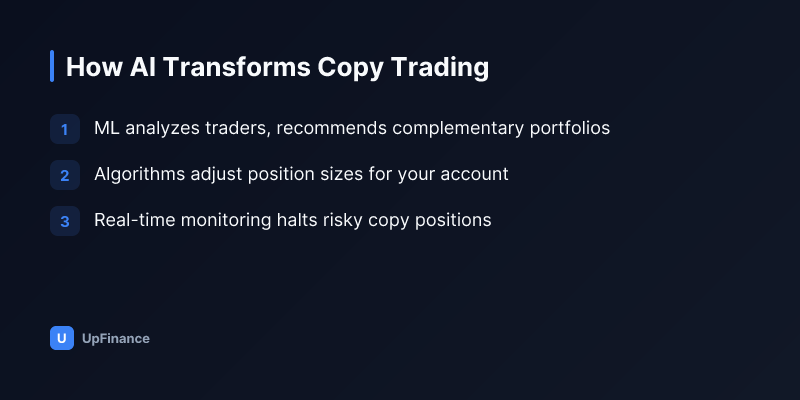
Strategy Selection: Machine learning models analyze thousands of traders and their historical returns, volatility, win rates, and drawdowns. Instead of manually choosing one trader, the AI recommends a portfolio of traders that statistically complement each other.
-
Position Sizing: Rather than copying trades 1:1, AI algorithms adjust position sizes based on your account balance, risk tolerance, and the master trader's volatility profile. This is critical—blindly copying a $1M trader's position sizes on a $10K account is a recipe for ruin.
-
Risk Management: Modern platforms use real-time monitoring to halt copying if a trader's drawdown exceeds your specified threshold, or if market conditions shift dramatically (like during the 2022 crypto winter).
-
Lag Reduction: High-frequency copy trading platforms now execute copies in milliseconds, reducing slippage. This matters enormously in crypto, where prices move faster than traditional markets.
-
Signal Filtering: Some platforms use natural language processing to analyze trader commentary, news sentiment, and on-chain data, adjusting which traders remain in your copy portfolio.
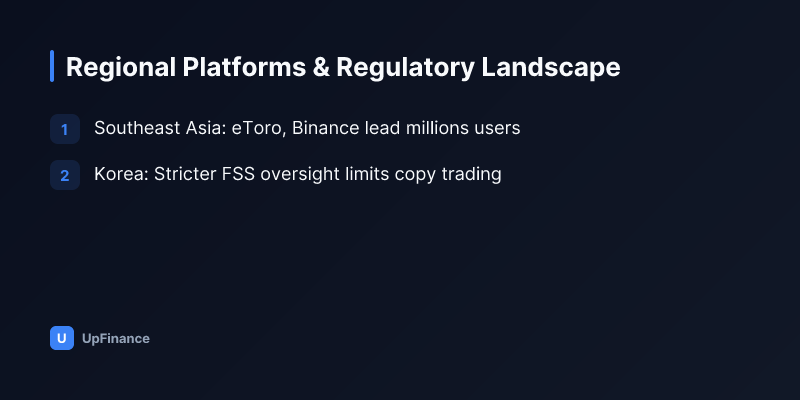
In Southeast Asia, platforms like eToro and Binance's Futures Copy Trading have millions of users. In Korea, the regulatory environment is stricter—copy trading exists but under tighter oversight from the Financial Supervisory Service (FSS). Japanese platforms like Gmo Coin and DMMBitcoin offer copy-like features, though they're technically labeled differently to comply with local fintech regulations.
The Real Advantages: Where AI Copy Trading Wins
If AI copy trading were just rebranded hype, it wouldn't attract billions in assets. There are genuine advantages worth understanding:
Time Efficiency
The most obvious benefit: you don't need to become an expert trader. A working professional in Manila, Singapore, or Seoul can set up a copy trading strategy in 20 minutes and have it generating trades while they sleep. This is particularly valuable in crypto markets, which never close—you can't monitor 24/7.
Diversification Without Expertise
Selecting a single trader is risky; copying a portfolio of traders is smarter. AI algorithms can construct a diversified copy portfolio by selecting traders with low correlation to each other. For example, one trader might specialize in high-volatility altcoins, another in stablecoin arbitrage, and a third in BTC/ETH spot trading. Traditional portfolio theory gets applied automatically.
Backtested Performance
Reputable platforms publish historical returns for each trader. You can see that Trader A generated 45% returns over two years with a max drawdown of 22%, while Trader B generated 28% with only 8% drawdown. This transparency—unheard of in traditional finance—lets you make informed decisions.
Emotional Discipline
One of the biggest reasons retail traders fail is emotional decision-making. Copy trading removes the temptation to panic-sell during a crash or chase FOMO rallies. The algorithm sticks to the plan, regardless of market noise.
Adapting to Market Regime Changes
Top AI platforms don't just copy blindly. They monitor whether a trader's strategy is still working in the current market environment. If a mean-reversion strategy that worked in 2023 starts bleeding money in 2026, the system can automatically reduce or pause that trader's weight in your portfolio.
The Serious Drawbacks: What Can Go Wrong
The marketing materials rarely emphasize these, but they're critical:
Survivorship Bias
The traders you see on leaderboards are the ones who survived. If 1,000 traders started on a platform, and 900 blew up their accounts, the platform's marketing focuses on the 100 successful ones. You're not copying the true distribution of trader skill; you're copying a selected sample of winners. This distorts your expectations massively.
Past Performance ≠ Future Results
This isn't just legal boilerplate—it's the crux of the problem. A trader who crushed the bull market of 2024 might be entirely wrong for the bear market of 2027. Their strategy might exploit specific market conditions (e.g., high volatility, retail FOMO) that don't repeat. Korean traders in 2017 who leveraged heavily on Upbit and Bithumb during the ICO boom looked genius—until the 2018 crash wiped them out.
Whipsaw and Slippage in Crypto
Crypto markets are less liquid than stock markets, especially for altcoins. When a copied trader executes a large position, your copy execution might happen at a worse price than theirs. If they trade KRW-denominated pairs on Upbit, and the platform routes your order through a different exchange, you're absorbing unfavorable slippage. Over hundreds of trades, this erodes returns significantly.
Platform Risk
Your copy trading platform could face regulatory action, hack, or insolvency. Korea saw this with the Luna collapse and subsequent regulatory tightening. If your platform is unregistered or lightly regulated, you have minimal recourse if something goes wrong.
Hidden Fees
Many platforms charge a percentage of profits (typically 10-30%) taken from successful trades. This is often buried in the terms. If a trader generates 50% annual returns but the platform takes 20%, you're left with 30%. Some platforms charge spreads on top of exchanges' spreads, doubling your costs.
Information Asymmetry
You don't know the trader's true edge. Are they genuinely skilled, or did they get lucky? Do they understand their own strategy, or are they pattern-matching? A trader who made money in 2024 might not know why—which means they can't adapt when conditions change.
How to Evaluate and Pick a Copy Trading Strategy
If you decide copy trading fits your goals, here's a framework for choosing wisely:
1. Establish Your Risk Tolerance First
Before copying anyone, define your acceptable drawdown and volatility. A typical framework:
- Conservative: Max 10% drawdown, target 8-12% annual returns
- Moderate: Max 20% drawdown, target 15-25% annual returns
- Aggressive: Max 35% drawdown, target 30%+ annual returns
This should align with your life stage and time horizon. A 25-year-old with 20+ years until retirement can tolerate 35% drawdowns; a 55-year-old cannot.
2. Audit the Trader's History Rigorously
Don't trust platform leaderboards. Dig deeper:
- How long has this trader been active? Less than 1 year is a red flag. Ideally, you want 3+ years across multiple market cycles.
- What was their performance in down markets? If they're up 300% but only traded during the 2024-2025 bull run, their strategy hasn't been tested in adversity.
- What's their Sharpe ratio? Returns are meaningless without risk context. A Sharpe ratio above 1.0 is decent; above 2.0 is excellent (though rare).
- Are they transparent about losses? Trustworthy traders show the bad months too. If someone claims 50 consecutive winning trades, they're either lying or operating on a timeframe so short you'll get destroyed by slippage.
3. Diversify Across Multiple Traders and Strategies
Never copy just one person. Even if they seem infallible, concentrating your capital is concentration risk. A reasonable allocation might be:
- 30% to a conservative, dividend-like strategy (stablecoin arbitrage, yield farming)
- 30% to a moderate growth strategy (balanced altcoin + BTC)
- 20% to a higher-risk, higher-reward strategy (leverage trading, derivatives)
- 20% in reserve for adjustments
This way, if one trader has a bad quarter, the others stabilize your portfolio.
4. Check Regulatory Status and Platform Security
- Is the platform registered? In the EU, legitimate platforms have ESMA registration or local financial authority approval. In Korea, check the FSS register. In Singapore, look for MAS licensing.
- Do they have insurance? Reputable platforms offer crypto asset insurance (typically up to $250K) in case of hack.
- Have they been audited? Look for third-party security audits, especially if they handle custody.
- What's their fee structure? Transparent platforms clearly state exchange fees, platform fees, and profit-sharing percentages upfront. If you have to hunt, they're hiding something.
5. Paper Trade First
Most platforms offer a demo mode where you copy traders with virtual money. Spend 2-4 weeks paper trading before committing real capital. This lets you see how the strategy actually feels in practice. Do the drawdowns bother you emotionally? Is the platform's interface clear? How often are traders making trades (which affects slippage costs)?
6. Start Small and Scale Gradually
Commit maybe 5-10% of your investable capital to copy trading initially. If it performs as advertised, you can gradually increase allocation. This cushions you against:
- Platform risk (smaller loss if they go under)
- Trader risk (easier to exit if the trader underperforms)
- Learning risk (you'll spot problems early without major damage)
Regional Considerations: Asia-Specific Context
Korea
South Korea has the world's highest retail participation in crypto, partly driven by high leverage available on local exchanges like Upbit and Bithumb. However, the FSS has cracked down hard on unregistered copy trading platforms. Legitimate platforms in Korea (like those affiliated with registered securities firms) exist but are fewer. The regulatory environment is shifting—expect stricter licensing requirements for AI-powered trading platforms by 2027.
Korean won (KRW) pairs dominate local platforms, meaning if you're copying a Korean trader on Upbit, make sure you understand FX risk if you're holding USD or EUR elsewhere.
Southeast Asia (Singapore, Thailand, Philippines, Vietnam)
Binance, Bybit, and OKX—which all offer copy trading—dominate the region due to lack of local restrictions. Singapore is the most regulated, with MAS overseeing platforms and requiring disclosure. Philippines and Vietnam have minimal regulation, which cuts both ways: fewer barriers to entry but also less consumer protection.
The huge retail base in Philippines and Vietnam means many young traders are copying strategies without fully understanding them. Be wary of any strategy that seems designed for someone else's market conditions.
Japan
Japan doesn't allow copy trading in the traditional sense due to Financial Instruments and Exchange Act (FIEA) restrictions. However, platforms like DMMBitcoin and GMO Coin offer "auto-trade" or algorithmic trading features that function similarly. These are more regulated but also more limited.
Practical Example: Building a Diversified Copy Portfolio
Let's say you have $10,000 to allocate and want moderate risk (20% max drawdown, 18-25% target annual return):
-
Identify 6-8 traders across different strategies and risk profiles. Use the vetting framework above.
-
Allocate 12-15% to each ($1,200-1,500 per trader). This gives you diversification without over-spreading thin.
-
Monitor quarterly, not daily.** Overmonitoring leads to emotional decisions. Every three months, review whether each trader is still meeting their historical performance standards and whether they fit your current risk appetite.
-
Rebalance if needed. If one trader has performed so well that they now represent 25% of your portfolio, trim back to 12% and redeploy to an underweighted trader.
-
Set hard stop-losses. If a trader's cumulative loss exceeds your threshold (e.g., -15%), stop copying them. Don't hope they'll bounce back.
"The most important thing in copy trading isn't finding the best trader—it's not losing your capital with the wrong one." — this mindset separates sustainable copy traders from those who flame out chasing the shiniest returns.
Red Flags to Avoid
- Promises of guaranteed returns or "never-losing" strategies. If someone claims this, they're scamming you.
- Traders with minimal public track record (less than 50 trades or less than 1 year of data).
- Extremely high returns with low drawdowns. If someone claims 100% annual returns with 5% max drawdown, they're either lying or trading something so exotic it'll blow up when market conditions shift.
- Platforms that don't allow you to see trader stats publicly. Transparency is non-negotiable.
- High fees (>20% profit share) or undisclosed fees. These erode your returns faster than poor strategy performance.
- No insurance or regulatory oversight. This is how you lose everything overnight.
UpFinance, as an AI fintech platform, has built copy trading features with particular emphasis on transparency and regulatory compliance. Even on our platform, though, the principles above remain: diversify, vet thoroughly, and start small.
The Bottom Line
AI-powered copy trading isn't a shortcut to wealth, but it can be a useful tool for investors who:
- Lack time or expertise to trade independently
- Want systematic, emotion-free execution
- Are disciplined enough to diversify and manage risk
- Understand that past performance is not predictive
It's not suitable for those seeking guaranteed returns, hoping to get rich quick, or unable to tolerate 15-20% drawdowns.
The real edge in copy trading comes not from copying the absolute best trader, but from intelligently combining multiple traders, managing risk ruthlessly, and staying disciplined through inevitable downturns. Technology and AI make this easier, but they don't eliminate the fundamental challenge: separating skill from luck, and protecting your capital when you're wrong.
This content is produced for marketing purposes by MIG Korea Group and is not investment advice. Crypto investing carries the risk of losing your principal; investment decisions are your own responsibility. UpFinance is the AI fintech service of MIG Korea Group.
Related posts
Start AI investing with UpFinance — free
Start free →Smart investing with UpFinance
AI-powered market analysis, automated portfolio rebalancing, and risk alerts.
We make crypto markets simple — without dumbing them down.