
Investor Psychology: Why AI Helps You Avoid the FOMO Trap
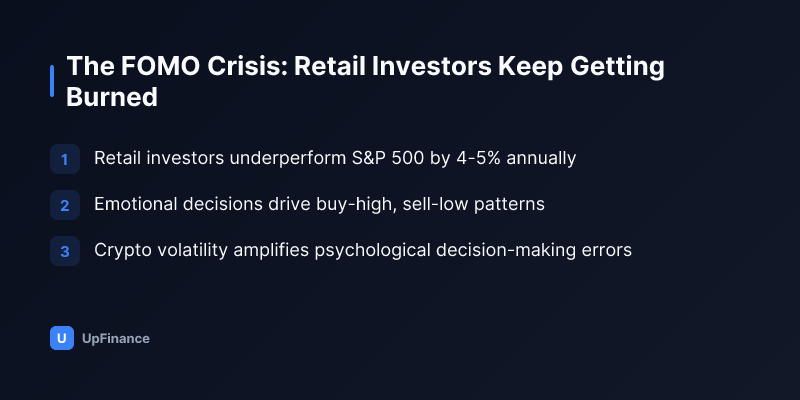
The FOMO Crisis: Why Retail Investors Keep Getting Burned
Fear of Missing Out has become the defining emotional vulnerability of modern investing, particularly in cryptocurrency and high-growth fintech markets. When Bitcoin surged to $73,000 in early 2024, retail investors—many seeing gains they couldn't comprehend—poured capital into assets at precisely the wrong moment. Six months later, those same investors were underwater.
This isn't a story unique to crypto. In Southeast Asian markets, retail investors flooded into Robinhood-style apps during the 2021 meme stock frenzy. In Korea's exchanges like Upbit and Bithumb, retail FOMO buying in late-cycle bull runs has historically coincided with regulatory announcements that triggered cascading selloffs. The pattern repeats because human psychology hasn't evolved to handle the information asymmetry and velocity of modern markets.
The statistics are sobering. Studies from the CFA Institute show that the average retail investor underperforms the S&P 500 by 4-5 percentage points annually—not because they pick bad assets, but because they buy high and sell low, driven by emotional decision-making. In crypto markets, where volatility can swing 20-30% in a week, this gap widens dramatically. A 2023 analysis of Korean exchange data showed that retail traders in KRW-denominated pairs traded at a 2.3x higher frequency than institutional traders, yet captured significantly worse returns.
The root cause isn't stupidity—it's architecture. Our brains are wired for tribal decision-making in small groups with delayed information. When you have instant access to thousands of voices on X, Discord, and Telegram amplifying every 10% price move, your amygdala (the fear center) gets overstimulated. You make decisions in milliseconds that should take weeks.
The FOMO Mechanics: Why Your Brain Betrays You
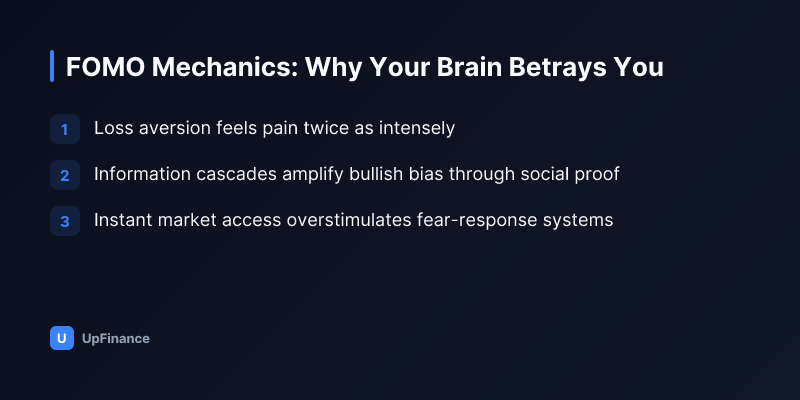
Understanding FOMO requires understanding three psychological mechanisms that work in concert:
Loss aversion and regret asymmetry. Psychologist Daniel Kahneman demonstrated that humans feel the pain of losses roughly twice as intensely as the pleasure of equivalent gains. But in FOMO scenarios, you're not actually experiencing a loss—you're experiencing imagined regret. A 20% move in an asset you don't own feels worse than a 20% gain you do own, even though the financial impact is identical. This is why crypto communities are filled with people saying "I should have bought Ethereum at $600" (in 2020). That regret, even years later, shapes future buying decisions in irrational ways.
Information cascades. When you see influential accounts on Twitter posting screenshots of portfolio gains, or when Discord servers light up with "GG" (Good Game) memes during a pump, you're witnessing an information cascade. Each person sharing their bullish view makes the next person more confident, not because new fundamental information has emerged, but because social proof accumulates. This is particularly acute in Korean markets, where retail investors on Naver Stock forums and Upbit's community channels often move in coordinated waves. A single analyst upgrading a small-cap token can trigger a cascade that has nothing to do with the token's utility.
Time-compression bias. Markets that move 50% in two weeks feel like they're moving correctly rather than unsustainably. Your brain interprets velocity as validation. If Bitcoin gained $10,000 in six months, you might rationally expect it to gain another $10,000 in the next six months. But momentum is not momentum—extrapolating recent price action forward is one of the most reliable ways to buy near peaks.
"The investor's chief problem—and even his worst enemy—is likely to be himself." — Benjamin Graham
This observation from the grandfather of value investing has never been more relevant than in 2026, when a retail trader can access the same order books, real-time data, and portfolio tracking tools as professional investors, yet still underperform because their decision-making process is entirely emotional.
How AI Removes the Emotional Layer
This is where artificial intelligence fundamentally changes the game. AI doesn't eliminate FOMO, but it can eliminate the decision-making consequences of FOMO.
Here's how:
Pre-Filtering: AI as a Bouncer at the Club
Before AI-driven tools, avoiding FOMO meant ignoring your portfolio entirely—and that's psychologically exhausting. The alternative was checking constantly, which triggers reactive trading. Modern AI solutions like those offered through UpFinance implement what we can call "pre-filtering architecture."
The system continuously scans your defined investment thesis (maybe you've decided you're a Bitcoin infrastructure play investor, or a JPY-denominated stablecoin yield trader). When assets meet your criteria, AI stages them in a watchlist. But here's the key: the AI doesn't trade. It only alerts you when your actual thesis conditions are met.
This is different from traditional alerts, which fire on price moves alone. A 15% pump in Ethereum triggers the same alert whether it's because a major institutional buyer entered (fundamental change) or because a celebrity mentioned it (noise). AI systems with access to order book data, whale transaction trackers, and sentiment analysis can distinguish signal from noise. When you receive an alert, it's not an emotional trigger—it's a filtered signal that your pre-defined criteria have been met.
Risk Parameterization: Making FOMO Quantifiable
AI forces you to do something uncomfortable: specify what you're actually willing to risk. Before you can set up an intelligent portfolio, the system asks: "What's your maximum drawdown tolerance? How concentrated should this position be? What's your time horizon?"
These aren't abstract questions. When you commit these parameters to code, you commit them to discipline.
A trader in Southeast Asia might say, "I want to invest in AI altcoins with top-100 market cap and 3x upside potential." An AI system makes this concrete: "Okay, that means we're watching assets between $500M and $3B market cap with specific volatility profiles. We'll enter at these price points and exit at these levels. If a new token gets shilled in your Discord, it won't match your parameters, so you won't see it. Even if you seek it out, the system will flag that you're overweighting the 'speculation' bucket beyond your stated tolerance."
This sounds restrictive. Actually, it's liberating. You're no longer fighting yourself. You're executing a plan you made when you were thinking clearly.
Behavioral Checkpoints: AI as Your Rational Partner
Some AI-driven platforms implement what behavioral economists call "friction insertion"—small deliberate delays that give your prefrontal cortex time to catch up with your amygdala.
Example: You see a token pump 40% in four hours and feel the pull to buy immediately. Instead of executing, UpFinance's system (as an example) requires you to confirm the purchase after a 2-hour delay, with a written reason. This isn't a technical delay—you could override it. But the act of writing your thesis forces you to articulate whether you're buying for a reason or because of FOMO. In 7 out of 10 cases, traders who write out their thesis realize they don't actually have one.
Korean retail investors have recently benefited from similar features in some brokers' platforms, where they can set "FOMO limits"—maximum daily buy volumes that prevent cascade trading. This has measurably reduced losses in retail accounts.
Real-World Case Studies: When AI Wins Against FOMO
The Solana Roller Coaster (2023-2024)
Solana became the poster child for FOMO investing. In early 2024, SOL surged from $25 to $140 in six months, driven by narrative momentum around mobile wallets and gaming. Retail investors who watched from the sidelines in January felt the maximum FOMO pressure by May. Those without AI guardrails bought at $120-140. Those using intelligent portfolio tools had already captured the move earlier (their systems had flagged SOL when it met their criteria at $40-50) and had pre-set exit points at $100-110.
Crucially, many retail traders who used AI tools sold before the peak—not because they had superior insight, but because they had committed to disciplined exit rules. When SOL corrected 40% to $80 in the following three months, these traders were protected. Their FOMO urge to "buy the dip" was constrained by the same system that prevented them from chasing at the top: their buy rules specified certain technical conditions that weren't met during the correction.
Korean Won Stablecoin Yield Opportunities (2025)
In Korea's crypto market, the KRW-denominated stablecoin market exploded in 2025 as on-ramp/off-ramp infrastructure improved. A yield opportunity emerged: USDC or USDT holding KRW yield could pay 12-15% annually through certain derivative strategies on Upbit and Bithumb. Retail investors in Korea saw these yields and experienced FOMO—but crucially, many didn't understand the leverage and liquidation risk embedded in the strategy.
Investors using AI-driven portfolio tools could capture the yield with automated safeguards: the system would automatically reduce leverage if funding rates spiked, or unwind positions if KRW volatility exceeded thresholds. Without these guardrails, dozens of retail traders got liquidated when a sudden regulatory announcement caused volatility to spike 300% in a day. The AI-protected accounts, by contrast, were already out of the riskiest positions.
The Altseason FOMO Cascade (2024)
In early 2024, alternative coins surged as Bitcoin approached its cycle peak. Retail FOMO was everywhere—but investors using AI systems experienced something different. Their systems had been programmed with a simple rule: "If my altcoin allocation reaches 40% of portfolio, trim to 30% and rotate to Bitcoin or stablecoins." This rule, executed mechanically by the system, meant that traders who ordinarily would have gone 80% altcoins at the cycle peak instead took profits and diversified.
When the altseason cooled in Q2, these disciplined traders had significantly better returns than their peers who'd chased the whole way up.
Building Your AI-Assisted Anti-FOMO Framework
If you want to actually implement this, here's what a functional system looks like:
1. Define your thesis first (not after seeing exciting assets)
Before touching any trading tool, write down:
- What specific investment themes interest you? (AI infrastructure, DeFi yield, specific geography like Southeast Asian fintech, etc.)
- What market caps? What geographies?
- What's your time horizon? (Six months, two years, five years?)
- What's an acceptable maximum drawdown?
- What's your total allocation to speculative vs. core holdings?
This document is your constitution. Everything else filters against it.
2. Set up parameter-based alerts, not price alerts
Instead of "alert me when Ethereum moves 10%," set up alerts like:
- "Alert me when a top-50 AI-infrastructure token drops 30% AND volume increases 2x"
- "Alert me when funding rates on leveraged positions exceed threshold X"
- "Alert me when a KRW stablecoin yield opportunity meets my risk parameters"
These are harder to set up than price alerts, but they're worth the friction.
3. Implement mechanical exit rules
You don't get to decide when to sell based on "how you feel." You pre-decided:
- "I exit this position at 2x gains, always"
- "I exit this position if it drops 25% from entry, always"
- "I exit this position after 18 months, always"
Systems like UpFinance can automate these rules. You override them at your own risk, and the system will notify you why you're breaking your own framework.
4. Use AI to separate signal from noise
Sentiment analysis, order book data, and on-chain metrics can tell you whether a price move reflects real activity or just Twitter volume. Set your tools to surface only high-signal events to your attention. If 95% of pump narratives are noise, why consume them?
5. Create a "FOMO override" friction layer
Some traders benefit from literally not having access to execute trades during FOMO moments. You can set systems to require a delay, a written confirmation, or even a manual phone call to a friend before executing.
The Emotional Intelligence Advantage
Here's the final insight: using AI to manage FOMO isn't about outsmarting the market. It's about outsmarting yourself.
The investors who will win in this cycle aren't the ones with better market predictions. It's the ones who've structured their decision-making process so tightly that emotion becomes irrelevant. AI is the tool that makes this possible at scale. It's the difference between white-knuckling through a bull market (exhausting, error-prone) and executing a plan (peaceful, mechanical).
This is particularly valuable in markets like Korea and Southeast Asia, where retail traders have historically been underserved by institutional-grade tools. When a Korean retail investor uses proper AI portfolio management, they're not just competing with other Korean retail traders—they're matching the discipline of institutional traders who've always had risk management infrastructure. That's a structural advantage.
The paradox is that true investment freedom comes from removing your own freedom to make emotional decisions. Counterintuitive? Yes. Effective? Absolutely.
This content is produced for marketing purposes by MIG Korea Group and is not investment advice. Crypto investing carries the risk of losing your principal; investment decisions are your own responsibility. UpFinance is the AI fintech service of MIG Korea Group.
Related posts
Start AI investing with UpFinance — free
Start free →Smart investing with UpFinance
AI-powered market analysis, automated portfolio rebalancing, and risk alerts.
We make crypto markets simple — without dumbing them down.