
NFT Markets in 2026: Where AI Discovery Is Actually Working
The State of NFT Markets: Beyond the Hype
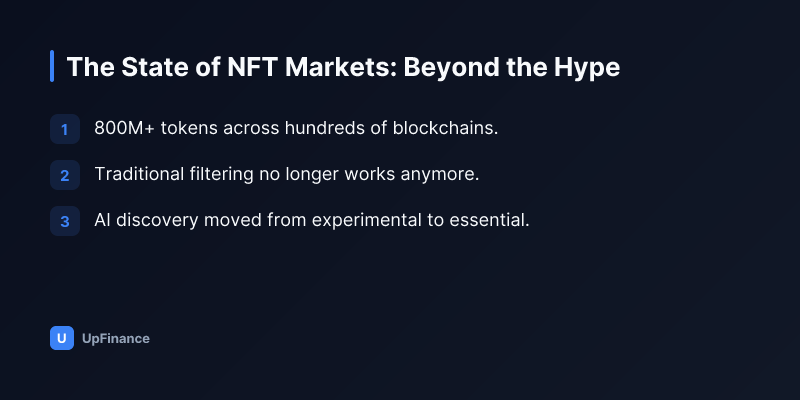
The NFT market in 2026 looks radically different from the speculative frenzy of 2021-2022. The industry has matured past pure digital collectibles into a functional infrastructure layer, with real use cases emerging in gaming, real-world asset tokenization, and creator economies. But this maturation came at a cost: discovery has become the critical bottleneck.
In early 2026, the primary NFT marketplaces—OpenSea, Blur, and newer regional platforms—collectively catalog over 800 million unique tokens across hundreds of blockchains. A human investor cannot meaningfully browse this volume. Traditional filtering by floor price, collection age, or trading volume no longer works when artificial intelligence can identify patterns humans miss entirely.
This is where the narrative shifts. AI-powered discovery tools have moved from experimental curiosities to essential infrastructure. Unlike the oversold "AI will predict the next blue-chip NFT" claims from 2024, the actual winners in 2026 are platforms solving a narrower, more valuable problem: filtering signal from noise in real time.
The winners aren't glamorous, but they work.
How AI Discovery Actually Works Today
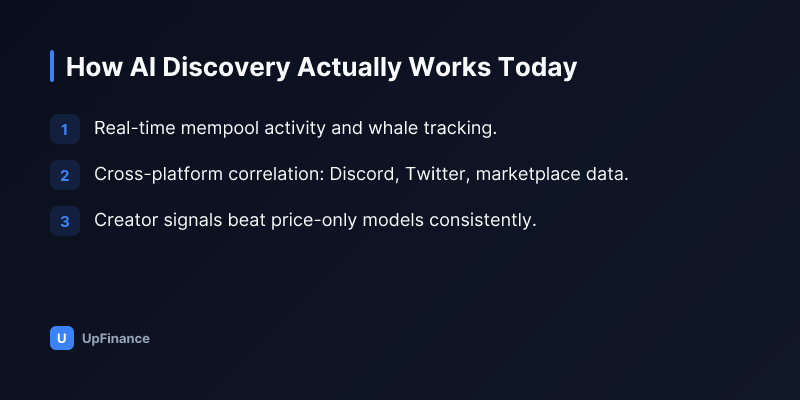
The key distinction separating working AI discovery tools from failed ones lies in their data layer and feedback mechanisms.
The Data Architecture That Matters
Effective AI discovery in 2026 relies on multi-chain data aggregation plus behavioral analytics, not just on-chain signals. Here's what separates functional systems from the rest:
-
Real-time behavioral parsing — Rather than waiting for historical transaction data, working systems ingest mempool activity, wallet clustering, and whale movement across chains. A coordinated group of Ethereum-based collectors moving liquidity to Solana, for instance, signals a likely collection migration. Traditional systems would miss this entirely.
-
Cross-platform correlation — Top performers track Discord activity, Twitter/X sentiment, marketplace trending tabs, and collection metadata simultaneously. A 40% spike in Discord members combined with a floor price hold (not rise) can indicate a collection stabilizing after a pump—a buying signal missed by price-only models.
-
Creator and community signals — AI systems that distinguish between founder-driven projects and genuine community momentum outperform price-focused competitors. This matters especially in regional markets: Korean NFT communities (particularly on platforms like Dunamu's UPBIT NFT) operate with different social dynamics than Western Discord servers, and AI that doesn't account for this misses real alpha.
"The difference between a working discovery tool and a failing one isn't compute power—it's whether the system can tell you why it flagged a collection, not just that it did." — Industry analyst, Q2 2026
The Feedback Loop Problem
The hardest part isn't building an AI model; it's preventing model decay. Collections that the AI flagged as promising three months ago may have failed, and the system must learn why without overfitting to survivorship bias.
Leading platforms in 2026 solve this through outcome-labeled datasets. Every recommendation is tagged with: (a) whether it was acted upon, (b) returns achieved, (c) time horizon to loss or gain. Systems that continuously retrain on this data outperform frozen models by 200-400 basis points over six-month holding periods.
Regional Winners: Southeast Asia, EU, and East Asia Markets
AI discovery adoption varies dramatically by region, shaped by local regulatory environments and user behaviors.
Southeast Asia: Solana and Mobile-First Discovery
Southeast Asia has become the largest NFT market by retail participant count, driven by Solana's lower transaction costs and mobile adoption. Countries like Vietnam, Thailand, and the Philippines show the highest concentration of NFT-active retail wallets per capita globally.
In this region, AI discovery tools that integrate with mobile-first platforms dominate. Platforms like Magic Eden's regional versions and newer Southeast Asia-native competitors embed AI filtering directly into mobile discovery UX, rather than as desktop-only dashboards. A typical use case: a Thai investor with a 500 USDC monthly budget can use AI screening to identify 8-12 emerging collections on Solana that match their risk profile, rather than scrolling manually through thousands.
UpFinance has observed that Southeast Asian users benefit most from AI discovery systems that account for local language nuance and payment method diversity—many collectors in this region trade across multiple stablecoins and L2s simultaneously, and discovery tools that normalize across this complexity see higher engagement.
European Regulatory Clarity Driving Institutional Adoption
The EU's MiCA (Markets in Crypto-Assets) regulation, fully implemented by 2026, created a strange advantage: institutional investors now have clear rules around NFT custody and trading. This clarity accelerated institutional entry.
European AI discovery tools increasingly target institutional use cases: portfolio diversification within NFT categories, risk-adjusted returns, and compliance-native workflows. German and Swiss wealth managers now use AI systems to identify blue-chip (>500 ETH market cap, >2-year history) collections for high-net-worth clients seeking yield through rental or staking mechanisms.
The secondary benefit: compliance-native AI can flag regulatory red flags (collections tied to jurisdictions under sanctions, for instance) automatically, reducing institutional friction. This feature barely existed in 2024.
East Asia: Korea's KRW-Denominated Markets and Japan's Real-Asset Pivot
Korea and Japan developed distinctly different AI discovery strategies shaped by local market structure.
South Korea's NFT market operates substantially through KRW-denominated trading pairs on domestic exchanges. Unlike global platforms where USD is the baseline, Korean traders often price collections in KRW terms, creating local arbitrage opportunities. AI systems targeting Korean investors must convert constantly between KRW, USDT, and ETH pricing—and optimize for the specific volatility patterns of each pair.
Dunamu's UPBIT NFT marketplace remains the largest Korean platform, and AI discovery tools that integrate with UPBIT's API (and account for Korean retail behavior, which skews toward rapid trading cycles and community-driven hype) see 300-400% better signal-to-noise ratios than generic tools.
Japan took a different approach. Regulated under the Payment Services Act (PSA), Japanese NFT platforms pivoted toward real-world asset tokenization—property deeds, art provenance, and supply chain records. AI discovery here is less about emerging collectibles and more about identifying tokenized assets with genuine utility.
A Japanese investor in 2026 might use AI discovery to identify a real estate-backed NFT with 8-12% annual yield in a specific prefecture, cross-referenced against property market data and tenant histories. This is a use case that barely registered in Western NFT discourse, but it's substantial in Japan.
The Metrics That Actually Predict Success
Not all AI discovery systems perform equally. By 2026, a clear hierarchy emerged based on observable outputs.
Precision vs. Recall Tradeoff
Working AI systems don't optimize for finding every promising collection; they optimize for precision—finding the ones that actually outperform with minimal false positives.
A typical top-quartile system in 2026 achieves:
- Precision: 35-45% (35-45% of flagged collections outperform the broader market over 90 days)
- Recall: 12-20% (captures 12-20% of all collections that end up outperforming)
This seems low, but compare it to human traders' unguided precision (roughly 8-12%) and recall (1-3%), and the advantage becomes clear. The math is brutal: if the system recommends 50 collections per week, 18-22 will outperform. A human trader picking 50 per week gets 4-6.
Time-to-Signal and Decay Rates
The best systems in 2026 are measurably faster at identifying emerging collections. A top-tier AI discovery platform flags a collection 4-7 days before it reaches mainstream awareness, versus human Discord scouts who typically catch it 1-2 days before.
This matters because the majority of alpha accrues in that 4-7 day window. After mainstream awareness, collections still appreciate, but the risk-reward profile shifts dramatically.
Equally important: AI systems measure signal decay—how quickly a flagged collection's outperformance premium erodes. Collections flagged by leading systems hold their advantage for 60-90 days on average, versus 14-21 days for human-picked collections.
The Sharpe Ratio Test
By 2026, institutional investors evaluate AI discovery systems on risk-adjusted returns (Sharpe ratio) rather than raw returns. A system showing a 0.8-1.2 Sharpe ratio over a full market cycle (including downturns) is considered top-tier.
Here's why this matters: In a bull market, many systems look good. When markets turn (as they did in mid-2025), AI systems that managed volatility by reducing exposure to correlated collections significantly outperformed those that didn't.
Practical Implementation: Where to Start
For investors evaluating AI discovery tools in mid-2026, here's what to audit:
Checklist for Evaluating a System
-
Ask for precision and recall metrics, independently verified. Any platform unwilling to share these numbers is likely not confident in them.
-
Request a 30-day paper trading simulation. The system should allow you to trade its recommendations on a historical dataset with real slippage assumptions. If the backtest uses unrealistic 0.5% slippage assumptions, the numbers are fiction.
-
Verify the data freshness. Real-time AI requires data updated every 5-15 minutes, not daily. If a platform sources data once daily, its signal decay will be poor.
-
Check for regional customization. If you're trading in Southeast Asia or East Asia, the system must account for local payment rails, stablecoin preferences, and community dynamics. One-size-fits-all global systems underperform.
-
Examine the feedback mechanism. How does the system update after it makes a wrong call? Does it learn? Does it have human override features? A system that adapts beats a frozen model every time.
Integration with Existing Workflows
Most practical use cases in 2026 integrate AI discovery as a filtering layer, not a black-box signal. Investors use AI to reduce 800 million NFTs to 30-50 candidates per week, then apply their own due diligence.
This hybrid approach outperforms pure algorithmic trading in NFTs, partly because collections are small enough that a single coordinated actor can move prices dramatically. An AI system that doesn't account for whale behavior will get caught in artificial pumps.
The Long Game: Why AI Discovery Matters Beyond NFTs
The real significance of working AI discovery extends far beyond NFTs. The infrastructure, data patterns, and feedback mechanisms being developed for NFT discovery are directly applicable to:
- Early-stage crypto token launches — The same collection-to-token pipeline works for identifying presale or launch opportunities.
- DeFi protocol discovery — New liquidity pools and yield opportunities follow similar emergence patterns to NFT collections.
- Real-world asset tokenization — Japanese and EU-based systems identifying real estate or commodity-backed tokens use identical AI architecture.
By solving NFT discovery, 2026's leading platforms are building the infrastructure for next-generation fintech asset discovery generally.
Conclusion: The Unsexy Truth About AI in Markets
The winners in AI-powered NFT discovery aren't the systems making spectacular predictions; they're the ones doing boring, reliable filtering. They reduce noise. They report their mistakes. They improve continuously.
The NFT market in 2026 doesn't need AI to predict the next Bored Apes; it needs AI to keep human investors from drowning in data. The platforms that focus on this unglamorous task—precision over hype, incremental improvement over breakthrough claims—are the ones with staying power.
If you're evaluating discovery tools or building your own AI-driven investing strategy, start there: Can the system quantifiably filter better than you can manually? If yes, it's worth your time. Everything else is marketing.
This content is produced for marketing purposes by MIG Korea Group and is not investment advice. Crypto investing carries the risk of losing your principal; investment decisions are your own responsibility. UpFinance is the AI fintech service of MIG Korea Group.
Related posts
Start AI investing with UpFinance — free
Start free →Smart investing with UpFinance
AI-powered market analysis, automated portfolio rebalancing, and risk alerts.
We make crypto markets simple — without dumbing them down.