
Whale Wallet Tracking — Reading Investment Signals from On-Chain Data
What Are Whale Wallets? Reading Signals from Major Asset Holders
In crypto markets, a "whale" refers to investors who hold and move large amounts of assets. Their trades wield enormous influence on the market, which is why retail investors work hard to track their every move.
Why whale wallet tracking matters:
- Anticipate market direction before major moves
- Analyze institutional investor intent through large capital flows
- Spot signals before sharp rallies or crashes
- Understand where the top 1% of investors are concentrated
Generally, wallets holding $10 million or more are classified as whale wallets. That said, the threshold varies by cryptocurrency, so you'll need to adjust based on context.
"Understanding whale movements is like tracking institutional investor positioning in the stock market. Know it early, and you can respond to market shifts."
How to Track Whale Wallets Using On-Chain Data
On-chain data refers to all transaction information recorded on the blockchain network. This data is completely public, so anyone can monitor whale wallet activity.
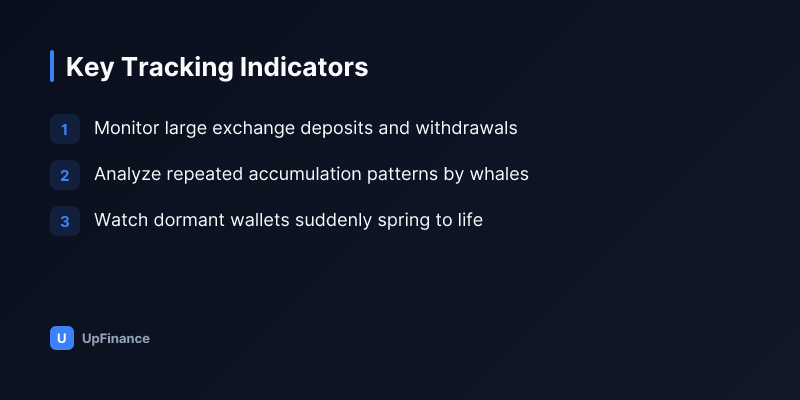
Key Tracking Indicators
1. Large Transactions Track when whales send or withdraw large amounts of crypto to and from exchanges. Deposits to exchanges signal selling intent; withdrawals suggest long-term holding.
2. Whale Accumulation Patterns Analyze when the same wallet repeatedly buys a specific asset—this reveals which assets are attracting whale interest.
3. Address Activity When a dormant whale wallet suddenly becomes active, it's often a signal of market change ahead.
4. HODL Waves Track when coins purchased long ago are sold. This reveals market psychology and price outlook.
How to Apply This to Real Investing
When using whale wallet data to inform actual investment decisions, careful judgment is essential.
Interpreting Investment Signals
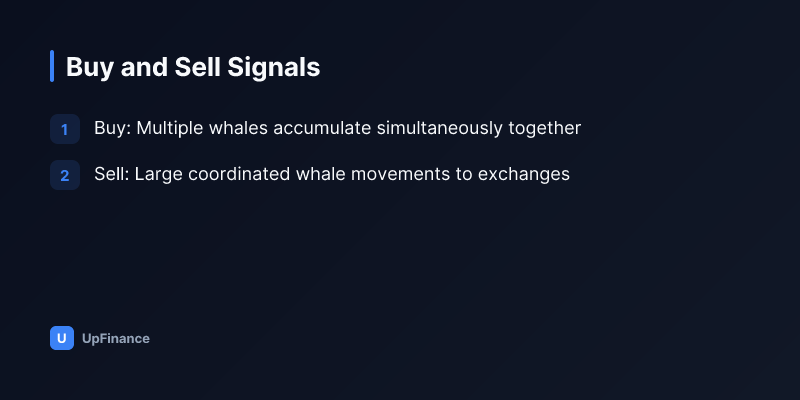
Potential Buy Signals:
- Multiple whale wallets accumulate the same coin simultaneously
- Large institutional-grade wallets are in accumulation mode
- Exchange inflows decline while personal wallet holdings rise
- Dormant whale wallets suddenly wake up and move
Potential Sell Signals:
- Whales send large volumes to exchanges
- Major withdrawals occur in profit-taking zones
- One-time massive selling pressure appears
- Multiple whales sell in coordinated fashion
Track More Easily with UpFinance
Direct blockchain analysis is complex. AI fintech platforms like UpFinance parse complex on-chain data and convert it into actionable investment signals. Automated analysis lets you monitor whale movements in real-time.
Cautions When Tracking Whales
Relying on data alone is risky. Whale wallet tracking is just one input to your decision-making process—never your sole criterion.
Key considerations:
- Check Overall Market Trends — Whale moves may contradict broader market direction
- Conduct Fundamental Analysis — Review tech upgrades, regulation, news, and other factors
- Maintain Time Frame Consistency — Distinguish between short-term noise and long-term trends
- Synthesize Multiple Whale Actions — Don't bet on one or two whales alone
- Spot False Signals — Separate market manipulation from genuine intent
"Whale wallet tracking is a market-reading tool, not a reliable prediction model. Always synthesize multiple analyses and stick to your investment principles."
On-Chain Data Analysis Platforms
Several platforms let you track whale wallets:
- Etherscan — Ethereum transaction and address analysis
- Blockchain.com — Bitcoin network analysis
- Glassnode — Advanced on-chain analytics and indicators
- CryptoQuant — Exchange inflow/outflow data
- Nansen — AI-powered advanced analytics
Many of these offer free versions, so choose the tool that fits your needs.
Conclusion: Use Information Edge, but Stay Cautious
Whale wallet tracking has become a critical skill for modern crypto investors. By understanding large capital flows through on-chain data, you can respond to market shifts faster.
But remember: this is supplementary information only. Whales make mistakes too, and markets remain full of unpredictable variables. So:
- Use multiple analysis tools together
- Include fundamental and technical analysis
- Don't let emotion dictate your moves
- Define clear investment goals and plans
- Invest only what you can afford to lose
Apply these core principles alongside whale wallet data, and you'll make more informed investment decisions. Automated analysis from platforms like UpFinance can be a valuable supporting tool.
This content is produced for marketing purposes by MIG Korea Group and is not investment advice. Crypto investing carries the risk of losing your principal; investment decisions are your own responsibility. UpFinance is the AI fintech service of MIG Korea Group.
Related posts
Start AI investing with UpFinance — free
Start free →Smart investing with UpFinance
AI-powered market analysis, automated portfolio rebalancing, and risk alerts.
We make crypto markets simple — without dumbing them down.