
AI Portfolio Rebalancing — Maintain Optimal Asset Allocation Automatically
A few months into investing, you check your portfolio and realize one asset has skyrocketed while another has cratered. Your carefully planned 50:50 allocation is now 70:30. What do you do? The answer is rebalancing—selling a portion of your top performers and buying the underperformers. But doing this manually every time is time-consuming and emotionally draining. Enter AI-powered dynamic rebalancing services. Let's explore how they solve this problem.
What Is Portfolio Rebalancing?
Portfolio rebalancing is the process of periodically adjusting your portfolio to maintain your target asset allocation. For example, if you started with Bitcoin 50%, Ethereum 30%, and stablecoins 20%, market movements will shift these percentages. Rebalancing means restoring those original targets.
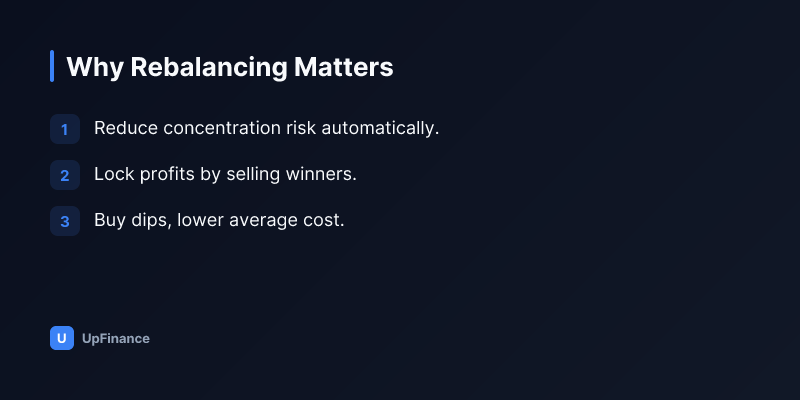
Why Rebalancing Matters
Novice investors often make a critical mistake: they chase winners, letting a single outperforming asset grow to an unhealthy size in their portfolio. It's like winning at a casino and going all-in on the same bet repeatedly.
The core benefits of rebalancing are:
- Risk Diversification: Reduce concentration in a single asset and lower overall portfolio volatility
- Rules-Based Investing: Stay disciplined by following a predetermined strategy instead of emotions
- Profit Locking: Automatically realize gains by selling portions of winners
- Downside Protection: Buy dips and lower your average cost basis
Successful investors share one common practice: systematic rebalancing. When you trade by rules instead of feelings, your long-term returns become far more stable.
How AI Automatic Rebalancing Works
AI-powered automatic rebalancing is a technology where machine learning algorithms analyze market data in real time and adjust your portfolio without human intervention. Platforms like UpFinance already offer this capability.
The Workflow
Here's how rebalancing happens step-by-step:
- Current State Analysis: AI calculates your portfolio's asset ratios
- Target Comparison: Compares against your predefined allocation targets
- Deviation Detection: Flags if any asset drifts beyond your threshold (e.g., more than 5% off-target)
- Auto Order Generation: Automatically creates buy/sell orders as needed
- Execution & Logging: Executes trades and records the results
Why AI Beats Simple Automation
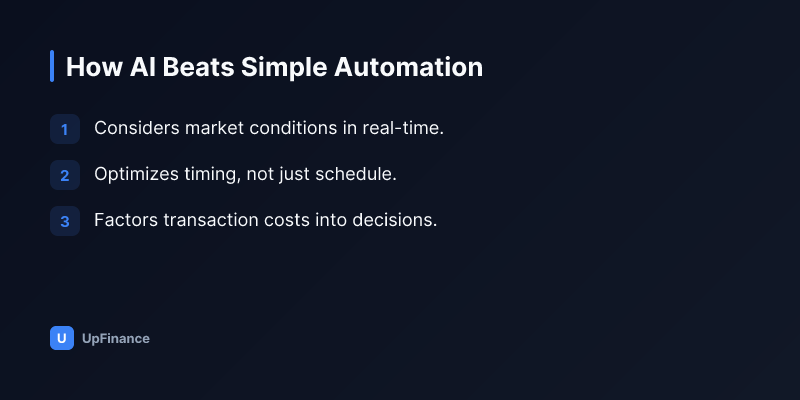
Basic automation rebalances on a fixed schedule (e.g., the 1st of every month), mechanically and without nuance. AI rebalancing, by contrast, factors in market conditions, volatility, and transaction costs to move at the optimal moment.
For example:
- Simple automation: "Rebalance on the 1st of every month, no matter what"
- AI rebalancing: "If volatility is high, wait a few days to save on fees. If an asset is oversold, buy more aggressively"
Real Advantages of AI Portfolio Rebalancing
1. Time Savings
Manual rebalancing requires checking prices, calculating ratios, placing orders, and confirming trades—easily 15–30 minutes of work. AI handles all of this in seconds. In a busy life, that's a massive difference.
2. Emotion Elimination
Your real enemy isn't the market—it's your own psychology. AI has no feelings, so it will cut losses when they're painful and lock in gains when you'd rather hold. This consistency drives long-term returns.
3. Cost Minimization
AI accounts for fees, slippage (the gap between expected and actual execution prices), and market impact. If you earn the same return but pay fewer costs, you pocket more profit.
4. 24/7 Monitoring
Markets never sleep. Crypto moves while you sleep. AI never stops watching your portfolio and rebalances instantly when conditions warrant.
5. Data-Driven Decisions
AI analyzes thousands of signals simultaneously—historical patterns, trend data, volatility indices—and makes decisions at a level humans simply cannot match.
Real-World Example
Suppose you start with a portfolio split across Bitcoin 60%, Ethereum 30%, and USDC 10%. Your initial investment is 10 million won.
- Bitcoin: 6 million won
- Ethereum: 3 million won
- USDC: 1 million won
Three months pass. Bitcoin rises 40%; Ethereum falls 15%.
- Bitcoin: 8.4 million won (73% of portfolio)
- Ethereum: 2.55 million won (18% of portfolio)
- USDC: 1 million won (9% of portfolio)
You're significantly off-target. Manually, you'd need to sell some Bitcoin and buy Ethereum. An AI rebalancing service detects this automatically and executes a trade: sell approximately 1.1 million won of Bitcoin, buy more Ethereum.
Result:
- Bitcoin: 7.3 million won (60%)
- Ethereum: 3.65 million won (30%)
- USDC: 1 million won (10%)
Back to your target. And you didn't lift a finger.
Choosing an AI Rebalancing Service
Not all AI rebalancing platforms are created equal. When evaluating, look for:
- Asset Coverage: Does it support only major coins or your preferred altcoins too?
- Customizable Frequency: Can you adjust rebalancing intervals, or is it locked to a fixed schedule?
- Fee Structure: Is it per-trade, subscription-based, or percentage-based?
- Backtesting: Can you test your strategy against historical data?
- User Experience: Can you get started without wrestling with complex configurations?
When using a platform like UpFinance, weigh all these factors carefully.
Important Caveats
AI rebalancing isn't magic. Know these risks and limitations.
- Extreme Market Events: Flash crashes can move faster than any algorithm can respond
- Low Liquidity: Small altcoins may lack the trading volume to execute orders at your target price
- Fee Creep: Frequent rebalancing can accumulate costs that eat into your gains
- Overfitting Risk: Strategies optimized for past data don't always work in future markets
No matter how advanced the technology, the fundamentals of investing remain constant. Avoid strategies you don't understand, and always verify that your approach aligns with your risk tolerance and goals.
Final Thoughts
AI portfolio rebalancing is a powerful tool for modern investors. It removes emotion, saves time, and executes at optimal moments. It's especially valuable for those managing multiple assets or busy professionals who can't monitor markets constantly.
The future of investing isn't just "which assets to buy"—it's "how to manage them intelligently." AI is making portfolio management smarter and more efficient. Is your portfolio ready to benefit from it?
This content is produced for marketing purposes by MIG Korea Group and is not investment advice. Crypto investing carries the risk of losing your principal; investment decisions are your own responsibility. UpFinance is the AI fintech service of MIG Korea Group.
Related posts
Start AI investing with UpFinance — free
Start free →Smart investing with UpFinance
AI-powered market analysis, automated portfolio rebalancing, and risk alerts.
We make crypto markets simple — without dumbing them down.