
How to Read AI Investment Signals — Beginner's Guide
What Are AI Investment Signals?
AI investment signals are buy/sell recommendations generated when artificial intelligence analyzes big data. Unlike traditional analysts who read charts and news reports, AI processes millions of data points simultaneously to identify patterns.
As fintech services have grown, these signals are now accessible to everyday investors. Platforms like UpFinance provide AI-powered analysis signals. But blindly following every signal you receive is risky.
Three Core Elements of AI Signals
- Data sources: Market prices, trading volume, news sentiment, social media trends, on-chain data, and more
- Analysis algorithms: Machine learning, deep learning, statistical models, and various other approaches
- Signal types: Buy/sell/hold signals with specific allocation percentages
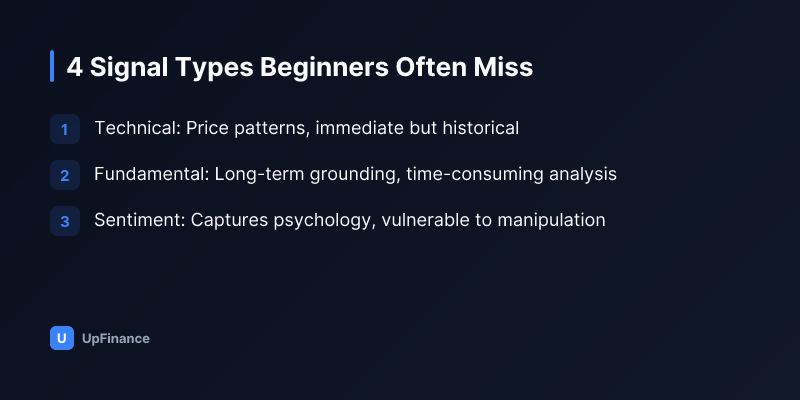
4 Signal Types That Beginners Often Miss
Investment signals come in different varieties. Identifying which type you're looking at is the first step.
1. Technical Analysis Signals
Based on price chart patterns, moving averages, RSI (Relative Strength Index), and similar indicators.
- Pros: Intuitive and immediate
- Cons: Relies on historical data; vulnerable to sudden market swings
- Best for: Short-term trading
2. Fundamental Signals
Evaluates project technology, team composition, partnerships, and ecosystem growth.
- Pros: Provides grounding for long-term investment
- Cons: Time-consuming analysis
- Best for: Medium to long-term investing
3. Sentiment Signals
Real-time analysis of public opinion from news, social media, and communities.
- Pros: Quickly captures market psychology
- Cons: Susceptible to misinformation and manipulated narratives
- Best for: Predicting market inflection points
4. On-Chain Signals
Analyzes actual blockchain transaction data, wallet movements, and large trades.
- Pros: Most objective and transparent data
- Cons: Can be complex to interpret
- Best for: Leading indicator of price movements
How Accurate Are AI Signals?
To be honest, no signal is 100% accurate. So how do you judge signal reliability?
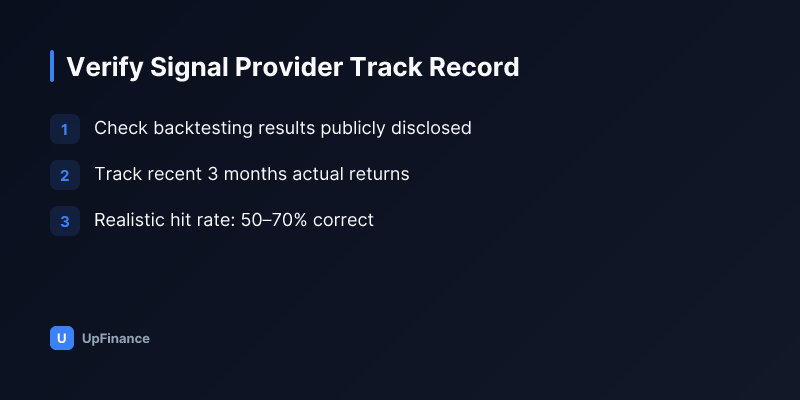
How to Verify a Signal Provider's Track Record
- Check backtesting results: Are past performance results publicly disclosed?
- Track recent 3 months of signals: Did they actually generate returns?
- Verify hit rate: What percentage of signals were correct? (50–70% is realistic)
- Review risk management: How does the system limit losses when wrong?
"AI signals are probabilistic tools, not prophecies. A 70% win rate means you'll take losses on 3 out of 10 trades."
Factors Affecting Signal Accuracy
- Market volatility: Higher volatility → lower accuracy
- Algorithm age: Newer algorithms tend to perform better
- Data quality: More and cleaner data = higher reliability
- Market cycle: Signal characteristics differ in bull and bear markets
5-Step Method for Actually Using Signals
Step 1: Validate the Signal Source
First, confirm the platform is trustworthy.
- How long has it been operating?
- Does it transparently share performance metrics?
- Is personal data protection adequate?
- Is it a legitimate fintech service like UpFinance?
Step 2: Understand the Signal's Logic and Origin
Never trust a signal you don't understand.
- What data did the AI analyze?
- Is it technical analysis, fundamental analysis, or sentiment?
- Is a confidence score (%) displayed?
Step 3: Use Signals as Part of Your Portfolio
Never invest your entire net worth based on a single signal.
- Start with 5–10% of total assets
- Combine multiple signals
- Diversify across different investments
Step 4: Plan Your Exit Targets and Stop-Loss Levels
What you do after receiving a signal matters most.
- If you get a buy signal, what's your profit target (%)?
- When will you cut losses? (at what loss %?)
- Will you take partial profits off the table?
Step 5: Review Signal Performance Regularly
Track signal accuracy at least monthly.
- How many signals from last month were correct?
- Actual returns vs. expected returns?
- Is the signal worth continuing to follow?
5 Common Mistakes When Using AI Signals
Avoid these pitfalls that trip up beginner investors.
- Overconfidence: Treating signals as certain predictions
- Overtrading: Following every minor signal and wasting on fees
- Ignoring emotions: Letting fear or greed override a signal's recommendation
- Entering without a plan: Buying without preset target and stop-loss levels
- Judging too quickly: Evaluating signal quality after just one week
Additional Indicators to Watch Alongside AI Signals
Signals alone aren't enough. Always confirm these factors:
- Overall market trend: Bull market or bear market?
- Macro news: Interest rate hikes, regulatory announcements
- Competing projects: How are similar coins in the same sector performing?
- Your financial situation: Can you afford to lose this amount?
Final Checklist for Beginners
Review this before acting on any signal.
- Have you verified the signal provider's credibility?
- Do you understand the reasoning behind the signal?
- Have you limited the amount of capital at risk?
- Have you preset your profit target and stop-loss?
- Do you accept the possibility of losing your principal?
- Do you have a plan to track performance regularly?
This content is produced for marketing purposes by MIG Korea Group and is not investment advice. Crypto investing carries the risk of losing your principal; investment decisions are your own responsibility. UpFinance is the AI fintech service of MIG Korea Group.
Related posts
Start AI investing with UpFinance — free
Start free →Smart investing with UpFinance
AI-powered market analysis, automated portfolio rebalancing, and risk alerts.
We make crypto markets simple — without dumbing them down.