
Korean Won-Bitcoin Premium: What the Kimchi Premium Tells Global Markets
What Is the Kimchi Premium and Why Should You Care?
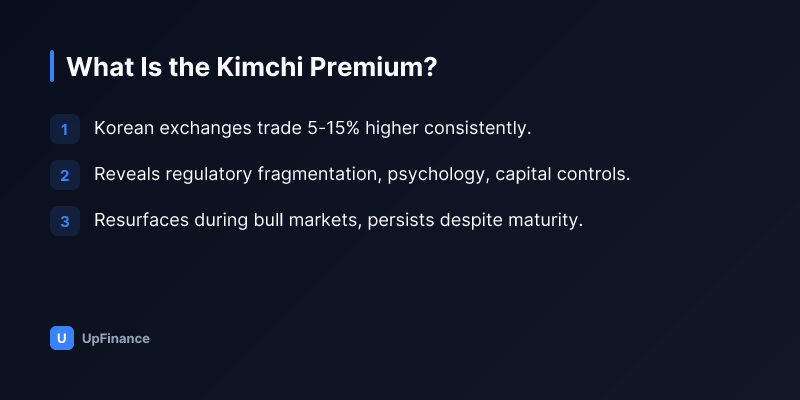
The "Kimchi Premium" is one of crypto's most durable and least understood phenomena. It describes the persistent price difference between Bitcoin (and other cryptocurrencies) on Korean exchanges and their prices on global venues like Coinbase or Kraken. Most often, Korean exchanges trade at a premium — sometimes 5-15% higher than Western exchanges — even though cryptocurrencies are supposed to be fungible, borderless assets.
For a global investor, the Kimchi Premium matters because it signals something deeper than simple market friction. It reveals how regulatory fragmentation, retail psychology, and capital controls create pockets of genuine inefficiency in what many believe to be an increasingly mature market. If you're building an AI-driven portfolio or trying to understand where real alpha might hide in crypto, understanding Korean market dynamics is no longer optional.
The premium has existed on and off for nearly a decade, but it resurfaces during bull markets when retail participation spikes. In January 2021, Korean exchanges traded Bitcoin at up to 30% premiums. By 2024-2026, as Korean fintech matured and institutional players entered, the gap narrowed — but never disappeared. This persistence tells us that Korean markets operate under constraints that Western markets don't, and that tells us something about global market structure itself.
The Regulatory Cage: Why Korean Exchanges Are Isolated
To understand the Kimchi Premium, you first need to understand South Korea's regulatory approach to crypto. Unlike the US or EU, which have been gradually developing frameworks, Korea has oscillated between openness and protectionism — and right now, it leans toward controlled access.
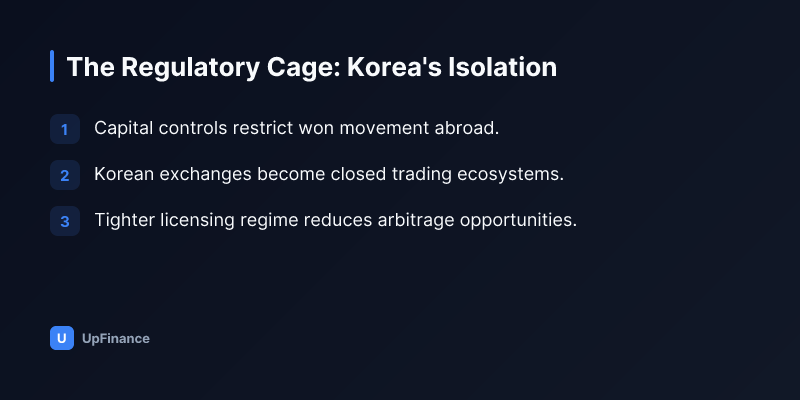
South Korean residents cannot easily move won off the island. This is not a crypto rule; it's a capital control rule that predates blockchain by decades. The Foreign Exchange Transaction Act (FETA) restricts how much currency Koreans can move abroad without documentation and reporting. For crypto, this creates a structural problem:
- A Korean investor wanting to buy Bitcoin on Kraken faces a two-step problem: converting won to USD (or EUR), then moving that USD abroad. Both steps trigger regulatory scrutiny.
- Conversely, a global investor wanting to cash out won on a Korean exchange faces the reverse: move dollars into Korea, convert to won, then withdraw — each step monitored.
The result: Korean exchanges become closed ecosystems. Demand inside is relatively trapped, arbitrage is blocked, and prices diverge.
Additionally, Korea's regulatory framework around exchanges has tightened significantly since 2021. The Cryptocurrency and Digital Assets Act (passed in 2023-2024) created a licensing regime that only a handful of exchanges could meet. This reduced competition inside Korea, further insulating Korean prices from global benchmarks. An investor using Upbit or Bithumb — Korea's two largest exchanges — has fewer easy exit ramps than someone on Coinbase.
"The Kimchi Premium exists because Korea has built the world's most sophisticated fintech infrastructure while simultaneously maintaining the world's strictest capital controls. It's a paradox that generates returns." — Industry analyst, Seoul Blockchain Forum, 2025
How Retail Psychology Amplifies the Premium
Regulatory friction explains why the Kimchi Premium can exist, but it doesn't explain why it does exist so persistently. For that, you need to understand Korean retail investor behavior.
South Korea has the highest retail participation rate in crypto globally — estimates suggest 30-40% of adult Koreans have held crypto at some point. This is a country where StarCraft tournaments are televised, where mobile gaming companies are household names, and where day-trading is treated as a legitimate career path. Crypto is not niche in Korea; it's mainstream consumer finance.
When Bitcoin rises, Korean retail investors FOMO in aggressively. This demand is trapped inside Korean exchanges because of capital controls. Korean exchanges then experience price spikes — a 10% global rally becomes a 15% rally on Upbit. Simultaneously, arbitrage traders who could theoretically bring prices in line face:
- Transaction costs (spreads, withdrawal fees on Korean exchanges can be 0.5-2%)
- Speed friction (converting won to stablecoin, transferring off-exchange, converting back takes hours)
- Tax uncertainty (Korea taxes capital gains but enforcement has been inconsistent; arbitrageurs don't want to trigger reporting)
The premium therefore reflects the cost of eliminating the premium. If you can't easily move money across the boundary, and if the cost of doing so exceeds 5%, then a 5% premium is rational and stable.
What makes this interesting for global investors is the timing signal. When the Kimchi Premium spikes, it often signals that Korean retail has entered a euphoric phase. This has historically preceded Korean market corrections by weeks or months. In other words, the premium is not just a friction artifact — it's a behavioral indicator that can inform global macro positioning.
The Premium as a Market Efficiency Signal
From a market microstructure perspective, the Kimchi Premium is fascinating because it challenges efficient market assumptions. In a perfectly efficient market, a 5-10% price gap should attract capital flows until the gap closes. The fact that it doesn't — year after year — suggests that markets are locally efficient but globally fragmented.
This matters for portfolio construction. If you're using an AI algorithm that assumes global crypto prices converge, you're leaving money on the table if you don't account for regional variance. Consider:
-
Funding rate arbitrage in perpetual futures: Korean exchanges have separate perpetual futures markets with their own funding rates. During premium spikes, Korean funding rates often diverge significantly from global venues, creating opportunities for AI-driven traders who can execute simultaneously on multiple exchanges.
-
Stablecoin demand patterns: The Kimchi Premium often correlates with demand for Tether (USDT) and USDC on Korean exchanges. When premiums widen, Korean investors buy stablecoins at a premium to lock in value. This creates volume imbalances in stablecoin pairs that precede broader market moves.
-
Volatility smile across regions: Korean markets historically show higher volatility than global indices during premium events. An AI model trained on global data will systematically underestimate volatility in Korean-denominated crypto portfolios.
The key insight: Markets are not one market. They're connected networks with friction points. UpFinance's approach to AI investing explicitly models these regional dynamics rather than treating crypto as a monolithic global asset class. Traders and institutions that overlay regional market structure on their AI models consistently outperform those that treat prices as globally synchronous.
When Does the Kimchi Premium Signal Real Opportunities?
The Kimchi Premium isn't consistent; it expands and contracts. Understanding when and why helps you position ahead of moves.
Premium typically widens when:
-
Bull markets hit Korean retail. Q4 2020, Q1 2021, Q4 2024 — these periods saw both Bitcoin rallies and expanded premiums. The mechanism is simple: retail demand outpaces capital controls. Global prices rise 20%, Korean prices rise 25% because fresh retail money is trapped inside.
-
Stablecoin inflows accelerate. Korean exchanges rely heavily on USDT and USDC for dollar exposure. During periods when these stablecoins become scarce or expensive on Korean exchanges, the premium for on-chain assets widens as investors bid up alternatives.
-
Regulatory announcements create uncertainty. Paradoxically, Korean regulatory tightening sometimes widens the premium temporarily as investors rush to secure coins on trusted domestic exchanges rather than trust withdrawal to foreign venues.
Premium typically narrows when:
-
Institutions enter Korean markets. Asset managers with compliance teams can navigate capital controls better. As institutional flows increased in 2023-2025, premiums narrowed sustainably.
-
Global volatility rises. When all markets are uncertain, regional friction matters less. Flight-to-safety dynamics dominate, and correlation rises.
-
Crypto bear markets. During downturns, retail FOMO reverses into panic selling. The premium can invert — Korean prices fall through global benchmarks. This happened briefly in late 2022.
Quantifying the Opportunity
Here's a concrete example from 2024-2025:
- Global BTC price: $42,000 (Coinbase)
- Upbit (Korean) price: $43,800
- Premium: 4.3%
An arbitrageur who:
- Buys 1 BTC on Coinbase for $42,000
- Transfers globally (assuming 2 hours, no slippage on 1 BTC)
- Lists on Upbit (through a Korean account or partner)
- Sells for $43,800
Nets: $1,800 gross, minus ~$300 in transfer fees and slippage = $1,500 gain, or 3.6%. For a professional trader, this is low-friction alpha. For retail, it's inaccessible (requires offshore arbitrage infrastructure). This is why institutions have quietly been building Korean exchange connectivity.
Capital Controls and Why They Persist
You might ask: Why hasn't Korea simply eliminated capital controls? The answer reveals something about Korean policy that's useful context.
South Korea maintains capital controls primarily for macroeconomic and national security reasons, not crypto-specific ones. The rules date to the 1960s, when Korea needed to defend against capital flight during development. While the economy is now advanced, policymakers worry about:
- Sudden outflows during geopolitical crises (North Korea tensions, economic shocks)
- Property market stability (Korea is terrified of housing bubble collapse; capital controls help contain domestic real estate demand)
- Corporate tax collection (if capital flows freely, high earners can hide money offshore)
Crypto hasn't changed these concerns; it's just made them more visible. Every time a major crypto bull run hits Korea, regulators see capital flight as a risk and tighten inbound/outbound rules. This is why Korean fintech has paradoxically advanced in isolation — Korea built world-class crypto infrastructure (exchanges, wallets, derivatives) while treating the asset class as suspect. The result: The world's most sophisticated closed market.
What the Kimchi Premium Tells Us About Future Market Structure
The Kimchi Premium is not a relic; it's a preview of fragmented global finance. As more countries regulate crypto differently, we'll see premiums emerge in other regions too:
- Japanese yen premiums are already visible (Japan allows crypto trading but restricts exchange leverage differently than Western venues)
- Brazilian real and Mexican peso premiums exist in lesser form
- Emerging market premiums will likely widen as more countries implement capital controls or establish domestic licensing regimes
For investors, this means global crypto strategies in 2026 and beyond require regional models. You can't just buy Bitcoin globally; you need to model:
- Which regions have capital controls?
- Which exchanges are licensed vs. unlicensed in each region?
- Where are retail flows concentrated?
- Which pairs have funding rate divergence?
UpFinance's AI investing approach explicitly incorporates these variables. Rather than treating Bitcoin as BTC/USD, we model it as BTC/KRW, BTC/JPY, BTC/BRL, etc., each with its own microstructure dynamics. This regional granularity is becoming the edge in crypto portfolio management.
Key Takeaways
The Kimchi Premium teaches several lessons:
-
Markets are fragmented by regulation and capital controls, not just by technology. Even in 2026, you cannot assume global price convergence.
-
Retail behavior is local and powerful. Korean retail drives outsized volume and volatility in Korean markets, creating exploitable patterns.
-
Premiums reflect real constraints, not inefficiency. A 5-10% premium is the equilibrium price of regulatory friction. This is stable and structural.
-
Timing matters. Premium expansion/contraction signals broader market regime shifts, especially in risk appetite.
-
Opportunities exist at the margins. Arbitrage, funding rate convergence, and volatility trading benefit traders who understand regional market structure.
The Kimchi Premium won't disappear until Korea eliminates capital controls or crypto becomes so globally regulated that regional frictions vanish. Neither is happening soon. For the next 5-10 years, the premium will remain a defining feature of global crypto markets — and a signal of where smart money is flowing.
This content is produced for marketing purposes by MIG Korea Group and is not investment advice. Crypto investing carries the risk of losing your principal; investment decisions are your own responsibility. UpFinance is the AI fintech service of MIG Korea Group.
Related posts
Start AI investing with UpFinance — free
Start free →Smart investing with UpFinance
AI-powered market analysis, automated portfolio rebalancing, and risk alerts.
We make crypto markets simple — without dumbing them down.