
Japan's Web3 Strategy: Inside Tokyo's Push to Become a Crypto Hub
Japan's Quiet Comeback in Crypto
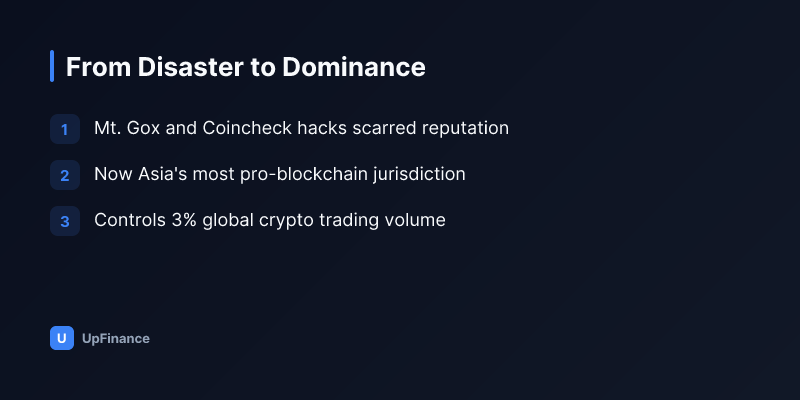
For years, Japan was synonymous with cryptocurrency disaster. The 2014 Mt. Gox collapse and the 2018 Coincheck hack left deep scars on the nation's crypto reputation. But something unexpected happened over the past 18 months: Tokyo transformed from crypto cautionary tale into one of Asia's most aggressively pro-blockchain jurisdictions.
Unlike Singapore's highly publicized crypto strategy or Dubai's flashy Web3 ambitions, Japan's pivot has been methodical and understated—exactly how the Japanese bureaucracy operates. Yet the implications are massive. Japan controls roughly 3 percent of global crypto trading volume and commands significant JPY liquidity pools. If Tokyo becomes the institutional gateway to Asian digital assets, the downstream effects could reshape how Western capital flows into crypto markets.
The catalyst wasn't a single policy shift. Instead, it was a convergence of three forces: a new regulatory framework explicitly allowing crypto businesses, institutional appetite for yield in a zero-interest environment, and generational pressure from Japan's tech-forward startups. Understanding this moment matters for anyone with exposure to Asian fintech, because Japan's regulatory clarity often cascades into Southeast Asia's playbook.
The New Legal Architecture: What Changed
In 2024-2025, Japan's Financial Services Agency (FSA) overhauled its approach to cryptocurrency regulation through amendments to the Payment Services Act (PSA) and the Investment Management Act. The changes were subtle in language but seismic in intent.
Key regulatory shifts include:
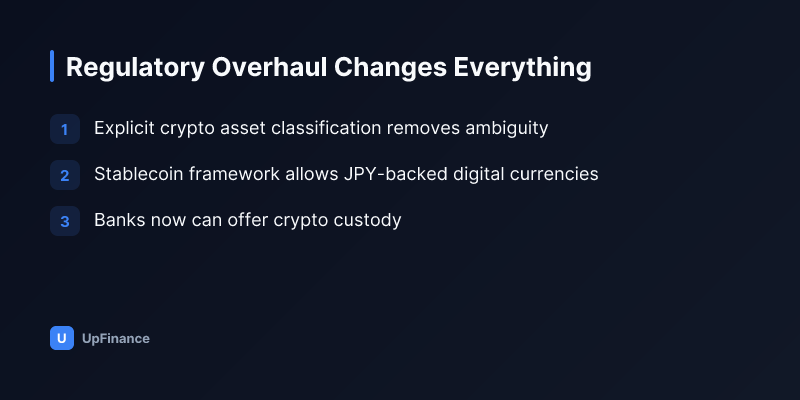
- Explicit crypto asset classification – Cryptocurrencies are now legally defined as assets (not just payment tokens), removing ambiguity that had paralyzed institutional participation
- Stablecoin framework – Japan now allows domestically-issued stablecoins with reserve requirements and issuer licensing, creating a sandbox for JPY-backed digital currencies
- Decentralized finance (DeFi) carve-out – Unlike the EU's MiCA, which treats all DeFi protocols as financial services, Japan's framework distinguishes between protocol development (unregulated) and commercial DeFi services (regulated)
- Custody and cold storage standards – The FSA published concrete technical standards for institutional-grade asset custody, borrowed partly from Switzerland's Finma guidelines
The last point matters more than it sounds. Japanese banks had been blocked from offering crypto custody because no regulatory pathway existed. Now, with published cold storage standards and insurance requirements, Mitsubishi UFJ Financial Group and MUFG Bank have quietly begun building crypto infrastructure. This is the equivalent of JPMorgan suddenly offering Bitcoin custody—incremental, but symbolically enormous.
"Japan's regulatory approach is neither innovation-first nor restriction-first. It's stability-first." — A senior FSA official quoted in a Reuters follow-up, accurately capturing Tokyo's middle path versus Asia's extremes.
The Institutional Awakening
Regulatory permission alone doesn't create a crypto hub. Capital has to show up. And in Japan, it finally is.
The economic context is crucial here: Japan's real interest rates remain deeply negative. The Bank of Japan kept policy rates near zero even as the Fed hiked to 5.5 percent, creating a 500+ basis point spread. For Japanese institutional investors—pension funds, insurance companies, family offices—this is catastrophic. A 100 billion yen allocation earning 0.1 percent yields 100 million yen annually. The same capital in US Treasuries yields over 500 million yen.
Crypto yields—especially staking rewards, liquidity provision, and institutional lending—suddenly looked less like speculation and more like rational portfolio allocation.
Institutional adoption markers in Japan include:
- Nomura (Japan's largest brokerage) launched a crypto trading desk for institutional clients in Q1 2025
- Sony Group announced a venture fund specifically for blockchain gaming and metaverse projects
- Japan's Government Pension Investment Fund (GPIF), which manages roughly 1.6 trillion USD in assets, began pilot programs with Bitcoin and Ethereum exposure through third-party managers
- Over-the-counter (OTC) desks at Japanese banks now quote crypto prices to clients—previously forbidden
What makes this different from a typical bull market? These aren't retail day traders on Coinbase. These are asset allocators making long-term rebalancing decisions. The average ticket size is tens of millions of dollars, not thousands.
The Yen Factor: Why JPY Liquidity Matters
Most English-language crypto commentary treats stablecoin liquidity as a technical detail. For Asia investors, it's existential.
Here's why: The yen is the fourth-most-traded currency globally, but its on-chain representation has been abysmal. USDC, USDT, and USDC dominate on-chain stablecoin pools, meaning traders face friction costs when moving between JPY banking rails and crypto markets. That friction translates directly to slippage, arbitrage spreads, and lower capital efficiency.
Japan's new stablecoin framework explicitly permits domestically-issued JPY stablecoins with 100 percent reserve backing. This sounds regulatory—it is—but it's also a market opportunity. A JPY stablecoin with genuine regulatory approval could become the gateway for intra-Asia trades.
Consider this scenario: A Korean investor wants to move capital to Thai markets. Traditionally, they'd convert KRW to USDT, transfer on-chain, convert USDT to THB, and cross three different exchange spreads. If a JPY stablecoin existed with deep liquidity, they could route through Tokyo, cutting spreads by 20-40 basis points on large trades.
Sora, Japan's first approved JPY stablecoin (issued by Japanese cryptoasset exchange Coinbase subsidiary SBI VC Trade), launched in limited form in early 2025. It's not yet widely traded, but its very existence signals that Tokyo is building infrastructure for something larger: a JPY-denominated on-chain ecosystem that could rival Singapore's USDT infrastructure.
The Startup Ecosystem: Where Innovation Meets Tradition
If you've never looked at Japan's crypto startup scene, the gap between its quality and its global visibility is striking.
Companies like Astar Network (a smart contract platform backed by Polkadot), Oasys (gaming blockchain), and LayerZero Labs' Japanese partners have been building quietly for years without the hype that follows every Singapore or Dubai announcement. Why? Partially because Japanese founders are culturally risk-averse about marketing. Partially because the regulatory uncertainty made fundraising impossible until recently.
The new FSA framework removes both constraints. Suddenly, a Tokyo-based crypto founder can raise from Japanese VCs without worrying that regulators will shut down operations mid-Series B.
Key startup tailwinds include:
- Government support: The Tokyo Metropolitan Government allocated 100 million yen (roughly 680,000 USD) to subsidize Web3 startups in 2024-2025
- Venture capital: Japanese VCs like Dragonfly Capital and Hashed increased their Tokyo presence specifically to capitalize on the regulatory opening
- Talent repatriation: Japanese engineers who worked at Ethereum Foundation, Consensys, and Polychain Capital are returning to Tokyo to build companies
- Gaming focus: Japan dominates mobile gaming revenue globally; combining this with blockchain creates natural defensibility (see Axie Infinity's success with Japanese players)
The startup angle matters for global investors because it's easier to find asymmetric return opportunities in early-stage Japanese Web3 companies than in saturated Singapore fintech. If you're an accredited investor managing an Asia tech fund, Japanese blockchain startups are still arbitrage-priced.
Comparing Tokyo's Path to Singapore and Hong Kong
Japan's crypto strategy differs fundamentally from its regional competitors, and understanding these differences is essential for positioning capital.
Singapore's approach: Fortress regulation with light licensing. The Monetary Authority of Singapore (MAS) issues individual payment institution licenses to each crypto exchange and custodian, creating scarcity and high barriers to entry. Result: Binance, Crypto.com, and other tier-1 exchanges got Singapore licenses early. Entry cost for new entrants is prohibitive. Strategy outcome: Singapore became a hub for crypto trading volume, but not innovation.
Hong Kong's approach: Political oscillation. After 2019, Hong Kong became increasingly restrictive, then loosened slightly in 2023-2024 with spot Bitcoin and Ethereum ETF approvals. But the regulatory uncertainty remains—the SFC (Securities and Futures Commission) still treats DeFi as quasi-illegal. Result: Hong Kong attracted institutional capital but repelled developers.
Japan's approach: Explicit framework with room for experimentation. The FSA created legal categories for stablecoins, custody, and exchanges—but didn't try to regulate every possible crypto use case. The DeFi carve-out is especially important because it signals that protocol developers can experiment without licensing.
For investors, this means:
- Singapore is for trading capital and market-making—deep liquidity, tight spreads, no surprises
- Hong Kong is for institutional wealth—custody, compliance, regulatory certainty, but limited upside
- Japan is for venture and protocol exposure—higher risk, higher optionality, earlier entry to emerging trends
Practical Implications for Global Investors
How does any of this affect your portfolio?
If you're managing Asia-focused fintech exposure: Japanese blockchain startups are earlier in the venture cycle than Singapore equivalents. This means higher volatility but potentially 5-10x returns if the regulatory tailwind continues. UpFinance's coverage of Asian fintech trends can help identify promising Japanese Web3 teams before they hit mainstream attention.
If you're running a prop trading desk: JPY liquidity is becoming more accessible on-chain. Arbitrage opportunities between Yen/USD and Yen/crypto pairs are narrowing, but cross-asset correlations are still inefficient. Japanese exchanges (bitFlyer, GMO Coin) now offer institutional APIs with better uptime and compliance than 3 years ago.
If you're a long-term Bitcoin or Ethereum holder: Japanese institutional demand is a macro tailwind. A single allocation decision by GPIF (which manages 1.6 trillion USD) would move global crypto markets. Japan's demographic crisis makes Bitcoin holdings strategically attractive for pension funds facing 30-year liabilities and negative real rates.
If you're exploring DeFi: Japanese developers are building privacy-focused and regulation-friendly DeFi tools specifically designed for Asian compliance. These may become standard infrastructure if Tokyo's framework succeeds.
The Obstacles Still Ahead
Japan's crypto strategy isn't inevitable. Several headwinds could derail the momentum:
- Regulatory backlash: A single exchange hack or fraud could trigger a political backlash, reversing course overnight (Japan's regulatory pendulum swings hard)
- Bank participation delays: Major Japanese banks have moved slowly—MUFG's crypto custody roll-out is years behind JPMorgan's
- DeFi taxation ambiguity: While protocols are unregulated, Japanese income tax treatment of DeFi yield remains unclear, potentially blocking retail participation
- International pressure: If the FATF or G7 increases pressure on crypto-friendly jurisdictions, Japan might tighten stance to maintain diplomatic relationships
These risks are real, but they don't negate the structural opportunity. Even a 30 percent probability of Japan becoming a genuine crypto hub justifies building exposure now.
The Broader Asia Narrative
Japan's Web3 strategy reveals something important about how Asia's fintech architecture is evolving. It's not one unified market—it's overlapping hubs with different competitive advantages.
Singapore dominates trading infrastructure and hedge fund capital. Hong Kong holds institutional wealth but limits innovation. South Korea drives retail adoption and gaming (see: Kakao's Klaytn blockchain). Southeast Asia (Thailand, Philippines, Vietnam) builds use cases for unbanked populations.
Japan's role: Infrastructure layer and institutional capital gateway.
If this thesis holds, Tokyo becomes the plumbing—the unsexy but essential layer that connects regional fintech markets. That's less glamorous than being the "Vegas of crypto," but it's more durable and more profitable long-term.
Looking Forward: 2026 and Beyond
The next 12-18 months will be critical. Watch for these milestones:
- JPY stablecoin TVL exceeding 500 million USD (signals mainstream adoption)
- First Japanese bank launching its own institutional crypto trading platform (confirms MUFG-level players are serious)
- Regulatory clarification on DeFi taxation (unlocks retail participation)
- Japanese corporate Bitcoin allocation announcements (Sony-level tier companies holding crypto on balance sheet)
If all four happen, Japan becomes undeniably a tier-1 crypto hub by 2027. If only two occur, it remains a strong regional player but doesn't shift global capital flows. Either outcome beats 2023's baseline.
Conclusion: Boring Infrastructure, Extraordinary Returns
Japan's push to become a crypto hub won't generate the headlines that Dubai's Web3 conferences or Singapore's regulatory arbitrage attract. That's precisely why it might work.
The Japanese government and regulators learned from Mt. Gox and Coincheck that hype-driven crypto policy fails. Their new approach—clear rules, institutional safeguards, reasonable taxation—is explicitly unglamorous. But unglamorous policy tends to be durable policy.
For investors, this creates an asymmetric opportunity window: Japanese crypto exposure is still relatively uncrowded, regulatory risks are priced in, and institutional tailwinds are just beginning. Whether you're evaluating a Tokyo-based blockchain startup, building exposure to JPY stablecoin infrastructure, or positioning for Japanese institutional Bitcoin adoption, now is the time to develop Tokyo expertise.
The next wave of Asia fintech opportunity isn't Singapore's next exchange license or Hong Kong's next ETF approval. It's Tokyo's quiet, methodical transformation of itself into the institutional backbone of Asian blockchain finance.
This content is produced for marketing purposes by MIG Korea Group and is not investment advice. Crypto investing carries the risk of losing your principal; investment decisions are your own responsibility. UpFinance is the AI fintech service of MIG Korea Group.
Related posts
Start AI investing with UpFinance — free
Start free →Smart investing with UpFinance
AI-powered market analysis, automated portfolio rebalancing, and risk alerts.
We make crypto markets simple — without dumbing them down.