
How to Read AI Investment Signals — A Practical Guide for Retail Investors
Understanding What AI Investment Signals Actually Are
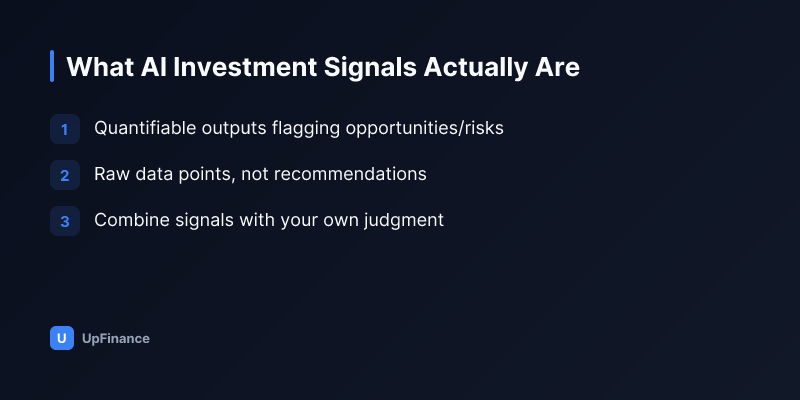
Most retail investors hear the term "AI investment signal" and imagine sophisticated machine learning models predicting stock movements with near-perfect accuracy. The reality is more nuanced—and more profitable if you understand the distinction.
An AI investment signal is fundamentally a quantifiable output from a computational model designed to flag market opportunities or risks based on patterns in data. These patterns might derive from price action, order flow, sentiment analysis, macroeconomic indicators, or even satellite imagery of shipping containers. The signal itself isn't a recommendation; it's a data point that increases (or decreases) your conviction in a trade.
The key insight for retail investors is this: you're not trying to beat the AI at its own game. You're learning to read the signals it produces and synthesize them with your own judgment. This is especially important in volatile markets like crypto and Asian equities, where retail participation is high and information asymmetry favors those who can quickly interpret signals.
Consider the distinction between a signal and a trading rule. A signal might say: "This token's on-chain activity has spiked 200% in the last 24 hours." A trading rule translates that signal: "If on-chain activity spikes 200% AND price is below the 50-day moving average AND funding rates are neutral, consider a small position." The signal is raw intelligence; the rule is your interpretation of it.
In Southeast Asian fintech platforms like UpFinance, users increasingly access curated AI signals alongside their own analysis tools. The platforms that succeed aren't those claiming perfect predictions—they're those that make signals interpretable and actionable.
The Three Tiers of AI Signals You'll Encounter
AI investment signals exist on a spectrum, from the relatively simple to the architecturally complex. Understanding this hierarchy helps you calibrate your confidence in each signal.
Tier 1: Statistical Signals (The Foundation)
These are algorithmic observations based on historical patterns. They're the most transparent and reproducible.
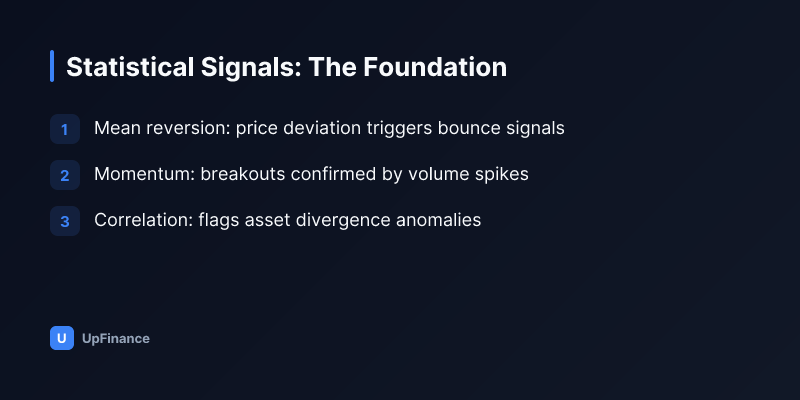
- Mean reversion signals: When an asset's price deviates significantly from its moving average or volatility bands, reversion signals activate. A stock trading 3 standard deviations below its 200-day mean triggers a "potential bounce" signal.
- Momentum signals: Assets breaking above or below key resistance/support levels, often confirmed by volume spikes.
- Correlation signals: When two normally correlated assets diverge sharply, a signal flags the anomaly—useful in pairs trading.
Why they matter: These signals are interpretable. You can audit the logic. If the model is wrong, you understand why. This is crucial for retail investors who need to trust what they're reading.
Tier 2: Sentiment and Behavioral Signals (Medium Complexity)
These aggregate data about human behavior—social media mentions, search trends, transaction counts, whale movements—and translate patterns into signals.
On-chain metrics for cryptocurrency are a classic example. Platforms now track:
- Large transaction volume: When whales move significant holdings, signals alert you to potential regime changes.
- Exchange inflows/outflows: A spike in Bitcoin moving to exchanges often precedes volatility; a spike moving off exchanges sometimes suggests accumulation.
- Active address metrics: Growing or shrinking number of addresses interacting with a protocol indicates adoption trends or exit activity.
In Korean markets, retail investor sentiment signals are particularly valuable. The Korea Exchange (KRX) publishes detailed daily data on foreign vs. domestic buying pressure, and KRW-denominated trading volumes are highly sensitive to retail mood shifts. Many Asian retail traders use these signals to front-run institutional rebalancing.
Tier 3: Machine Learning and Multivariate Signals (Advanced)
These combine dozens or hundreds of variables—technical, fundamental, macro, behavioral—through neural networks or ensemble models. They're harder to interpret but often more accurate.
The trade-off is transparency. A deep learning model might accurately predict that a fintech stock will outperform, but if you ask it why, the answer is often "a complex interaction of weighted features you can't easily visualize."
This is where platforms like UpFinance differentiate themselves: they use advanced models but surface the most important contributing factors to each signal, so you're not operating as a black box user.
"The best AI signals aren't the ones that predict perfectly—they're the ones that illuminate relationships you didn't know existed. Then you verify them yourself." — Market observations from fintech traders across Asia
Reading Signals Without Getting Whipsawed
The most common mistake retail investors make is treating a strong signal as a certainty. Signals are probabilistic, not deterministic. A 75% confidence signal still loses one in four times.
Signal Strength and Conviction
Always check the metadata around any signal:
- Confidence/probability score: A legitimate platform reports this. 80% confidence is meaningfully different from 60%.
- Historical win rate: How often has this signal been correct in the past 100 occurrences? Past 1000?
- Sharpe ratio or risk-adjusted return: What's the average return per unit of risk when you trade on this signal?
- Recency: Is the signal based on patterns observed in the last year, or the last decade? (Recent patterns are more relevant but also more prone to overfitting.)
Signal Decay and Market Regime Changes
AI signals trained on 2020-2022 data performed poorly in 2023-2024 because market structure shifted. Cryptocurrencies went from speculative assets to quasi-correlated with risk assets. Interest rate sensitivity changed everything.
Watch for regime indicators: When VIX spikes, when bond yields invert, when central banks pivot—signals trained on "normal" conditions often fail. The best platforms update their signals when they detect regime change.
In Japanese equity markets, the introduction of yield-curve-control policies in 2016 fundamentally altered the relationship between JGB yields and Nikkei performance. Old signals became unreliable. Traders who recognized this shift early had a significant edge.
Combining Multiple Signals
Don't rely on a single signal, no matter how strong. Diversify across signal types:
- If a mean reversion signal says "oversold" but sentiment signals are aggressively negative and macro signals show deteriorating conditions, the reversion signal is less trustworthy.
- If three independent signals (technical, on-chain, macro) all point in the same direction, conviction should be higher.
This is called triangulation, and it's the closest thing retail investors have to institutional-grade risk management.
Practical Signal-Reading for Crypto, AI Stocks, and Asian Equities
Let's ground this in real scenarios you'll encounter.
Cryptocurrency: On-Chain + Sentiment
Bitcoin and Ethereum publish on-chain data in near real-time. Here's how to read signals:
- Rising exchange outflows + stable or rising price: Accumulation signal. Confidence higher if funded by large transactions (whale activity) rather than dust.
- Rising exchange inflows + downward price pressure: Liquidation or distribution signal. Retail investors moving coins to exchanges to sell.
- Futures funding rates at extremes (1-2% per 8-hour period): Overly leveraged market. Signals elevated reversal risk.
South Korean crypto traders, who represent a disproportionate portion of global trading volume despite the country's smaller population, often interpret these signals faster than Western counterparts. The KRW-denominated orderbooks on Upbit and Bithumb move before BTC on US exchanges show corresponding momentum. If you're watching global signals, watch Korean exchanges first.
AI and Semiconductor Stocks: Earnings Revisions + Macro
- Rising analyst earnings revisions: Strong signal for outperformance. Not every upward revision is equal—revisions driven by demand growth are more sustainable than margin-expansion revisions.
- Memory/GPU utilization rates rising: Leading indicator for semiconductor revenue. Companies rarely guide down after signaling capex increases.
- Interest rate expectations declining: AI infrastructure stocks have high duration. Falling rate expectations usually trigger outflows; rising expectations trigger inflows. This macro signal often overrides fundamentals in the short term.
Asian Equities: Rotation and Regime Signals
The complexity of Asian markets—different regulatory environments, currency movements, foreign ownership rules—means signals must be contextualized geographically.
- Foreign investor buying in ASEAN: Often precedes 3-6 month outperformance as capital flows. Thai SET and Indonesian IDX are particularly sensitive.
- KRW strength vs. USD: When the Won strengthens, Korean export-dependent stocks underperform. Signal for rotating out of Hyundai, Samsung semiconductors into domestic consumption plays.
- Nikkei breakout above structural resistance: In JPY-denominated terms, the Bank of Japan's 2024 policy shift created new signals. Rising JGB yields now have inverse relationship with Nikkei, a regime change from 10+ year pattern.
Building Your Own Signal-Reading Framework
You don't need to build AI models yourself, but you should develop a personal rubric for evaluating signals from platforms, brokers, and services.
The Signal Quality Checklist
Before acting on any AI signal, ask:
- Is the logic transparent? Can you explain to a friend what the signal is measuring? If not, it's too much of a black box for your risk tolerance.
- Is it based on sufficient data? A signal that works "most of the time" from a dataset of 50 samples is unreliable. Demand at least 500 recent instances.
- What's the opportunity cost of being wrong? If a buy signal is wrong and you're down 15%, can you handle it? Adjust position size accordingly.
- Is there timing information? A signal that says "this asset will outperform in the next 3-6 months" is more useful than one without a timeframe.
- Does it account for your time horizon? A signal calibrated for intraday traders is misleading if you're holding for months.
Creating a Signal Dashboard
If you're using platforms like UpFinance or similar services, you likely have access to pre-built dashboards. Customize them:
- Tier 1 signals (technical/statistical): Display these in the background. They're your baseline.
- Tier 2 signals (sentiment/behavioral): Center these. They often have the best risk-reward for retail investors.
- Tier 3 signals (ML/advanced): Use these as confirmation, not primary signals. They're sophisticated but require sophistication to interpret.
- Macro and regime indicators: Keep these at the top. A strong micro signal in the wrong macro regime loses money fast.
Backtesting Against Your Own Psychology
The hardest part of signal-reading isn't understanding the math—it's not overriding your emotions when a signal conflicts with your conviction.
Spend time reviewing past signals from the platforms you use:
- How often was the signal right?
- When it was wrong, how wrong was it?
- Most importantly: would you have actually followed the signal in real-time, or would you have second-guessed it?
Honesty here prevents expensive mistakes later.
Common Pitfalls and How to Avoid Them
Overfitting to Recent Performance
A signal that worked perfectly for six months might be overfitted to current market conditions. When conditions shift, it fails spectacularly.
Prevention: Demand that platforms show signal performance across multiple market cycles—bull markets, bear markets, high-volatility periods, and quiet periods. A signal that's 80% accurate in all conditions is better than one that's 95% accurate in bull markets but 40% in bear markets.
Confirmation Bias in Signal Interpretation
You'll unconsciously interpret ambiguous signals in ways that confirm your existing position. "This on-chain metric is mixed, but the part that supports my bullish view is the signal."
Prevention: Before trading on a signal, write down what would disprove it. If Bitcoin posts an on-chain accumulation signal but closes below the 20-day moving average, does that invalidate the signal? If so, specify the price action that would make you exit. Commit to it in advance.
Ignoring Liquidity and Slippage
A signal might be accurate in identifying mispriced assets, but if the asset has thin liquidity, your execution costs will eat the profit.
Always check: What's the typical spread? What's the daily trading volume? For cryptocurrencies, check multiple exchanges—the same asset might have very different signals depending on liquidity. For Asian equities, small-cap stocks on KRX or TSE can have significant spreads that negate signal-based gains.
Mistaking Correlation for Causation
Signals often work because they're correlated with underlying market moves, not because they're causal. This is fine until correlation breaks. Especially in AI and crypto markets, where retail sentiment and macro flows are increasingly dominant, correlations can flip suddenly.
"The most dangerous signal is the one that's been right so often you stop questioning it." — Observation from quantitative traders
The Role of Platforms: How UpFinance and Similar Services Deliver Signals
Retail investors now have access to signal-delivery platforms that were only available to institutions five years ago. Understanding how these work helps you extract maximum value.
UpFinance and competitors focus on a few key differentiators:
- Signal curation: Instead of throwing 50 signals at you, they select the most reliable ones.
- Explainability layers: Machine learning signals come with "top contributing factors," so you're not operating blind.
- Backtested performance: Transparent historical accuracy metrics, updated regularly.
- Multi-asset coverage: Signals across stocks, crypto, forex, and commodities in one interface.
- Macro context: Signals are filtered through regime indicators, so you're not getting buy signals during a market crash.
For users in Asia, additional value comes from local context. Platforms covering Korean, Japanese, and Southeast Asian markets integrate regulatory changes, currency movements, and retail-flow data that Western-only platforms miss.
The practical edge: if you're a US or EU investor trading Asian assets, using a platform with Asian market expertise is worth the subscription.
Moving Forward: Developing Signal Literacy
Becoming fluent in AI signals is a learnable skill. It's not about advanced mathematics—it's about pattern recognition, comfort with probabilistic thinking, and disciplined risk management.
Your roadmap:
- Weeks 1-2: Observe signals without trading. Get familiar with the outputs. What do they say? How often do they trigger?
- Week 3-4: Start paper trading (sim trading) on signal recommendations. Track accuracy without risking capital.
- Month 2+: Small real positions, sized to your risk tolerance. Document every trade and outcome.
- Ongoing: Update your signal-reading framework quarterly. What's working? What's not? How has the market changed?
The investors who'll outperform over the next decade won't be those who blindly follow AI signals—they'll be those who understand them deeply enough to know when not to follow them.
This content is produced for marketing purposes by MIG Korea Group and is not investment advice. Crypto investing carries the risk of losing your principal; investment decisions are your own responsibility. UpFinance is the AI fintech service of MIG Korea Group.
Related posts
Start AI investing with UpFinance — free
Start free →Smart investing with UpFinance
AI-powered market analysis, automated portfolio rebalancing, and risk alerts.
We make crypto markets simple — without dumbing them down.