
AI Trading Bots Explained: How Automated Investing Works and How to Use Them
AI Trading Bots: A New Era in Investing
If you've been investing lately, you've probably heard this question: "You can't monitor the markets 24 hours a day—why not use a bot?" It might sound like a joke, but the truth is that thousands of investors are already implementing exactly this. Welcome to the world of AI trading bots.
Investing used to mean personally committing your time and attention to every decision. But technology has changed everything. AI trading bots use artificial intelligence and machine learning to analyze data at scales no human could handle, then execute trades without emotion or hesitation. Now it's possible to capture market opportunities even while you're sleeping.
How AI Trading Bots Work
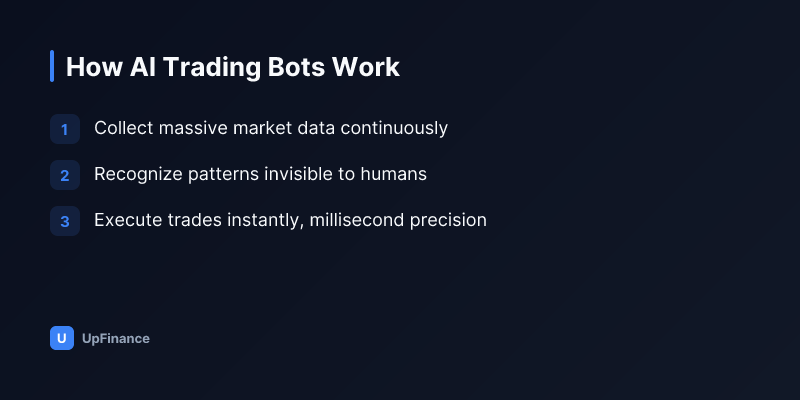
Step 1: Data Collection and Analysis
The first thing an AI trading bot does is gather massive amounts of market data.
- Price data: minute-by-minute, hourly, and daily price movements
- Trading volume: buy/sell sizes and frequency
- Technical indicators: moving averages, RSI, MACD, and more
- News and sentiment metrics: text analysis that captures market tone
- Macroeconomic indicators: interest rates, inflation, policy changes
This data feeds into machine learning models that identify patterns. Subtle correlations invisible to the human eye suddenly become clear.
Step 2: Pattern Recognition and Signal Generation
After analyzing the collected data, the bot generates trading signals.
- Check if specific conditions are met
- Assess risk level
- Calculate expected return
- Determine signal strength
For example, the bot might simultaneously evaluate complex conditions like: "Price breaks above the long-term moving average while volume increases 20%, and positive news sentiment is rising."
Step 3: Automated Trade Execution
Once a signal is generated, the bot executes trades immediately, without emotion.
- Automatically places buy/sell orders
- Sets stop-loss and take-profit levels automatically
- Determines position size algorithmically
- Applies risk management rules consistently
All of this happens in milliseconds. By the time you'd click to place an order, the bot has already completed the trade.
Why Use an AI Trading Bot?
Removes Emotion
"The biggest enemy in investing is yourself." — A timeless trading saying
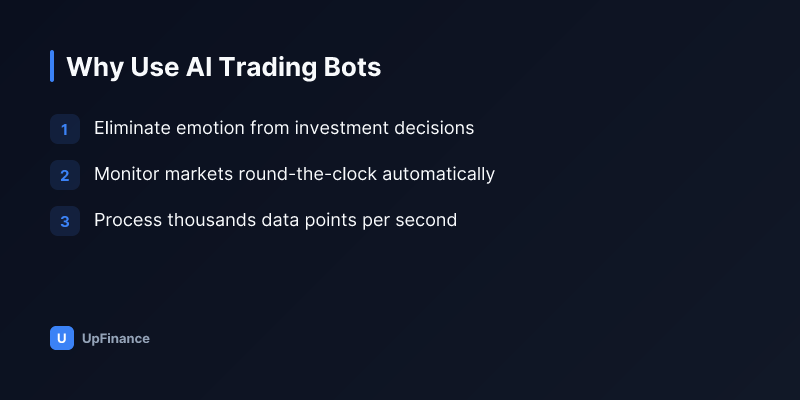
AI bots cut losses when they should, and take profits when they should, regardless of hope or fear. Over time, this consistency creates massive advantages.
24/7 Monitoring
Whether you're sleeping, working, eating, or relaxing, the bot is watching. For markets that never close—like crypto or global equity markets—this is essential.
Extraordinary Processing Speed
Humans process 2-3 pieces of information per second. AI bots analyze thousands of data points per second.
Consistent Strategy Execution
Humans get tired, have bad days, change their minds. Bots apply the same rules, every single time.
Types of AI Trading Bots
1. Technical Analysis Bots
Uses traditional indicators (moving averages, RSI, etc.) to make trades. Relatively simple to build and understand.
2. Machine Learning Bots
Learns patterns from historical data and builds predictive models. More sophisticated; automatically discovers new patterns as markets evolve.
3. Deep Learning Bots
Neural network-based AI that can capture highly complex, non-linear relationships. Powerful but computationally intensive and harder to interpret.
4. Hybrid Bots
Combines multiple strategies simultaneously: technical analysis + machine learning + risk management rules. This is the approach adopted by modern AI fintech services like UpFinance.
How to Use AI Trading Bots: A Practical Guide
Step 1: Choose the Right Platform
You'll need to either build a bot or use an existing service.
- Build it yourself: If you know how to code, use Python to implement your strategy
- Use an existing platform: Services like UpFinance offer pre-built AI bots
- API integration: Connect to an exchange API and automate at your preferred level
Step 2: Develop Your Strategy and Backtest It
Don't blindly copy strategies you find online. Always validate using historical data.
- Run simulations on at least one year of past data
- Analyze win rate and profit factor
- Check maximum drawdown (MDD)
- Test across different market conditions
- Watch out for overfitting
Step 3: Decide Your Position Size
Start with 5-10% of your total capital. Never go all-in from day one.
- Early phase: 1-5% of capital
- After confirming results: 5-10%
- Mature phase: 10-20% (never exceed this)
Step 4: Set Up Risk Management
AI bots aren't perfect. Always establish stop-loss and take-profit rules.
- Max loss per trade: 1-2% of capital
- Max daily loss: 5% of capital
- Max monthly loss: 10-15% of capital
- Auto-pause the bot when these limits are hit
Step 5: Monitor and Continuously Improve
Don't set it and forget it.
- Weekly: Review performance
- Monthly: Assess if strategy adjustments are needed
- Quarterly: Respond to major market shifts
- Annually: Completely review and improve your approach
Advantages and Limitations of AI Trading Bots
Advantages
✅ Emotion-free, consistent trading
✅ 24-hour automated monitoring
✅ Faster decision-making than humans
✅ Flawless execution of complex strategies
✅ Saves your time
Limitations and Cautions
⚠️ Past performance doesn't guarantee future results: Market conditions change, and bot performance changes with them.
⚠️ Struggles in extreme market conditions: Black swan events and unpredictable shocks expose bot limitations.
⚠️ Model risk: A bot built on wrong assumptions can cause serious losses.
⚠️ Technical dependency: System failures and bugs are real risks.
⚠️ Trading costs: High-frequency trading can accumulate significant fees.
Key Tips for Profiting with AI Trading Bots
1. Think Long-Term
5-10% monthly returns compound to 60-120% annually. Don't obsess over two months of results.
2. Diversify Across Strategies
Don't rely on a single bot. Running several low-correlated strategies simultaneously reduces overall risk.
3. Understand Market Cycles
Bull markets, bear markets, and sideways markets all reward different strategies. Adjust your bots accordingly.
4. Optimize for Costs
"Investment returns are reduced by every fee you pay."
Higher trading frequency means higher fees. Choosing a low-fee platform like UpFinance matters.
5. Keep Learning
AI and machine learning technology evolve rapidly. Continuously study new techniques and approaches.
Conclusion
AI trading bots represent the future of automated investing. But this doesn't mean "set it and forget it to get rich." Without solid strategy, rigorous risk management, and continuous improvement, bots can cause major losses.
To succeed in the age of AI investing, you need to understand the technology while never abandoning fundamental investment principles. When using trusted AI fintech services like UpFinance, always remember: you remain responsible for managing your own capital.
Are you ready to harness AI's power and become a smarter investor?
This content is produced for marketing purposes by MIG Korea Group and is not investment advice. Crypto investing carries the risk of losing your principal; investment decisions are your own responsibility. UpFinance is the AI fintech service of MIG Korea Group.
Related posts
Start AI investing with UpFinance — free
Start free →Smart investing with UpFinance
AI-powered market analysis, automated portfolio rebalancing, and risk alerts.
We make crypto markets simple — without dumbing them down.