
The Art of Risk Management — How AI Reduces Investment Losses
AI Is Transforming the Investment Landscape
Artificial intelligence has become the hottest topic in markets today. Yet most investors view AI as simply a "magic tool for boosting returns." The real value of AI, however, lies in reducing losses and managing risk.
Think about it: earning profits matters, but avoiding losses matters even more, doesn't it? This is why institutional investors are focused on AI-powered risk management systems. It's also why platforms like UpFinance are gaining attention.
The Problem with Traditional Risk Management
The Limitations of Manual Approaches
In conventional investing, risk management is mostly handled manually. Investors read news, analyze charts, and rely on intuition to make decisions.
The problems with this approach:
- Human emotion interferes with objective judgment
- Continuous 24-hour market monitoring is nearly impossible
- Rapidly shifting market signals can be missed
- Data processing speed is extremely slow
- Personal biases influence decision-making
"In investing, emotion is the enemy. Especially when losses occur." - A shared view among investment professionals
Missing Opportunities in the Big Data Era
Modern markets generate massive amounts of data every second. Stock trades, social media mentions, news articles, economic indicators—all streaming in real-time. The human brain simply cannot process this volume of information.
AI emerged to fill this information gap.
How AI-Powered Risk Management Works
The Role of Machine Learning Models
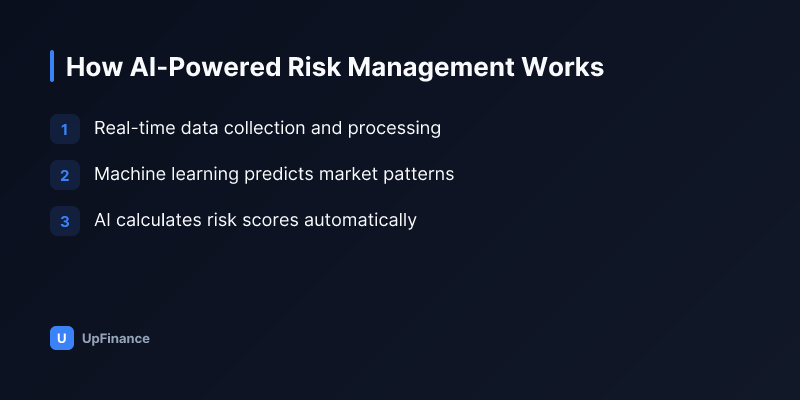
AI-based risk management systems operate in the following way:
Step 1: Data Collection and Processing
- Collect all relevant market data in real-time
- Analyze historical data alongside current data
- Filter out noise and extract meaningful signals
Step 2: Pattern Recognition
- Machine learning algorithms learn from past patterns
- Predict market responses in similar situations
- Discover hidden correlations
Step 3: Risk Score Calculation
- Quantify the loss potential of each asset
- Assess the overall risk of the entire portfolio
- Recommend optimal diversification ratios
The Accuracy of Predictive Analytics
What's remarkable about AI is its predictive precision. Advanced platforms like UpFinance use machine learning to forecast:
- The timing of high-volatility periods
- The likelihood of specific asset crashes
- Changes in correlations between markets
- Anomalies and unusual signals
The more accurate these predictions, the sooner investors can adjust positions and minimize losses.
Real-World AI Risk Management Examples
Portfolio Optimization
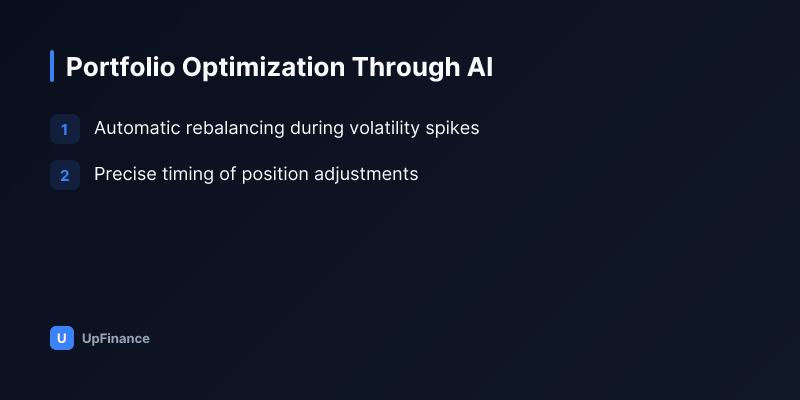
AI does more than just alert you to risk. It automatically rebalances your portfolio.
For example:
- When volatility spikes, it increases exposure to safe-haven assets
- When it detects concentrated risk in a sector, it diversifies
- It automatically adjusts highly correlated assets
Real-Time Monitoring
Traditional methods analyze based on daily closing prices. AI watches the market by the minute, by the second. This means:
- Small signals are detected early
- Quick responses minimize losses
- Overnight market moves aren't missed
- Emergency situations trigger automatic responses
Automated Stress Testing
AI learns from every past market crisis and stress-tests your current portfolio against those scenarios in advance. This allows:
- Contingency plans to be prepared before crises
- Risk limits set to withstand worst-case scenarios
- Position sizing to be calculated more accurately
The Changes AI Risk Management Brings
Impact on Investors
Key Benefits of AI Risk Management:
- Emotion-free decision-making — objective, consistent decisions
- Time savings — complex analysis becomes automated
- Enhanced accuracy — pattern recognition surpasses human ability
- 24/7 monitoring — tireless market surveillance
- Loss minimization — prevention becomes possible
Structural Market Changes
As AI adoption spreads, the market itself is changing:
- Volatility moves more quickly
- Irrational pricing is corrected faster
- High-frequency trading increases
- Data-driven investing becomes dominant
In this environment, competing without AI support is becoming increasingly difficult.
The Limitations of AI in Risk Management
No technology is perfect. AI risk management is no exception:
- Model risk: Models based on wrong assumptions produce inaccurate results
- Data quality: Poor data produces poor outcomes
- Black swan events: Unprecedented crises can't be predicted
- Overfitting: Over-optimization to past data can fail on future data
- Regulatory changes: Sudden policy shifts aren't captured by models
"AI is a powerful tool, but it's not a silver bullet. Human judgment is still required." - Machine learning expert
Practical Steps Investors Can Take
Choosing AI Tools
If you're considering an AI-powered risk management platform:
- Verify transparency — Can it explain how the algorithm works?
- Review backtests — Did it actually perform in historical data?
- Assess loss control — How well did it limit losses?
- Evaluate UX — Is it simple and easy to understand?
- Check costs — Are fees reasonable?
Apply these same criteria when evaluating platforms like UpFinance.
A Hybrid Approach
The best strategy is to combine AI analysis with human judgment:
- Accept AI's objective recommendations
- But align final decisions with your investment goals and values
- Regularly review AI suggestions
- Revisit assumptions when market conditions shift significantly
The Road Ahead
How Technology Will Evolve
AI risk management continues to advance:
- Reinforcement learning: Systems that learn and adapt on their own
- Explainable AI: Models that justify their decisions
- Quantum computing: Analysis of far more complex scenarios
- Blockchain integration: More transparent, verifiable systems
- Multi-agent systems: Sophisticated collaboration between multiple AIs
How Investors Should Respond
The future of risk management will be led by AI. Smart investors are:
- Getting comfortable with AI tools
- Building data literacy
- Understanding technology's strengths and weaknesses
- Finding trustworthy platforms
Conclusion: AI Is Changing How We Invest
AI-powered risk management is no longer the future—it's now. Institutional investors managing large assets have already adopted it broadly, and more individual investors are following suit every day.
If you want to reduce losses and achieve better long-term returns, it's time to seriously consider the help of AI-powered risk management systems. Platforms like UpFinance are making this technology increasingly accessible at reasonable price points.
But remember: AI is just a tool. You remain ultimately responsible. Accept AI's recommendations, but never lose sight of your investment principles. That's the essence of successful investing.
This content is produced for marketing purposes by MIG Korea Group and is not investment advice. Crypto investing carries the risk of losing your principal; investment decisions are your own responsibility. UpFinance is the AI fintech service of MIG Korea Group.
Related posts
Start AI investing with UpFinance — free
Start free →Smart investing with UpFinance
AI-powered market analysis, automated portfolio rebalancing, and risk alerts.
We make crypto markets simple — without dumbing them down.