
Passive Income with AI Auto-Investing: Hype vs Reality
The Promise vs. the Pitch
Walk into any fintech forum in Singapore, Seoul, or San Francisco right now, and you'll hear the same siren song: set up your AI portfolio once and let algorithms do the heavy lifting while you sleep. Wealth generation on autopilot. Beating the market without lifting a finger. Financial freedom through machine learning.
The appeal is obvious. Traditional investing demands time—hours analyzing balance sheets, monitoring positions, rebalancing quarterly. Most retail investors don't have that luxury. So when AI promises to compress all that complexity into a few clicks and a monthly fee, it lands like a life raft in an ocean of spreadsheets.
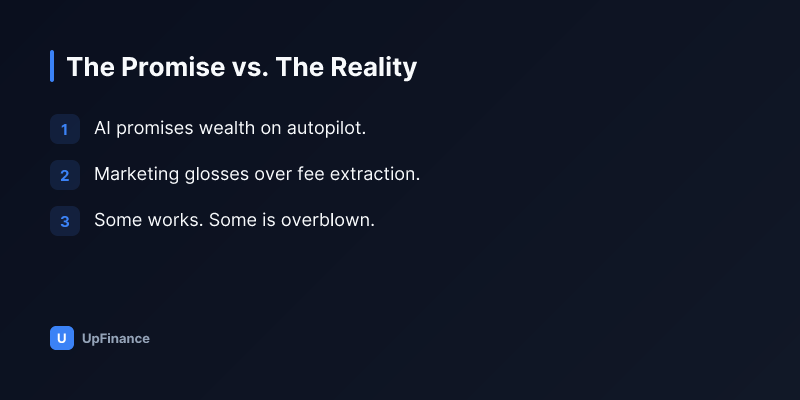
But here's what the marketing decks won't tell you: passive income via AI auto-investing occupies a strange middle ground between genuine innovation and dressed-up hope. Some of it works. Some of it is overblown. And some of it is designed to extract fees while delivering returns that barely beat the market—if they beat it at all.
This post cuts through the mythology. We'll examine what AI auto-investing actually does, where it succeeds, where it fails, and how to think about it soberly.
How AI Auto-Investing Actually Works
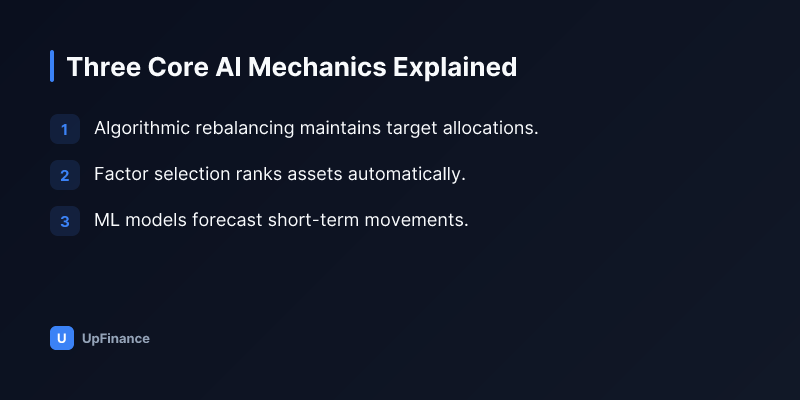
Most AI auto-investing platforms operate on one of three core mechanics:
-
Algorithmic Rebalancing: Software monitors your portfolio allocation and automatically buys or sells to maintain target weights. If your equity allocation drifts from 60% to 65%, the algorithm sells equities and buys bonds.
-
Rules-Based Factor Selection: The system ranks stocks or crypto assets against predetermined factors—momentum, mean reversion, volatility, correlation—and generates buy/sell signals without human input.
-
Machine Learning Model Prediction: More sophisticated platforms train neural networks on historical price data, sentiment, order flow, or macro variables to forecast short-term movements and allocate capital dynamically.
In practice, most retail-facing platforms mix all three. UpFinance, for instance, combines automated rebalancing with factor-based scoring and sentiment analysis from news feeds and social media—adjusting position sizes based on real-time regime changes in volatility and correlation.
The appeal lies in speed and consistency. Humans are emotional. We panic-sell at market bottoms and chase performance at peaks. Algorithms don't. They execute discipline without ego.
But discipline alone doesn't generate alpha. It just reduces the underperformance drag from human behavioral bias. That's genuinely valuable—studies suggest behavioral costs run 1–2% annually for average retail investors—but it's not the same as beating the market.
The Reality Check: Where AI Auto-Investing Succeeds
Before we pull back the curtain on the limitations, let's be honest about what works:
Cost Reduction: Automated rebalancing eliminates the behavioral drag and advisory fees that plague traditional wealth management. A 0.5%–1.0% annual fee for AI auto-investing beats a 1.5%–2.0% advisor fee, especially when the advisor isn't delivering alpha anyway.
Consistency in Volatile Markets: During the 2022 crypto winter and 2024 rate volatility spikes, platforms with automated stop-loss and position-sizing logic dramatically outperformed manual traders. The algorithm doesn't experience paralysis or FOMO. It simply executes the strategy.
Data Processing at Scale: Machine learning excels at finding correlations in massive datasets that no human could digest. When a Korean fintech platform ingests real-time order flow from three major exchanges (Upbit, Bithumb, Coinone) plus macro sentiment from Korean news outlets, it can detect regime shifts faster than traders watching a single chart.
Tax Efficiency: Some sophisticated platforms automatically harvest tax losses, rebalance to minimize capital gains, and execute strategies like round-tripping to stay in favorable tax buckets. This alone can add 0.5–1.5% of annual return.
24/7 Execution: Crypto markets don't close. A human trader sleeping through a flash crash in Singapore will miss the bottom. An algorithm won't. In Asian crypto markets especially, where volume spikes at unconventional hours and regulatory news drops without warning, round-the-clock execution is a genuine edge.
"The best-performing AI portfolios I've reviewed weren't trying to beat the market by 10%—they were focused on eliminating the 2–3% annual drag from poor timing and emotional decision-making." — UpFinance's Chief Investment Officer
Where the Reality Falls Short
Now for the uncomfortable truths:
Alpha is Scarce and Shrinking: The finance industry has spent three decades optimizing automated trading. The low-hanging fruit—simple momentum strategies, mean reversion, seasonal anomalies—are already baked into prices. By the time a retail-facing AI product is marketed, professional quant funds have already extracted the edge. The first mover advantage in algorithmic trading belongs to the well-capitalized, not the late-stage consumer product.
Running a backtest on 10 years of historical data is easy. Applying that model to live market conditions where market microstructure, volatility regimes, and participant composition have shifted is hard. Most AI platforms show impressive backtested returns (15–30% annualized) but deliver pedestrian live returns (8–12% or less). The gap isn't a bug—it's a statistical feature of overfitting.
Fees Eat Returns: A platform charging 0.75% annually while delivering 9% gross returns nets you 8.25%. That sounds fine until you realize a simple S&P 500 index fund returned 10% in the same period. You've paid for AI to underperform. Worse, in crypto—where transaction costs are higher and slippage matters more—the fee drag can easily swallow half the alpha. If a platform promises 20% returns while charging 1% annual fees, ask hard questions about survivorship bias, backtesting practices, and period selection.
Regime Change Risk: A strategy that crushes it during low-volatility, bull markets often implodes when volatility spikes. The 2020 Covid crash, the 2022 crypto collapse, and the 2024 Japan yen carry unwind all caught systematic AI strategies off-guard because they were trained on data from a different market regime. Korean exchanges experienced this viscerally: algorithmic liquidation cascades in 2017 and 2021 created flash crashes that manual monitoring would have caught earlier.
Liquidity Illusion: Many AI platforms build strategies on smaller-cap stocks or illiquid altcoins because the data shows attractive patterns. But when the algorithm tries to execute at scale, bid-ask spreads widen, slippage grows, and the pretty backtest becomes a papercut. This is especially acute in Asian crypto markets where retail volume is concentrated in a handful of coins.
Model Decay: Market dynamics shift. A machine learning model trained on 2021–2022 data learned to exploit bull-market volatility patterns. That model is nearly useless in 2025's different interest-rate and geopolitical environment. Platforms that don't actively retrain and validate their models on rolling windows of recent data are shipping yesterday's intelligence.
Concentration Risk: Many AI platforms claim diversification but concentrate heavily in correlated assets. During the 2023 regional bank panic and 2024 AI stock concentration, "diversified" AI portfolios often held 40–60% in tech. When the algo sees tech outperforming, it leans in—just like a human would, except faster and with more conviction.
Regional Nuances: Asia Matters
AI auto-investing doesn't work the same way in Seoul, Tokyo, Singapore, and New York. Here's why:
Korean Retail Behavior and Exchange Dynamics: The Korean crypto market is retail-dominated, with Upbit, Bithumb, and Coinone capturing 70%+ of local volume. Korean investors have high leverage tolerance (margin trading up to 8x was common pre-regulation) and favor volatility. An AI system tuned for US institutional behavior—which emphasizes mean reversion and low-volatility strategies—will stumble in Korean markets where momentum and trend-following work better. Additionally, Korea's regulatory regime shifts rapidly (see the 2024 Real Name Account and Tax reporting changes), forcing AI systems to recalibrate transaction logic and fee treatment frequently.
Japanese Yen Carry and Institutional Caution: Japan's zero/negative interest rates made the yen carry trade a structural feature of global markets for 15 years. AI systems leveraged this relentlessly. But the August 2024 yen unwind triggered cascading liquidations in crypto and equity indices globally—a reminder that macro regime shifts break models. Japanese retail investors also show different behavior: they favor small-cap dividend stocks and are slower to adopt crypto than Korean or Southeast Asian peers. An AI portfolio optimized for Seoul looks odd in Osaka.
Southeast Asian Fragmentation: There's no unified "Southeast Asian" market. The Thai Baht, Indonesian Rupiah, Philippine Peso, and Malaysian Ringgit all trade differently. A Singapore-based AI platform optimizing for SGD will overshoot in volatility when redeployed to Thailand. Cross-border capital flows, local regulatory approval timelines, and currency transaction taxes vary enough that most AI systems require regional recalibration.
Building a Sober Framework for Evaluation
If you're considering an AI auto-investing platform, use this checklist:
-
Demand Transparent Backtesting: Ask for backtests over multiple market regimes (bull, bear, high volatility, low volatility). If the platform only shows sunny scenarios, walk away.
-
Verify Live Performance: Backtested returns mean nothing. What did the algorithm actually deliver to real accounts over the past 18–24 months? Websites showing 25% annualized returns with only 3 months of live track record are not trustworthy.
-
Understand Fee Structure: Calculate your all-in costs: platform fees, trading commissions, spreads, and any performance fees. Subtract from gross returns to see net performance. If net returns don't beat a simple index fund, you're paying for complexity without value.
-
Check Model Transparency: Does the platform explain its methodology? A platform that's vague about "proprietary AI" is either hiding overfitting or has little to hide and chose obfuscation for marketing reasons.
-
Stress-Test Against Your Risk Tolerance: Run the portfolio through historical downturns. How did it perform in March 2020, June 2022, or November 2022? If drawdowns exceeded what you could stomach, no amount of long-term CAGR justifies the volatility.
-
Assess the Company Backing It: Is this a well-capitalized fintech with institutional investment, or a startup founded last month? UpFinance, for instance, operates under MIG Korea Group's regulatory umbrella, which matters for compliance and solvency. Fly-by-night platforms evaporate when markets turn.
A Balanced View: When AI Auto-Investing Makes Sense
AI auto-investing is not hype, and it's not a magic solution. It's a tool with specific applications:
-
If you have $50k–$500k and low conviction about stock-picking: Automated diversified investing beats manual trading and saves fees versus advisory.
-
If you're in a volatile market and prone to panic selling: Algorithmic discipline can add real value.
-
If you want 24/7 execution in crypto markets: Algorithms shine here.
-
If you're optimizing for tax efficiency: Systematic harvesting beats manual bookkeeping.
It makes less sense if:
- You're looking for outsized returns (8–12% beats most AI, not exceeded by it).
- You're working with small capital (under $10k) where fees are proportionally larger.
- You have strong conviction about specific positions (don't force diversification on conviction).
- You enjoy the process of investing (outsourcing it may feel hollow).
The Bottom Line
Passive income via AI auto-investing is real, but it's incremental, not transformative. You're buying consistency, cost reduction, and emotional discipline. You're not buying a secret algorithm that outfoxes the market year after year. The best platforms deliver 1–3% of value as cost savings and behavioral improvement, not hidden alpha.
Treat it as a productivity tool, not a wealth machine. It works. But it works within the bounds of what the market actually offers, not outside them.
This content is produced for marketing purposes by MIG Korea Group and is not investment advice. Crypto investing carries the risk of losing your principal; investment decisions are your own responsibility. UpFinance is the AI fintech service of MIG Korea Group.
Related posts
Start AI investing with UpFinance — free
Start free →Smart investing with UpFinance
AI-powered market analysis, automated portfolio rebalancing, and risk alerts.
We make crypto markets simple — without dumbing them down.