
Global Crypto Regulation and Investment Strategy
Why the Regulatory Era Is Here
As the crypto market grows, regulation has become unavoidable reality. The wave of global regulatory tightening that began in 2024 is accelerating through 2026. The SEC's approval of spot Bitcoin products, the EU's full rollout of MiCA, Japan's enhanced crypto exchange oversight — these are all underway.
How should individual investors respond? Regulation isn't purely negative. It can boost market credibility and reduce fraud and manipulation. But strategy adjustments are essential as rules shift.
This article maps major regulatory trends and offers practical strategies investors can implement today.
The United States: Regulatory Clarity Takes Shape
The SEC's Clear Stance
The US is the center of the global crypto market. Since American regulatory direction directly shapes global investor sentiment, understanding exactly what falls under regulation matters.
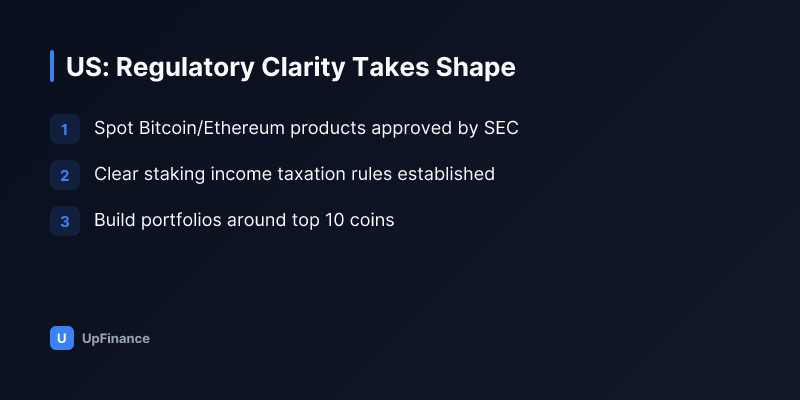
- Spot Bitcoin product approval: The January 2024 SEC greenlight of spot products marked crypto's move into mainstream finance
- Ethereum spot product approval: Regulatory expansion to major altcoins
- Staking income taxation: Clear rules on taxing rewards earned while holding
"Regulation can be helpful. It drives better product development and raises barriers to entry, leaving only quality firms standing." — Common view among crypto industry leaders
US Investor Response Strategy
- Integrate tax management into your investment strategy
- Consider tax benefits of holding spot products through brokers
- Build portfolios around the top 10 coins (minimizes regulatory risk)
Europe: MiCA's Implementation and Implications
The EU's Comprehensive Regulatory Framework
The EU's MiCA (Markets in Crypto-Assets Regulation) is the most comprehensive crypto regulatory framework globally. Fully operational since June 2024, it features:
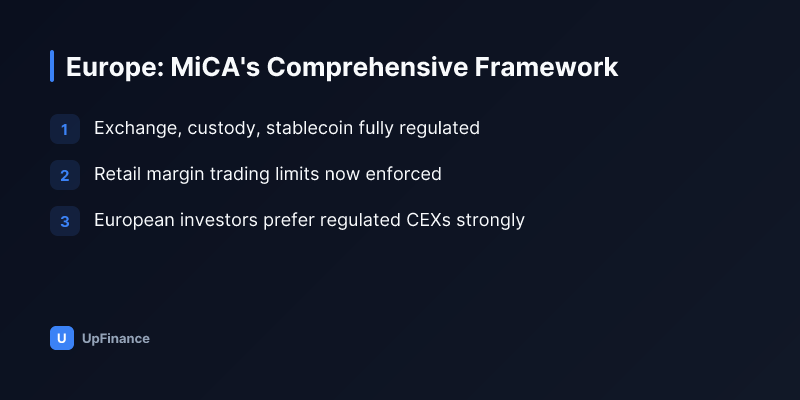
- Exchange and custody regulation: Clear licensing criteria and application procedures
- Stablecoin regulation: Issuers must maintain sufficient asset backing
- Consumer protection: Asset safeguards during trading halts, mandatory disclosure
- Margin trading limits: Restrictions on retail investor leverage
European Investor Shifts
Post-MiCA, European investors are changing behavior:
- Growing preference for regulated CEXs: Regulated exchanges seen as safer
- Stablecoin shift: EURS and EURe preferred over unregulated USDT
- Professional asset management: Increased use of dedicated asset managers
"MiCA brought clarity to the industry. There's a compliance cost, but now customers can invest with confidence." — European crypto exchange CEOs
Asia-Pacific: Varied Regulatory Approaches
Japan's Careful Tightening
Japan historically favored crypto but has been strengthening rules since 2023.
- Stricter exchange standards: Higher capital requirements, leadership qualifications, security standards
- Staking service regulation: Some staking services now classified as regulated products
- Derivatives limits: Enhanced retail investor protections
Singapore's Forward-Thinking Model
Singapore balances industry growth with smart regulation.
- Tokenized asset support: Active promotion of digital asset issuance and trading
- Financial institutions opening up: Selective approval for bank crypto services
- Global leadership: Drives international regulatory coordination
Korea's Regulatory Landscape and Investor Impact
The Special Financial Transactions Act
Korea's Special Financial Transactions Reporting Act is the most direct regulatory pressure on local crypto investors.
Key provisions:
- Mandatory real-name accounts for crypto exchange trading
- Clear taxation of mining income
- Defined tax treatment for staking rewards
Smart Korean Investor Response
- Keep detailed transaction records: Prepare for tax audits with organized trade history
- Use regulated domestic exchanges: Lower risk than overseas platforms
- File income tax returns: Report crypto gains as aggregate income
- Leverage AI platforms like UpFinance: Automated trade tracking and tax reporting
Investment Strategies for the Regulatory Era
Regulatory Risk Classification
High risk:
- Trading on unregulated exchanges
- Securities-like tokens (may be classified as securities)
- Leveraged trading (especially retail investors)
Lower risk:
- Spot trading on regulated exchanges
- Major coins like Bitcoin and Ethereum
- Spot products and crypto-focused ETFs
Portfolio Composition Under New Rules
Regulation-aligned portfolio structure:
- Core holdings (60%): Bitcoin and Ethereum spot or spot products
- Growth allocation (30%): Top 10 coins from regulated exchanges
- Conservative cushion (10%): Stablecoins or crypto-backed savings products
The Case for Automated Investing
Given rapid regulatory change, automated trading and management tools are increasingly essential. AI-driven platforms like UpFinance offer:
- Auto-rebalancing based on regulatory shifts
- Integrated tax tracking and reporting
- Real-time risk monitoring
Opportunities Within Regulation
Institutional Capital Inflow
Regulatory clarity signals institutional entry. Institutions reduce volatility and drive long-term value appreciation.
Quality Projects Rise
Higher barriers from regulation ensure only strong blockchain projects and cryptocurrencies survive. This favors long-term investors.
Arbitrage Between Jurisdictions
Different national rules create opportunities:
- Coins regulated in one country may be unregulated in another
- Tax-efficient jurisdictions offer trading advantages
- Regulatory arbitrage opportunities can be identified
Regulatory Issues to Watch (2026–2027)
Expected Regulatory Developments
- Unified asset standards: FATF strengthens global baseline rules
- Staking and DeFi oversight: New products reclassified as regulated instruments
- Spot product expansion: More countries approve Bitcoin spot products
- Carbon neutral rules: High-energy coins face potential restrictions
- AI trading bot regulation: Automated trading systems under regulatory scrutiny
How Investors Should Prepare
- Monitor regulatory announcements: Track major agencies' official statements
- Consult tax professionals: Stay ahead of jurisdiction-specific tax changes
- Evaluate exchange credibility: Check regulatory approval, capital reserves
- Choose smart platforms: Use UpFinance and similar tools with strong compliance features
Conclusion: Smart Investing Within Regulation
Regulation is an inevitable stage in crypto's maturation. The goal isn't to avoid it—it's to understand it and build strategy around it.
Global regulatory trends show:
- Transparent, secure projects survive
- Regulated exchanges and institutions earn trust
- Retail investor protections strengthen
So 2026 crypto investing success rests on:
- Portfolios focused on major coins
- Trading on regulated exchanges
- Tax planning done upfront
- AI-powered automated management
- Staying informed on regulatory news
These five elements are your foundation. Consider platforms like UpFinance for automated portfolio management that adapts to regulatory change.
Regulation purifies markets and enables sustainable growth. Only investors who navigate this shift wisely will achieve long-term returns.
This content is produced for marketing purposes by MIG Korea Group and is not investment advice. Crypto investing carries the risk of losing your principal; investment decisions are your own responsibility. UpFinance is the AI fintech service of MIG Korea Group.
Related posts
Start AI investing with UpFinance — free
Start free →Smart investing with UpFinance
AI-powered market analysis, automated portfolio rebalancing, and risk alerts.
We make crypto markets simple — without dumbing them down.