
Crypto Tax Guide 2026 — Essential Information You Need to Know

Crypto Taxes: No Longer Avoidable
Starting in 2026, income from crypto trading is subject to mandatory tax reporting. With governments strengthening verified exchange accounts and transaction tracking systems, investors need to pay attention now. Many retail investors face hefty penalties and back taxes after failing to report crypto income—and this is no longer someone else's problem.
"The global trend is clear: crypto investors should bear the same tax obligations as stock investors. Proactive preparation is essential."
As crypto popularity grows, tax policies are becoming increasingly detailed. Understanding the key changes in 2026 and preparing accordingly is both a fundamental investor responsibility and smart wealth management.
Major Crypto Tax Policy Changes for 2026
Capital Gains Tax Overhaul
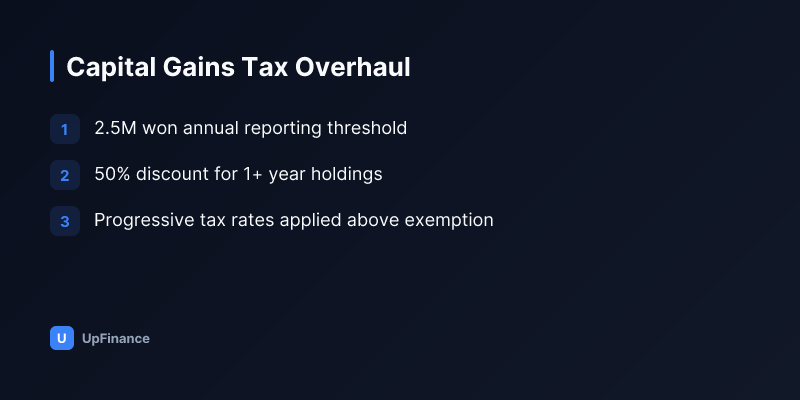
Starting in 2026, capital gains from crypto transactions become an explicit taxable category. As crypto trading profits move from the gray zone to official recognition, the following standards apply:
- Mandatory reporting for annual capital gains exceeding 2.5 million won
- Basic exemption of 2.5 million won applied
- Progressive tax rates applied to amounts above the exemption
- Expected maximum 50% long-term holding discount for assets held over 1 year
This mirrors the stock market capital gains tax system, meaning the longer you hold, the less you pay in taxes.
Interest Income and Staking Income Taxation
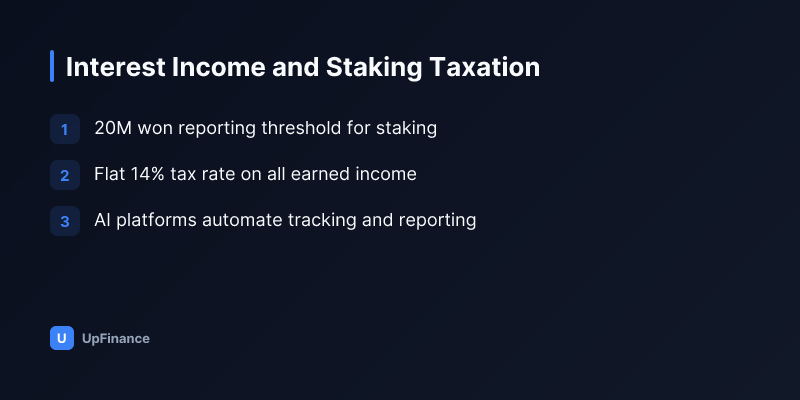
Income from crypto staking, DeFi liquidity mining, lending interest, and similar sources are now classified as interest income and subject to taxation starting in 2026. Key points to watch:
- Reporting required for annual interest income exceeding 20 million won
- Flat 14% interest income tax (15.4% with local tax)
- All earned income is taxable regardless of holdings size
Using AI investment platforms like UpFinance to automatically track staking rewards makes tax reporting record-keeping far more manageable.
Essential Reporting Obligations and Procedures
How to Report Crypto Income
Here's a step-by-step breakdown of the process for reporting crypto income:
- Collect Trading Records: Download annual transaction statements from your exchange
- Calculate Cost Basis: Determine cost per unit using average price method
- Calculate Sale Price: Use price at time of sale as sale value
- Calculate Capital Gain: Sale price minus cost basis, minus transaction costs
- File Tax Return: Report together with annual income tax filing
"Planning taxes upfront is far more economical than paying penalties later."
Exchange-by-Exchange Documentation Status
As 2026 arrives, major domestic exchanges are responding to government crypto tax policies:
- Upbit: Automatic tax proof issuance for users
- Bithumb: Detailed transaction report provision
- CoinOne: Annual transaction summary service
- Huobi: Multi-country tax reporting guidance
Document formats differ by exchange, so confirm in advance and prepare accordingly.
Smart Tax Optimization Strategies for Investors
Loss Harvesting for Tax Deductions
Losses from crypto trading can offset other capital gains. Consider:
- Intentionally realizing losses on long-term holdings to generate loss positions
- Combining with other year's capital gains to reduce overall tax
- Carrying forward net losses if applicable
However, to qualify as legitimate investment losses rather than tax avoidance, your transaction records must be clear and defensible.
Long-Term Holding Strategy
Starting in 2026, capital gains from crypto held over 1 year qualify for special deductions. Use this tax optimization approach:
- Build a portfolio separating short-term and long-term holdings
- Hold large-cap, lower-volatility assets for at least 1 year
- Stagger sales across multiple years to spread taxable events
For example, if you realize 1 million won in gains:
- Short-term holding: fully taxable
- Long-term holding (1+ years): up to 50% deduction → only 500,000 won taxable
The Critical Importance of Record-Keeping
Accurate transaction records are your path to lower taxes. Essential items to track:
- Purchase date, quantity, and price
- Sale date, quantity, and price
- Fees and transaction costs in detail
- Crypto transfer history and records
Using integrated platforms like UpFinance automatically manages these records, letting you save significant time and money when filing end-of-year taxes.
Legal Consequences of Unpaid Crypto Taxes in 2026
Penalties and Back Taxes
Failing to report or underreporting isn't a minor issue:
- Non-filing penalty: 40% of unpaid tax
- Underreporting penalty: 20% of unpaid tax
- Late payment interest: starts at 1.5% annually
- Progressive taxation applied upon detection
The penalties and back taxes far exceed any short-term benefit from non-compliance.
Strengthened Verified Account Tracking
The government plans to strengthen exchange verification account systems in 2026:
- Automatic recording of fund transfers between banks and exchanges
- Auto-reporting of large transactions (10 million won+)
- Integrated trader information systems across platforms
Transparent trading is what actually protects you in today's environment.
Must-Check Checklist for Crypto Investors
Review these items before investing or finalizing your positions:
- Have I obtained my annual transaction statement from each exchange?
- Have I organized all purchase records to calculate cost basis?
- Do I know my total taxable income for 2026?
- Have I accounted for staking, lending, and liquidity mining income?
- Have I identified losses available for deduction?
- Have I scheduled a consultation with a tax professional?
- Have I developed a tax strategy matched to my investment pattern?
Conclusion: Taxes as Investment Strategy, Not Burden
The 2026 crypto tax policy is an opportunity, not a threat. With proper understanding and advance preparation, you can legally minimize your tax burden.
As the crypto market matures, tax frameworks are standardizing to match traditional securities. This validates crypto investing while clarifying investor responsibilities.
By leveraging AI platforms like UpFinance to track performance and systematically manage transaction records, tax filing becomes a routine procedure rather than a source of stress.
Start preparing for 2026 now. Your future self will thank you.
This content is produced for marketing purposes by MIG Korea Group and is not investment advice. Crypto investing carries the risk of losing your principal; investment decisions are your own responsibility. UpFinance is the AI fintech service of MIG Korea Group.
Related posts
Start AI investing with UpFinance — free
Start free →Smart investing with UpFinance
AI-powered market analysis, automated portfolio rebalancing, and risk alerts.
We make crypto markets simple — without dumbing them down.