
5 Blockchain Trends to Watch in 2026
The Signals of Change in Blockchain in 2026
More than 15 years have passed since blockchain technology first emerged. Moving beyond early speculation, blockchain is now establishing itself as a legitimate business solution. 2026 is expected to be a turning point where technological maturity and regulatory stability advance simultaneously.
Industry experts point out that the blockchain market will undergo fundamental changes this year. Expectations point to an acceleration in integration with the real economy. UpFinance is closely monitoring these trends and providing analysis resources for investors.
In this article, we'll examine in detail the five key trends that will drive the blockchain industry in 2026.
Trend 1: The Convergence of AI and Blockchain
The Era of Technology Fusion
Artificial intelligence and blockchain represent the most powerful technology combination of 2026. This union isn't simply a technical merger—it will create entirely new possibilities.
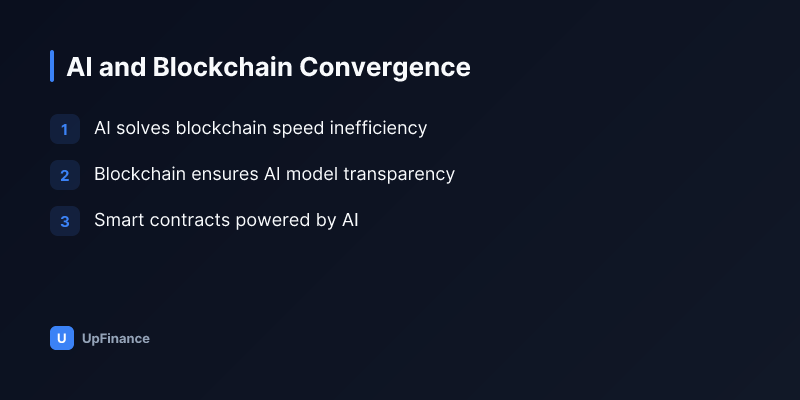
AI addresses blockchain's biggest weakness: processing speed and energy efficiency. Meanwhile, blockchain ensures transparency and trustworthiness for AI models. This complementary relationship will enable:
- Smart contract automation powered by AI
- Distributed processing for large-scale data analysis
- Source verification and intellectual property protection for machine learning models
- Transaction record management for autonomous vehicles and robotics
"AI-blockchain integration project funding is expected to increase more than threefold by 2026."
Investment Opportunities
AI blockchain projects are already gaining attention. Particularly hot sectors include distributed machine learning platforms, on-chain AI agents, and private AI services.
Investors should closely monitor:
- Established AI companies' blockchain adoption plans
- Blockchain projects' AI technology partnerships
- Advances in AI-on-chain data analysis platforms
Using UpFinance's analysis tools, you can track these projects' technical development progress and investment signals in real time.
Trend 2: Establishment of Regulatory Frameworks
Global Regulatory Convergence
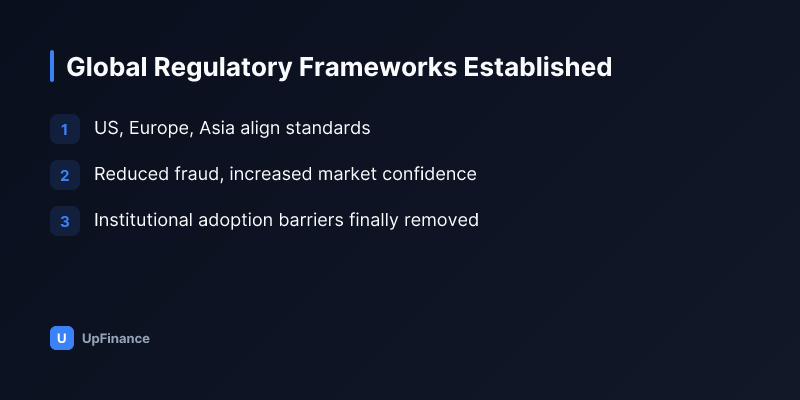
2026 will be the year crypto regulation becomes mainstream. Major economic powers—the US, Europe, and Asia—are establishing regulatory standards at similar levels.
Following MiCA's (Markets in Crypto-Assets Regulation) implementation in Europe, the US has introduced specific regulatory proposals including FIT21 and SAB 121 amendments. South Korea's Financial Services Commission and Financial Supervisory Service are also overhauling their blockchain business licensing systems.
Positive impacts of regulation:
- Reduced fraud projects and increased market confidence
- Removal of institutional investor barriers to entry
- Legal recognition of crypto assets
- Clear tax calculation standards
The Importance of Risk Management
As regulation clarifies, transparent fund flows and identity verification become mandatory. Individual investors must complete KYC (Know Your Customer) procedures, meaning more personal data will be connected on-chain.
Key considerations for 2026 investors:
- Use only licensed exchanges
- Fulfill tax reporting obligations
- Maintain transparency in asset management
Trend 3: Expansion of Real World Asset (RWA) Tokenization
Real Assets Come On-Chain
RWA (Real World Asset) will be the growth engine of the blockchain industry in 2026. While blockchain has primarily dealt with virtual tokens, the movement toward digitizing real assets—real estate, artwork, bonds—is accelerating.
Key RWA sectors:
- Real Estate: Tokenizing ownership of buildings and land
- Art & Collectibles: Verifying ownership of paintings and antiques
- Bonds: On-chain issuance of government and corporate bonds
- Commodities: Futures contracts for gold, oil, and other commodities
- Intellectual Property: Tokenizing patents and music rights
This innovation can fundamentally solve the liquidity problems faced by traditional finance.
Institutional Investor Entry at Scale
Major US asset managers (BlackRock, Fidelity, and others) are actively entering the RWA market. The global RWA market is projected to exceed $1 trillion by 2026.
For individual investors, this means:
- Access to high-value assets with minimal capital
- 24/7 trading capability
- Higher returns through elimination of intermediaries
UpFinance is strengthening its fundamental analysis capabilities for RWA projects.
Trend 4: Layer 2 and Sidechain Competition
The Era of Scalability Competition
Blockchain's critical weakness—transaction speed and cost—is expected to be nearly resolved by 2026. Layer 2 solutions like Arbitrum, Optimism, and Polygon are capturing increasing user adoption.
Current state:
- Ethereum mainnet: ~15 transactions per second
- Arbitrum: 4,000+ transactions per second
- Polygon: 7,000+ transactions per second
Characteristics of Layer 2 networks:
- Low transaction fees: Under $1 per transaction
- Fast processing: Completion in seconds
- High security: Connected to the main chain
- Diverse ecosystems: DeFi, NFTs, gaming, and more
The Importance of Ecosystem Selection
In 2026, which Layer 2 you hold assets on will significantly impact returns. Each network supports distinct protocols and tokens with growth potential.
Key factors for investors to consider:
- Daily active user trends on the Layer 2
- TVL (Total Value Locked) growth rate
- New project onboarding activity
- Governance token value trajectory
Trend 5: Evolution of Asset Management and DeFi Technology
The Emergence of Sophisticated Portfolio Management
2026 marks the end of DeFi's early stage. Complex financial products are now deliverable on-chain.
Emerging DeFi trends:
- Structured Financial Products: On-chain options and futures-like instruments
- Automated Rebalancing: AI-driven portfolio optimization
- Cross-Chain Trading: Seamless asset exchanges across multiple blockchains
- Composable Protocols: Financial services building blocks that combine like Lego
Advances in Risk Management
Past DeFi had a well-earned reputation for high risk. By 2026, insurance protocols, stablecoin diversification, and advanced collateral systems are expected to substantially mitigate these concerns.
A safer environment for individual investors:
- Thoroughly audited smart contracts
- Standardized multi-signature wallets
- Expanded DeFi insurance products
- Liquidation risk mitigation technologies
UpFinance's portfolio tracking feature allows unified management of assets distributed across multiple protocols, making it invaluable in 2026's complex DeFi landscape.
Your Blockchain Investment Strategy for 2026
Essential Checklist
When developing your investment approach based on these five trends:
- Verify technical progress of AI blockchain projects
- Choose regulation-friendly exchanges and protocols
- Validate underlying asset value of RWA tokens
- Monitor the ecosystem health of your preferred Layer 2
- Review smart contract audit reports for DeFi protocols
Comprehensive judgment across these elements is critical.
The Diversification Principle
"2026 is the year to build a balanced portfolio rather than going all-in on a single trend."
Consider allocating roughly 30% to AI blockchain companies, 20% to RWA projects, 20% to major Layer 2 tokens, 20% to DeFi protocols, and 10% to cash and stablecoins.
Of course, adjustments based on your personal risk tolerance and investment goals are necessary. Crypto investing still carries significant volatility, so only invest with disposable capital. Never use leverage irresponsibly or invest money needed for living expenses.
Given the rapid pace of blockchain development, now is the perfect time to understand this ecosystem and prepare. Join UpFinance and become an investor leading the charge through 2026's blockchain transformation.
This content is produced for marketing purposes by MIG Korea Group and is not investment advice. Crypto investing carries the risk of losing your principal; investment decisions are your own responsibility. UpFinance is the AI fintech service of MIG Korea Group.
Related posts
Start AI investing with UpFinance — free
Start free →Smart investing with UpFinance
AI-powered market analysis, automated portfolio rebalancing, and risk alerts.
We make crypto markets simple — without dumbing them down.