
The Fintech Revolution — Where Traditional Finance Meets Crypto
What Is the Fintech Revolution?
Financial technology is shaking up an industry long considered the most conservative. The fintech revolution goes beyond mere technological progress—it represents a fundamental paradigm shift in the entire financial ecosystem. Financial services once monopolized by traditional banks, brokerages, and insurers are now accessible through a single smartphone.
Over the past five years especially, the fintech market has experienced remarkable growth. Global fintech investment reaches tens of billions of dollars annually, and traditional financial institutions are reinventing themselves to keep pace with this momentum.
The Evolution of Traditional Finance
Banking is no longer confined to brick-and-mortar branches:
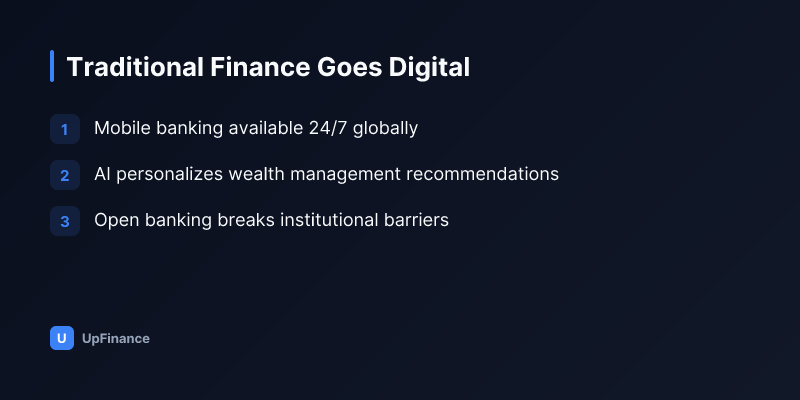
- Mobile banking expansion — Financial services available 24/7, anytime, anywhere
- AI-powered wealth management — Personalized investment portfolio recommendations tailored to individual needs
- Contactless payments — QR codes and mobile payments becoming everyday transactions
- Open banking — Breaking down barriers between institutions and opening up data sharing
Traditional financial institutions can no longer ignore digital transformation. Losing younger customers is not an option.
The Role of Crypto and Blockchain
Crypto is no longer simply a speculative asset. At its foundation lies blockchain technology—a revolutionary solution that, when combined with traditional finance, opens entirely new possibilities.
The Evolution of Crypto
Bitcoin's early promise was a currency free from central control. Today's crypto market is far more sophisticated:
- Stablecoins — Cryptocurrencies pegged to real-world assets (dollars, gold, etc.) to reduce price volatility
- DeFi (Decentralized Finance) — Direct peer-to-peer transactions without intermediaries
- Smart contracts — Self-executing agreements that dramatically reduce transaction costs
- NFTs and tokenization — Converting physical assets into digital form, creating entirely new asset markets
"The future of finance lies in harmony between centralization and decentralization. True revolution begins when crypto's transparency combines with traditional finance's stability." - International blockchain researcher
The Advantages Blockchain Brings
Let's examine how blockchain technology is transforming financial transactions:
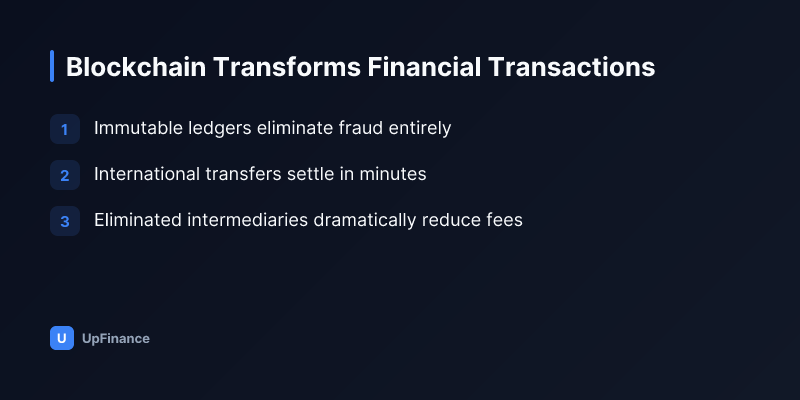
- Enhanced transparency — Every transaction recorded on an immutable public ledger, making fraud impossible
- Faster settlement — International transfers completed within minutes
- Cost reduction — Elimination of intermediaries dramatically lowers fees
- Financial inclusion — Access to financial services for the unbanked population
- Smart contracts — Automatic execution when conditions are met
Real-World Examples of Traditional Finance and Crypto Convergence
The intersection of these two domains is already happening in practice.
Key Convergence Cases
Central Bank Digital Currencies (CBDCs) Digital currencies issued by central banks that leverage blockchain technology while maintaining state backing. South Korea is actively developing its own digital won.
Traditional Finance's Crypto Services Major brokerages and banks now offer cryptocurrency trading directly to customers—a signal of crypto's legitimacy.
Hybrid Financial Products New investment products combining traditional finance with crypto yields are emerging. Deposit accounts offering staking rewards are one example.
Integrated Finance Platforms AI fintech platforms like UpFinance are building ecosystems that unify traditional finance and crypto. The era of managing stocks, funds, and cryptocurrencies in one place is already here.
The Changing Regulatory Landscape
The fintech revolution isn't driven by technology alone. Proactive regulatory improvements are essential.
Global Regulatory Trends
South Korea's Approach The implementation of the Special Finance Information Act has strengthened transparency requirements for crypto exchanges. This balanced approach enhances investor protection while enabling industry growth.
International Standards Following FATF (Financial Action Task Force) recommendations, nations are implementing know-your-customer requirements for crypto transactions.
Institutional Investment Entry As regulatory clarity improves, institutional investors are entering the crypto market in force—a positive signal of market maturation.
The Future Shape of Fintech
What will financial services look like over the next 5 to 10 years?
Anticipated Changes
Complete Digital Asset Management Bank accounts, investment portfolios, and crypto wallets will be unified in a single platform. Users will see their complete financial picture at a glance and receive AI-powered advice for optimal decisions.
Personal Finance Automation AI and machine learning will automate individual financial activities—from salary deposits to investments, tax calculations, and retirement savings. Users can focus on decisions that truly matter.
Maturation of Decentralized Finance DeFi protocols will become increasingly stable and user-friendly. As institutional capital floods into this space, market depth will deepen considerably.
Bridging the Financial Gap Blockchain and crypto will provide financial access to populations currently underserved by traditional systems. A smartphone will be all that's needed to access financial services from anywhere in the world.
"The fintech revolution is not an ending but a beginning. True financial democratization stems not just from technology, but from accessibility and education."
What Young Investors Should Know
Your financial life is already changing. Young retail investors are the protagonists of this fintech revolution.
Practical Tips You Can Use Today
-
Build financial literacy — Basic understanding of crypto and blockchain is becoming as essential as traditional financial knowledge.
-
Diversify your assets — In Korea's low-interest-rate environment, savings accounts alone won't grow wealth. Explore stocks, funds, and crypto.
-
Choose trustworthy platforms — Use compliant AI fintech platforms like UpFinance to manage assets safely and receive credible investment guidance.
-
Stay informed — Track regulatory developments and industry news to ride the wave of change.
The Challenges of the Fintech Revolution
Not every revolution is smooth sailing. Significant obstacles remain:
-
Security threats — Mobile-based financial services may be more vulnerable to hacking and fraud.
-
Regulatory uncertainty — Many nations still lack clear crypto and fintech regulations.
-
The technology gap — Not everyone can easily adopt fintech. Generational differences in tech literacy could become problematic.
-
Systemic risk — Complete digitization of finance could amplify the impact of cyberattacks or system failures.
Conclusion
The fintech revolution has already begun and is irreversible. The boundary between traditional finance and crypto is collapsing, and their convergence will make financial services more accessible, efficient, and transparent.
To stay ahead of this change, continuous learning and adaptation are essential. Show interest in emerging financial technology, find products suited to your needs, and manage your assets safely through trusted platforms. The future of finance ultimately rests in your hands.
This content is produced for marketing purposes by MIG Korea Group and is not investment advice. Crypto investing carries the risk of losing your principal; investment decisions are your own responsibility. UpFinance is the AI fintech service of MIG Korea Group.
Related posts
Start AI investing with UpFinance — free
Start free →Smart investing with UpFinance
AI-powered market analysis, automated portfolio rebalancing, and risk alerts.
We make crypto markets simple — without dumbing them down.