
Bitcoin vs Altcoins: How AI Builds a Resilient Crypto Portfolio
The Great Crypto Portfolio Debate: Bitcoin Maximalism vs. Diversification
The cryptocurrency market presents investors with a fundamental strategic choice: concentrate wealth in Bitcoin, the oldest and most established digital asset, or diversify across altcoins—thousands of alternative tokens promising specialized utility or higher growth potential. This tension between safety and opportunity is not new, but AI now provides a third way: systematic diversification informed by real-time data and predictive models.
Bitcoin commands roughly 45-55% of total cryptocurrency market capitalization on any given day, yet altcoins collectively represent a comparable or larger pool of capital. For retail investors in Seoul, Singapore, New York, and Frankfurt, the question is no longer purely ideological. It has become quantitative: given your risk tolerance, time horizon, and capital constraints, what mix of Bitcoin and altcoins produces the best risk-adjusted returns?
The traditional answer relied on gut feeling, community sentiment, or the advice of crypto-native personalities. AI-driven portfolio construction sidesteps emotion by treating crypto asset allocation like institutional asset managers treat stocks and bonds—with data, correlation analysis, and rebalancing rules.
Understanding Bitcoin's Role: Digital Gold, Not Growth Stock
Bitcoin occupies a unique position in the crypto ecosystem. It is often called "digital gold" because it functions as a store of value rather than a technology platform. Unlike altcoins that promise innovations in smart contracts, privacy, scalability, or decentralized finance, Bitcoin remains intentionally simple: a peer-to-peer electronic cash system secured by proof-of-work mining.
From a portfolio perspective, Bitcoin is the anchor—the low-volatility, high-conviction core holding that defines your risk profile. Here is why:
- Largest network effects: Bitcoin has the deepest liquidity, the largest developer ecosystem, and the strongest brand recognition among institutional investors. Regulatory clarity—or at least regulatory precedent—tends to arrive for Bitcoin first.
- Low correlation with altcoins during calm markets: When the broader crypto market is stable, Bitcoin and altcoins sometimes move independently. This decorrelation provides genuine diversification benefit.
- Hedge against altcoin collapse: If an altcoin project fails due to technical flaws, governance disputes, or fraud, Bitcoin typically holds value. It acts as a hedge against idiosyncratic crypto risk.
- Institutional adoption path: Major corporations, sovereign wealth funds, and central banks that enter crypto almost always start with Bitcoin. This structural demand supports long-term price floors.
Conversely, Bitcoin's downsides are well known: it is slower and less feature-rich than newer altcoins, and its price volatility—while lower than many altcoins—still exceeds traditional assets by orders of magnitude. An investor seeking pure stability would choose sovereign bonds or money-market funds, not Bitcoin.
The Altcoin Opportunity: Where Growth Lives (and Risk Concentrates)
Altcoins represent the experimental frontier of blockchain development. Ethereum, for instance, evolved from a smart-contract platform into a settlement layer for decentralized finance. Solana emphasized throughput and cost efficiency. Polkadot and Cosmos pursued interoperability between blockchains. Newer tokens like Arbitrum and Optimism capture value from scaling Ethereum itself.
The appeal is clear: altcoins offer leverage to specific technological or use-case bets. An investor convinced that decentralized finance will dominate global financial infrastructure might overweight Ethereum or other DeFi-native tokens. One betting on gaming convergence with blockchain might allocate to gaming-focused altcoins.
However, altcoin risk is asymmetric and compounding:
- Execution risk: Altcoin projects are younger and less battle-tested. Technical bugs, abandoned development, or governance crises can crater token value from $100 to near zero.
- Regulatory risk: Altcoins face higher regulatory scrutiny than Bitcoin, particularly in Asia. South Korea's Digital Assets Committee and Japan's Payment Services Agency have tightened rules on altcoin listing and staking, adding friction for retail investors.
- Liquidity risk: Unlike Bitcoin, which trades in liquid pairs on every major exchange worldwide, many altcoins have thin order books. A large sell order can trigger sharp price declines.
- Narrative risk: Altcoin prices often depend on momentum, influencer endorsement, or technical hype cycles rather than fundamental utility. A shift in sentiment can obliterate gains.
The classic error is overweighting altcoins during bull markets, becoming emotionally attached to narrative, and holding too long into a downswing. AI portfolio tools address this by enforcing discipline.
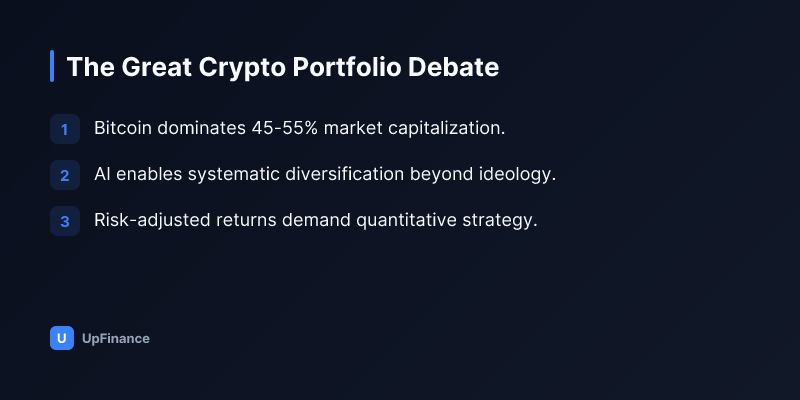
How AI Rebalancing Works: From Theory to Practice
AI-driven portfolio management applies three core principles to the Bitcoin-altcoin allocation problem:
Correlation and Covariance Analysis
AI models ingest months or years of historical price data for Bitcoin, Ethereum, and dozens of other altcoins. They compute how returns move together. During certain periods—typically bull markets—altcoins exhibit high positive correlation with Bitcoin, providing little diversification benefit. During bear markets or technical innovations that favor specific chains, correlations can break down.
An intelligent rebalancing algorithm detects these regime changes and adjusts allocations. When Bitcoin and altcoins are highly correlated, the algorithm tilts toward Bitcoin to reduce redundancy. When correlations weaken, it may increase altcoin exposure to capture idiosyncratic upside while Bitcoin remains as the ballast.
Volatility Targeting
AI models measure the standard deviation of returns for each asset class over rolling windows. A portfolio targeting 15% annualized volatility adjusts its Bitcoin-to-altcoin ratio to stay within that band. If altcoins surge in value and now comprise 60% of your portfolio's notional exposure while volatility remains stable, the algorithm sells some altcoins and buys Bitcoin to re-establish the target ratio.
This sounds mechanical, but it is powerful: it forces selling highs and buying lows automatically, without emotional friction.
Sharpe Ratio Optimization
The Sharpe ratio measures risk-adjusted returns: how much excess return (above a risk-free rate) you earn per unit of volatility. AI models calculate the Sharpe ratio for Bitcoin, the Sharpe ratio for each major altcoin, and the Sharpe ratio for the combined portfolio.
The algorithm then searches for the allocation—say, 70% Bitcoin, 15% Ethereum, 10% Solana, 5% Polkadot—that maximizes the portfolio Sharpe ratio. This does not guarantee the highest absolute returns, but it optimizes the return-per-unit-of-risk, which is what matters for sleep-at-night diversification.
Regional Variance: Asian Markets and Staking Complexity
In South Korea, where crypto adoption is exceptionally high, many retail investors use exchange-based staking and yield farming as a way to boost returns. Platforms like Upbit and Coinbase offer staking rewards for Ethereum, Solana, and other proof-of-stake altcoins. An AI portfolio manager operating in South Korea must account for staking yield when calculating expected returns and rebalancing decisions.
For example, if Ethereum staking yields 4% annually in KRW terms but Bitcoin produces zero direct yield, the Sharpe ratio comparison is not purely price-based; it includes the staking income. An algorithm that ignores this context would misevaluate the true return profile.
Japan presents a different constraint: the country's Payment Services Agency (PPA) maintains a whitelist of approved crypto assets for retail trading, and altcoins not on that list face practical barriers. An AI portfolio manager serving Japanese investors must restrict allocations to PPA-approved tokens, reducing the altcoin universe significantly compared to US or EU investors.
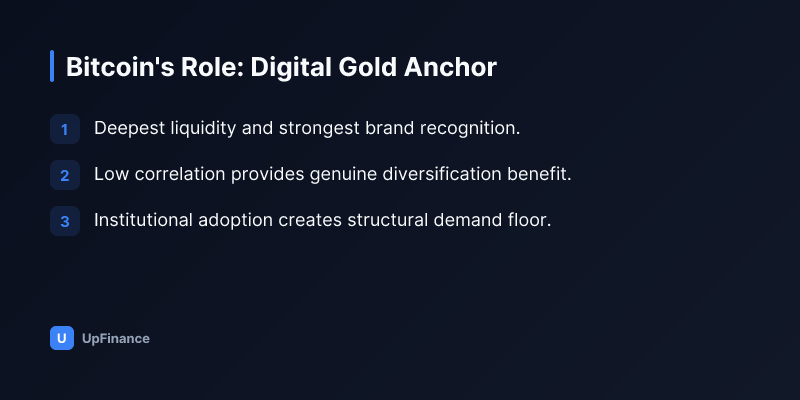
Building a Resilient Portfolio: Practical AI-Driven Strategies
The Core-Satellite Model
One of the most popular AI-informed strategies is "core-satellite" allocation:
- Core (70-80%): Bitcoin and possibly Ethereum, held in a long-term, low-turnover position. These are your conviction holdings, the ballast that prevents catastrophic loss.
- Satellite (20-30%): A rotating basket of 3-8 altcoins selected by AI based on momentum, technical signals, correlation, and fundamental metrics. The satellite position is rebalanced monthly or quarterly, trimming winners and adding to positions that show promise.
Why this works: The core locks in the diversification benefit and downside protection of Bitcoin's network stability. The satellite lets you capture altcoin upside without exposing your entire portfolio to idiosyncratic risk. UpFinance's AI models, for instance, can monitor thousands of altcoins and identify which ones are breaking out of downtrends or showing sustainable adoption metrics.
Threshold-Based Rebalancing
Instead of rebalancing on a fixed schedule, AI can monitor portfolio drift and rebalance only when allocations stray from targets by a threshold—say, 5%. This reduces transaction fees and tax drag.
Example: Your target is 75% Bitcoin, 25% altcoins. Bitcoin rallies, pushing the ratio to 80/20. You do not rebalance. But if Bitcoin then surges to 85/15, the algorithm triggers a rebalance, selling 10% of Bitcoin and buying altcoins to return to 75/25.
Drawdown Protection via Correlation Breaks
Advanced AI systems detect when Bitcoin and altcoin correlations spike suddenly—a sign of systemic stress or market panic. During these episodes, altcoin prices can fall faster than Bitcoin, wiping out diversification benefits.
The algorithm can respond by temporarily reducing altcoin exposure or switching to more defensive altcoins (those with active development, institutional backing, or stablecoin utility rather than pure-play speculation). Once correlations normalize, the algorithm rebuilds the satellite position.
Yield-Aware Allocation for Staking Regions
In markets where altcoin staking is accessible and profitable (South Korea, Singapore, parts of Europe), AI can incorporate expected staking rewards into return calculations. A model that accounts for 4-5% annual staking yield on Ethereum may rationally allocate more to Ethereum relative to pure capital-appreciation Bitcoin than a model that ignores yield.
This is especially relevant for buy-and-hold investors with long time horizons; compounded staking rewards can meaningfully boost returns.
Risk Management: What AI Cannot Prevent
It is crucial to understand the limits of AI portfolio management. Machine learning and statistical optimization are powerful tools for diversification and rebalancing discipline, but they do not eliminate crypto's fundamental risks:
- Black swan events: A catastrophic security flaw in Bitcoin or Ethereum, a regulatory ban in a major market, or a geopolitical shock (e.g., crypto ban by China 2.0) can reset the entire market. AI models trained on historical data will not predict truly novel events.
- Model overfitting: AI systems trained on recent bull-market data may assume continued correlation patterns that do not hold in downturns. Backtesting often looks better than forward performance.
- Liquidity crises: During panics, even large altcoins can experience funding rate spikes on leveraged trading platforms, or bid-ask spreads widen sharply. An AI algorithm telling you to buy Ethereum at the lows is unhelpful if you cannot execute because the order book has vanished.
- Regulatory whiplash: A sudden regulatory shift—like South Korea tightening altcoin rules or the EU's Markets in Crypto Regulation (MiCA) creating new compliance burdens—can devalue altcoins overnight. AI models cannot predict regulatory decisions.
The responsible approach is to use AI as a tool for systematic discipline, not as a source of alpha or a substitute for due diligence. Pair AI portfolio management with a core conviction about why you own crypto at all, and maintain cash reserves to weather drawdowns.
Comparing AI-Managed vs. Manual Crypto Portfolios
A simple comparison illustrates the value of AI-driven rebalancing:
Manual investor approach: Buys 80% Bitcoin and 20% Ethereum in January 2024. Ethereum rallies 150% while Bitcoin gains 80%. By June, the portfolio is 65% Bitcoin and 35% Ethereum, well above the intended risk level. The investor is either unaware of the drift or emotionally attached to Ethereum's outperformance and does not want to "lock in" gains by rebalancing. In July, a market correction hits; altcoins fall 40% while Bitcoin falls 15%. The portfolio loses 27% versus the intended 18% for the rebalanced equivalent.
AI-managed approach: The same allocation starts at 80/20 in January. As Ethereum outperforms, the algorithm detects the drift. In March, it rebalances, selling 10% of the Ethereum gains and buying Bitcoin to restore the 80/20 ratio. The same July correction hits; the AI-managed portfolio is 82/18 due to normal volatility, very close to target. It loses 16%, only 1-2% worse than target despite the same market swings.
The edge is not dramatic, but over a decade of multiple market cycles, behavioral discipline compounds. AI removes the emotional friction that causes retail investors to buy high and sell low.
Regional Insights: Altcoin Strategies by Market
United States and Europe
The US and EU markets have relatively permissive altcoin access; retail investors can trade hundreds of tokens on Coinbase, Kraken, and Bitstamp. Regulatory framework is evolving (MiCA in EU, SEC guidance in US), but both allow broad exposure. AI portfolios here can be more aggressive in altcoin allocation because liquidity and regulatory risk are lower.
A common profile: 60% Bitcoin, 25% Ethereum, 15% emerging altcoins (Solana, Arbitrum, Optimism, Chainlink, or sector-specific tokens like Uniswap for DeFi conviction).
South Korea
South Korea's market is the most retail-heavy globally and features the highest per-capita crypto adoption. However, regulatory tightening and exchange-based compliance create constraints:
- Upbit and Bithumb (South Korea's largest exchanges) have strict listing policies. Unlisted altcoins cannot be traded on these platforms, limiting retail access.
- Staking and yield farming are popular; AI models must account for rewards in KRW.
- Leverage is widespread; many Korean retail traders use 5x-10x leverage on altcoin trades, creating systemic fragility. An AI portfolio for the Korean mass market would typically be de-leveraged (1:1 or lower) to avoid cascade liquidations.
A prudent profile: 70% Bitcoin, 20% Ethereum, 10% KRW-liquid altcoins (Solana, Polkadot, staking-enabled tokens). De-leverage by default; recommend staking for yield rather than leverage for returns.
Japan
Japan's regulatory environment is institutionally mature but restrictive:
- Only PPA-approved altcoins can be traded on regulated exchanges (Coinbase Japan, DeCurret, etc.). This list includes Bitcoin, Ethereum, Litecoin, and a handful of others—but excludes thousands of tokens traded freely in the US.
- Institutional interest is growing, but retail participation is more conservative than in South Korea.
- Tax treatment is clear but onerous: gains are treated as miscellaneous income taxed at progressive rates up to 55%, encouraging long-term holding.
A Japanese-optimized profile: 75% Bitcoin, 20% Ethereum, 5% other PPA-approved tokens (Litecoin, Ripple). Leverage is discouraged by regulation; long-term holding is tax-efficient.
Southeast Asia (Singapore, Thailand, Vietnam)
Southeast Asia is emerging as a crypto hub due to liberal regulations and young, tech-savvy populations. However, market infrastructure varies:
- Singapore has clear frameworks (Payment Services Act), institutional-grade exchanges (Crypto.com, Binance Singapore), and deep liquidity. Portfolios here can mirror US risk profiles.
- Thailand restricts leverage but allows broad altcoin access; institutional adoption is growing.
- Vietnam has informal but growing markets; regulatory clarity lags, creating execution risk.
A Southeast Asia profile might be: 65% Bitcoin, 25% Ethereum, 10% altcoins with strong Asia presence (layer-2 solutions, regional DeFi tokens). Liquidity considerations matter more than in developed markets; rebalancing via limit orders is preferred to market orders.
The Practical Implementation: Using UpFinance and Similar Tools
Modern AI portfolio management is no longer the domain of quant hedge funds. Retail investors can now access AI-driven crypto portfolio tools via platforms like UpFinance, which combines machine learning, correlation analysis, and rule-based rebalancing into a single interface.
Here is how a typical workflow looks:
- Input your preferences: Target volatility (e.g., 20% annually), risk tolerance (conservative, moderate, aggressive), and geographic constraints (e.g., only PPA-approved tokens for Japan).
- Approve initial allocation: The AI recommends a Bitcoin-Ethereum-altcoin split based on current correlation and volatility. You review and approve.
- Set rebalancing rules: Rebalance monthly, or trigger rebalancing only if allocations drift by 10%. Specify tax-loss harvesting preferences if applicable.
- Monitor and adjust: The system alerts you if major market shifts occur or if allocations drift significantly. You can manually override recommendations if your conviction changes.
- Harvest insights: Over time, the system provides reports on which altcoins outperformed, which rebalancing decisions were beneficial, and how your portfolio's Sharpe ratio compares to a pure Bitcoin holding or pure altcoin holding.
The key advantage of AI tools is that they reduce operational friction. Instead of manually checking portfolio weights every week or month, the algorithm does it automatically while you focus on higher-level strategy.
Common Mistakes and How AI Helps Avoid Them
Mistake 1: Overweighting Narrative-Driven Altcoins
Many investors fall for compelling stories: "This token will revolutionize DeFi" or "This blockchain is faster than Ethereum." They overweight the altcoin, it experiences a bull run, and they hold too long. The narrative becomes reality until it suddenly does not.
AI helps by keeping positions sized to target allocations. If your rule is 10% maximum per altcoin, the algorithm sells 5% of your position as it appreciates, locking in gains and preventing catastrophic concentration.
Mistake 2: Panic Selling During Drawdowns
Crypto bear markets are steep and fast. A 30-40% drawdown in six months is not unusual. Emotional investors sell everything, locking in losses. AI portfolio systems recommend rebalancing into the drawdown instead, automatically buying the dip with funds that drift from Bitcoin (which typically declines less than altcoins).
Mistake 3: Ignoring Correlation Changes
An investor might build a 50/50 Bitcoin-altcoin portfolio assuming correlations stay low. In a true market panic, correlations spike to 0.9 (nearly perfect), and both fall together. The diversification benefit evaporates. AI systems detect this and can reduce altcoin exposure before the collapse, or trigger manual review so you understand the risk shift.
Mistake 4: Chasing Shitcoins
Not all altcoins are equal. Some are genuine innovations; others are pure speculation or outright scams. A retail investor can spend months researching tokens only to pick losers. AI systems typically exclude tokens below a minimum market cap, those with concentrated ownership, or those with suspicious trading patterns. This is not foolproof, but it screens out the worst offenders.
Mistake 5: Neglecting Taxes and Fees
Each rebalancing trade generates a taxable event (in most jurisdictions). An investor who rebalances monthly may accumulate a large tax bill. AI systems can incorporate tax-loss harvesting (selling losing positions to offset gains) and can space rebalancing to minimize turnover, especially in high-tax regions.
Looking Ahead: AI's Evolution in Crypto Portfolio Management
The field is moving fast. Near-term developments to watch:
- On-chain data integration: AI models will increasingly ingest on-chain metrics—transaction volumes, developer activity, whale movements, staking participation—to predict price movements and fitness. A token with declining developer activity may be a sell signal that price data alone would miss.
- Sentiment analysis: Machine learning can parse social media, news, and forum discussions to gauge altcoin sentiment independently of price. When sentiment breaks below a threshold, the algorithm may reduce exposure before price crashes.
- Cross-chain risk modeling: As interoperability protocols mature, portfolios will be optimized across multiple blockchains. An investor might hold Bitcoin on the Lightning Network, Ethereum on the mainchain, and Solana as a liquidity farm, all coordinated by a unified AI manager.
- Regulatory integration: AI systems will track regulatory news and proposals in real time. If a major market (EU, US, or Asia) signals altcoin restrictions, the algorithm can automatically adjust allocations or alert investors to compliance risks.
Looking further out, AI-managed crypto portfolios may become as routine as robo-advisors for stocks and bonds. The technology is already mature; adoption is the remaining frontier.
This content is produced for marketing purposes by MIG Korea Group and is not investment advice. Crypto investing carries the risk of losing your principal; investment decisions are your own responsibility. UpFinance is the AI fintech service of MIG Korea Group.
Related posts
Start AI investing with UpFinance — free
Start free →Smart investing with UpFinance
AI-powered market analysis, automated portfolio rebalancing, and risk alerts.
We make crypto markets simple — without dumbing them down.