
DeFi Yield Strategies in 2026: Real APYs vs Marketing APYs
The APY Illusion: Why 847% Yields Don't Mean What They Sound Like
If you've scrolled through DeFi protocols in the past year, you've probably seen it: a gleaming yield percentage that seems almost too good to be true. Often, it is.
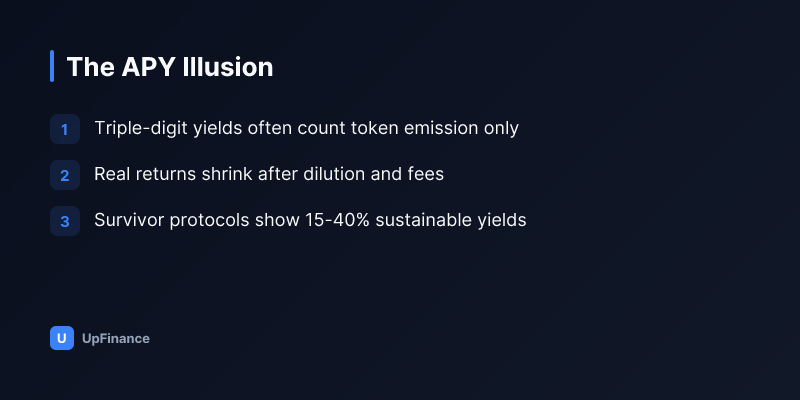
The gap between advertised APY and actual take-home returns has never been wider than it is in 2026. Most projects marketing triple-digit APYs are counting in sheer token emission, not actual user capital gains. And when you factor in token dilution, impermanent loss, and transaction fees, the real yield often sits at a fraction of the advertised number.
The problem starts with how APY is calculated and communicated. A protocol might claim 500% APY by dividing its total annual token emissions by the liquidity pool size. But if those emissions represent 80% of the protocol's actual revenue generation, you're essentially getting paid in newly created tokens—tokens that immediately dilute your share and typically drop in price as they hit exchanges.
"The difference between sustainable yield and marketing yield is the difference between earnings and dilution. One compounds your wealth; the other distributes it across more tokens." — DeFi analyst consensus, 2026
This became especially apparent after the 2024-2025 crash cycle. Protocols that promised 200%+ APYs with no fundamentals behind them simply ceased operations or saw their tokens crater by 95%+. Survivor protocols—the ones still running strong in 2026—typically advertise 15-40% real APY, and most of that comes from transaction fees or actual protocol revenue, not emissions.
Understanding Real Yield vs Token Emissions
The distinction matters profoundly, and it's where UpFinance's AI-driven portfolio analysis tools help investors separate signal from noise.
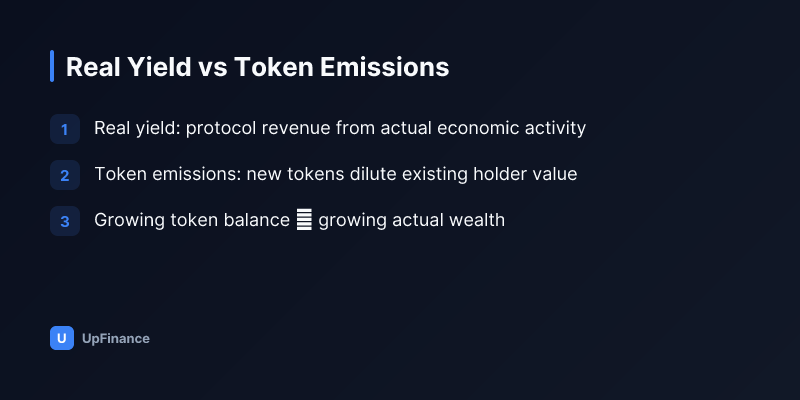
Real yield comes from protocol revenue: trading fees, liquidation penalties, borrowing interest paid by real users, or governance revenue. If a lending protocol earns 8% APY from actual borrower interest payments, that's real yield. You're being compensated for real economic activity.
Token emissions yield is different. The protocol mints new tokens and distributes them to liquidity providers. If you're earning 300% in newly minted governance tokens, the protocol is paying you in dilution. Your token balance grows, but the value of each token typically shrinks proportionally—or worse.
The Math of Dilution
Let's use a concrete example:
- You deposit $10,000 into a DeFi pool offering 400% APY (all in newly minted tokens)
- After one year, you've received $40,000 worth of tokens at entry price
- But the protocol has minted enough new tokens to pay everyone: say, 1 million new tokens entered circulation
- The token's market cap didn't grow; the community just got diluted
By month six, the token has already declined 40% as the market recognizes the dilution. Your $40,000 of earned tokens is now worth $24,000. You've lost more than you gained, even without impermanent loss.
Real yield protocols, by contrast, might only offer 18% APY—but it comes from sustainable fee revenue. If the protocol actually processes $500 million in daily volume and captures 0.05% in fees, those payouts will continue whether markets boom or crash.
Red Flags: How to Spot Unsustainable Yields
By 2026, the warning signs are well-documented. If you see any of these, proceed with extreme caution:
-
Yields don't correlate with protocol revenue. If a protocol claims 120% APY but its actual trading volume suggests it only captures $5 million annually, the math doesn't work. Cross-check claimed yields against on-chain revenue data (available through Dune Analytics, Messari, and similar tools).
-
Governance token emissions exceed 30% of annual supply. If a protocol is minting more than 30% of current supply annually as incentives, it's essentially running a high-velocity dilution machine. Eventually, these protocols either shut down emissions (causing yields to crater), or they collapse entirely.
-
The protocol offers different yields to different depositors. Some projects offer insanely high yields for new deposits, then slash them once the pool reaches a certain size. This is classic ponzi-scheme behavior: early depositors are paid from later deposit inflows, not from actual revenue.
-
No clear path to sustainability. Ask: when will this protocol stop needing to mint tokens to attract liquidity? If there's no answer—or if the answer is "never"—the protocol has no economic moat. It's subsidizing yield indefinitely.
-
The project team has weak skin in the game. If founders didn't lock up significant tokens or if they're actively selling through every market cycle, they've already de-risked themselves. You're holding the bag.
Korean and Japanese markets have historically been particularly vulnerable to yield farming hype. In South Korea, the retail crypto investor demographic skews younger and more aggressive, with many willing to chase 200%+ yields with minimal due diligence. Japanese retail investors, while more conservative on average, still faced serious losses from projects like Celsius and Luna that marketed stable yields before imploding. Check whether a protocol has clear Korean or Japanese regulatory approval before deploying capital there—many high-yield projects operate in gray zones.
The 2026 Yield Hierarchy: Where Real Returns Live
The DeFi landscape has consolidated around a few reliable yield sources. Understanding this hierarchy helps you allocate efficiently:
Tier 1: Blue-Chip Protocol Yields (8-18% Real APY)
These are the survivors: Uniswap, Aave, Curve, Lido, MakerDAO, and their peers. They're boring, which is the point. They offer yields primarily from:
- Trading fees on decentralized exchanges
- Borrowing interest on lending platforms
- Staking participation rewards
Uniswap's fee-earning positions (concentrating liquidity in tight ranges) now consistently deliver 12-16% APY to sophisticated LPs. Aave offers 4-9% on stable deposits, depending on market conditions. These returns are sustainable because they're not propped up by token emissions alone.
The trade-off: You're competing with professional market makers and arbitrage bots. Impermanent loss is real on volatile pairs. But at least you're not gambling on token prices.
Tier 2: Emerging Protocol Yields (20-50% Real APY)
Smaller but growing protocols with genuine utility might offer 25-40% real APY. Think specialized lending pools for emerging asset classes, niche derivatives platforms, or regional protocols with strong product-market fit.
The key difference from Tier 1: these are still earning meaningful protocol revenue, but they haven't reached the scale that lets them lower yields to Tier 1 levels. They're still in growth mode, offering higher returns to attract liquidity.
The calculation: If a protocol does $50 million daily volume and captures 0.1% in fees, that's $50 million annually in gross revenue. Split across $100 million in total liquidity, that's 50% annual revenue. After operational costs, maybe 30-35% of that flows to LPs as yield.
Tier 3: Synthetic Yield and Composability (Variable, 15-200%+)
This is where things get creative and risky. Projects like Yearn Finance, Convex, and other yield optimizers use leverage and multi-protocol strategies to boost returns. A "delta-neutral" farming strategy might compound yields from three protocols simultaneously, targeting 60-120% annual returns.
These work when market conditions align. They blow up spectacularly when they don't. The 2024 Lido-Curve depegging crisis, for example, liquidated billions in levered positions within hours. Composability amplifies both gains and losses.
Tier 4: Anything Promising 200%+ APY
In 2026, this category is mostly graveyard. If a project is still offering these yields, ask yourself: would a rational protocol operator rather pay 300% APY to attract $100 million in liquidity, or would they scale their product to earn fees naturally?
The only exceptions are genuine alpha strategies—but those are rarely public, and if they are, they're expensive to access and require heavy AI/algorithmic trading expertise.
How AI and Algorithmic Tools Are Changing Yield Strategy
The democratization of AI in crypto investing has fundamentally shifted how informed investors approach yield farming. In 2026, the edge increasingly belongs to those using data-driven tools to:
Optimize portfolio allocation across protocols. Instead of dumping $50,000 into a single 45% APY pool, AI tools can backtest allocations across 10-15 protocols, accounting for historical impermanent loss, slashing risks, and protocol correlation. UpFinance's portfolio optimization uses machine learning to suggest allocations that maximize risk-adjusted returns rather than nominal APY.
Monitor real-time yields and protocol health. Token emissions, protocol revenue, and TVL change constantly. Spreadsheets can't keep up. Automated monitoring systems alert you when a protocol's real yield dips below a threshold or when risk metrics degrade. This lets you exit before the protocol becomes a zombie.
Model dilution forward. An AI system can ingest a protocol's emission schedule, historical price data, and volume trends to forecast where the token price will trade in 3, 6, and 12 months. This lets you contextualize the 120% nominal APY against realistic token depreciation.
Identify emerging opportunities early. By analyzing on-chain metrics (new smart contract interactions, fee growth, capital inflows), AI can identify protocols in genuine product-market fit before yields compress. You get to stake capital when yields are still high but the fundamentals are real.
The key advantage: you're no longer comparing marketing numbers; you're comparing risk-adjusted, forward-looking expected returns. Most retail investors still use the APY listed on the website. Serious investors use models.
Geographic Nuance: DeFi Yields Across Regions
DeFi is global, but yield opportunities and risks vary significantly by geography.
United States and EU: The home markets for most major DeFi protocols. Regulatory clarity has improved significantly by 2026, with staking and yield farming generally permissible under securities law (though tax treatment remains complex). Competition among protocols is fierce, so sustainable yields have compressed to 12-22% for most opportunities. The advantage: low regulatory risk and established on-ramp infrastructure. The downside: lower yields and heavier bot competition.
Southeast Asia (Thailand, Vietnam, Singapore): Retail yield farming remains popular, partly due to currency dynamics. A 25% yield in USD terms is a 35-40% yield in THB terms for local investors. Many regional exchanges (Binance, OKX) offer incentives and yield products tailored to Southeast Asian users. Regulatory clarity is improving but still patchy. Risks include liquidity fragmentation and lower scrutiny of protocols.
South Korea: Korean retail investors have historically been aggressive yield chasers, which created opportunity windows for well-timed DeFi plays. However, Korea's regulatory environment has tightened significantly post-FTX. The Financial Services Commission (FSC) has clarified that high-yield products require explicit disclosures and risk warnings. Korean-denominated yield opportunities (KRW staking, KRW-denominated pools) are less common but sometimes offer premium yields due to lower competition. Be aware that yield farming services are monitored closely and any protocol without clear compliance can face rapid delisting from Korean exchanges.
Japan: Japanese regulatory framework is clearer than Korea's, thanks to the Payment Services Act (PSA). This has made Japan somewhat more conservative; you'll see fewer 100%+ APY opportunities, but more established ones. Japanese retail investors tend toward lower-risk yields (10-20% range) backed by real protocol revenue. Yen-denominated yields can sometimes offer opportunities due to the yen carry trade dynamics, but these are less common post-2024.
Building a Diversified Yield Portfolio for 2026
Rather than chase a single high-yield opportunity, consider this framework:
Core allocation (60-70%): Tier 1 blue-chip yields. Park this in established protocols earning real fees. Aim for 12-18% blended real APY. Rebalance quarterly.
Growth allocation (20-30%): Emerging protocols with good fundamentals. Select 4-6 protocols with strong daily volume growth, reasonable emissions schedules, and clear paths to profitability. Target 25-40% real APY. Monitor monthly for changes in protocol health.
Opportunistic allocation (0-10%): Emerging alpha strategies. This is your risk capital. Use AI tools to identify protocols in genuine product-market fit that haven't yet had yields compress. You might get 50-100% APY here, but accept that some bets will total loss. Only deploy capital you can afford to lose.
Rebalancing rule: If a protocol's real yield drops more than 30% without a corresponding drop in your APY (indicating you're being paid in emissions, not fees), reallocate. Protocol yields are meant to be dynamic; stale positions are risk concentrators.
A concrete 2026 example portfolio might look like:
- 35% in Lido staking (Ethereum validator rewards, ~6% real APY)
- 20% in Uniswap concentrated liquidity positions on major pairs (~15% real APY after IL)
- 15% in Aave stable lending (~7% real APY)
- 15% in a mid-cap protocol with strong fee revenue (~32% real APY)
- 10% in experimental yield strategies (managed via AI optimization)
- 5% in cash/stablecoins (for opportunistic entries)
This blended approach targets a real, risk-adjusted 14-16% annual return—nothing flashy, but solid, and defensible across a full market cycle.
The Tax and Accounting Reality
One final detail that separates winners from losers: taxes.
In the US, every yield event is a taxable transaction. If you earn 45% APY in governance tokens, you owe income tax on the full value at issuance—even if you don't sell. Many retail investors in 2025-2026 are facing six-figure tax bills from yield farming they thought was "free money."
In Korea, crypto income is subject to 20% capital gains tax on profits above 250,000 KRW annually. Yield farming income is classified as business income, which can push you into higher tax brackets. Always consult a Korean tax advisor before deploying serious capital into yield strategies; the FSC has been actively auditing high-yield participants.
In the EU, yields are taxed as ordinary income in most countries. France, Germany, and the UK all have different rules, but all require tracking and reporting. The compliance burden is real.
This changes the math significantly. A 35% nominal APY in a high-tax jurisdiction (US, most of EU) is closer to a 21-24% real APY after taxes. Factor this into your yield targets.
This content is produced for marketing purposes by MIG Korea Group and is not investment advice. Crypto investing carries the risk of losing your principal; investment decisions are your own responsibility. UpFinance is the AI fintech service of MIG Korea Group.
Related posts
Start AI investing with UpFinance — free
Start free →Smart investing with UpFinance
AI-powered market analysis, automated portfolio rebalancing, and risk alerts.
We make crypto markets simple — without dumbing them down.