
Asia's AI Fintech in English
AI-powered crypto insights, Korean and Japanese market trends, and on-chain intelligence from the team behind UpFinance.
Licensed. Compliant. Borderless. 🌐
Wealth Favors the Explorers — but only when it is built on a foundation you can trust. In Web3, speed means nothing without security. That is why UpFi
UpFinance User Guide — Getting the Most Out of Your AI Investment Platform
Learn how to fully leverage UpFinance's AI capabilities. Step-by-step guidance and practical tips for both beginners and experienced investors.
One Wallet for All Your Assets. 📱
Wealth Favors the Explorers. For too long, managing crypto and fiat has meant switching between apps, juggling wallets, and dealing with fragmented ex
Web3 Wallet Security — AI-Powered Fraud Detection
Discover how AI-based fraud detection technology protects Web3 wallets. From smart contract monitoring to transaction pattern analysis.
Your digital life, sorted with one card. 💳
At UpFinance, our vision goes beyond just payments — we are building the ultimate bridge between your digital assets and your everyday life. We believ
NFT Market Revival — AI's Discovery of Valuable Digital Assets
Explore how AI technology is reshaping the NFT market and discover the future of identifying valuable digital assets.
Sentiment Analysis in Crypto Markets: Turning Twitter Noise into Signals
The Signal-to-Noise Problem in Crypto Twitter
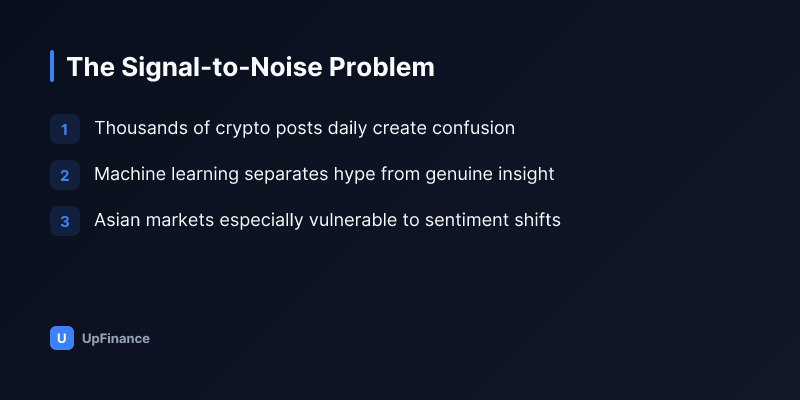
The cryptocurrency market never sleeps, and neither does Twitter. Every second, thousands of posts mention Bitcoin, Ethereum, or the latest altcoin. For retail investors—whether checking price action from Seoul, Singapore, or San Francisco—this creates a genuine problem: how do you separate legitimate market insight from hype, FUD (fear, uncertainty, doubt), and coordinated pump-and-dump schemes?
This is where sentiment analysis enters the picture. Rather than manually scrolling through endless threads and Discord channels, sophisticated investors now use machine learning models to quantify the emotional temperature of the market in real time. The approach has evolved from simple keyword counting to nuanced natural language processing (NLP) that understands context, sarcasm, and even the subtle difference between genuine concern and coordinated misinformation.
For Asian fintech investors specifically, the stakes are particularly high. Korean exchanges like Upbit and Bithumb serve millions of retail traders who move on sentiment shifts within minutes. Japanese institutional investors, bound by stricter regulatory frameworks under the Financial Instruments and Exchange Act, rely more heavily on quantifiable signals. Southeast Asian markets, with their younger demographic and high mobile penetration, are especially vulnerable to viral social media movements. Understanding how to filter signal from noise in this environment can mean the difference between capturing alpha and falling prey to manipulation.
How Sentiment Analysis Actually Works in Practice
Sentiment analysis in crypto markets typically follows a pipeline: collection, preprocessing, analysis, and signal generation.
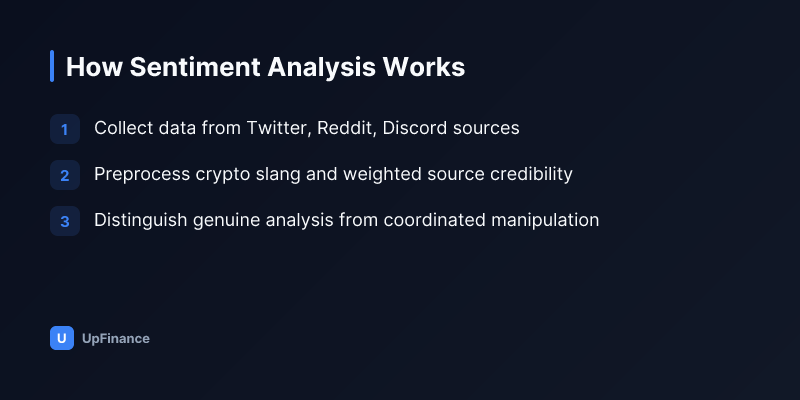
Data collection starts with API integrations to Twitter (now X), Reddit, Discord, and blockchain-specific forums. Most institutional approaches also weight sources differently—a verified analyst's tweet carries more signal weight than an anonymous account's post. This is crucial because crypto Twitter has notorious coordination problems. During the 2021 Dogecoin rally, sentiment metrics showed extreme positive bias, yet underlying fundamentals had barely moved.
The preprocessing stage handles the messy reality of social media language. Crypto-native slang must be interpreted correctly: "HODL" is bullish (hold on for dear life), while "bagholder" is bearish. Emojis carry meaning—rocket ships and to-the-moon language correlate with hype cycles. A sophisticated model must distinguish between:
- Genuine technical analysis (credible signals worth 10x weight)
- News commentary (moderate weight, time-sensitive)
- Community enthusiasm (noisy, high volume, low signal)
- Coordinated manipulation (often detectable through bot analysis and repetition patterns)
The analysis phase employs various techniques:
- Lexicon-based methods: Dictionary lookups for positive/negative words, fast but context-blind
- Machine learning classifiers: Trained on labeled datasets of bullish/bearish posts, better accuracy
- Transformer models: Modern deep learning (BERT, GPT variants) that understand context and nuance, highest accuracy but computationally expensive
- Aspect-based sentiment: Distinguishing whether sentiment is positive on "regulatory outlook" but negative on "network adoption"
Once sentiment scores are computed—typically on a scale from -1 (extreme bearish) to +1 (extreme bullish)—the system generates signals. A simple example: if sentiment suddenly shifts from 0.3 (mildly bullish) to -0.7 (bearish) within 30 minutes, that's an alert. More sophisticated systems calculate sentiment momentum, correlation with price action, and contrarian indicators (extreme sentiment often precedes reversals).
Practical Signal Generation: From Theory to Trade
Theory is elegant; practice is messier. The real challenge is converting sentiment data into profitable trades without overweighting social media chatter.
Consider a concrete scenario: Ethereum's Shanghai upgrade in April 2023. In the weeks leading up, sentiment on crypto Twitter was overwhelmingly positive. Most conventional sentiment models would have flagged a strong buy signal. But sophisticated investors using UpFinance's multi-factor approach could see the dilemma: positive sentiment was high, but so was volatility and whale whale sell-offs detected on-chain. The model could down-weight pure social sentiment and incorporate on-chain metrics (large holder movements, exchange inflows), institutional positioning, and technical levels. The result: a more balanced signal that captured upside without overexposure.
Here's a practical framework for actionable sentiment signals:
-
Sentiment velocity: Rate of change matters more than absolute levels. Rapid sentiment swings often precede price reversals.
-
Cross-platform correlation: If sentiment is bullish on Twitter but Reddit's r/cryptocurrency is skeptical, that divergence itself is a signal. Coordinated shilling typically shows up uniformly across platforms.
-
Time-lag adjustment: Social sentiment often leads price by 2–48 hours, depending on market conditions. Your model should optimize for this lag, not assume simultaneous correlation.
-
Volatility filtering: During extreme volatility, sentiment becomes noisier. Reduce position sizes or increase confidence thresholds.
-
Regulatory sentiment: Separate "market sentiment" from "regulatory sentiment." A negative regulatory post from a government official carries different weight than casual speculation.
The Korean market offers a particularly rich case study. Korean retail investors (흩어진 개미, "scattered ants") are known for coordinated retail behavior on platforms like Naver and Kakao. Sentiment models trained exclusively on English-language data miss this entirely. An investor monitoring KRW-denominated trading pairs on Upbit must account for Korean-language sentiment from Naver Finance forums and Kakao Talk group chats—networks largely invisible to global sentiment APIs. This local sentiment often leads global market movements by 6–12 hours, especially for altcoins with strong Korean community backing.
The Limitations and Pitfalls You Need to Know
Sentiment analysis is powerful, but it is not magic. Understanding its failure modes is as important as knowing when it works.
First, sentiment can be systematically manipulated. Coordinated campaigns—whether by projects shilling their tokens, competitors running FUD campaigns, or market makers moving prices—create false signals. In 2023, several low-cap altcoins saw coordinated Twitter campaigns that lifted sentiment to extreme levels without corresponding fundamental changes. Traders who relied purely on sentiment got liquidated within weeks.
Second, sentiment has low predictive power in certain regimes. During genuine black swan events—regulatory crackdowns, exchange hacks, macro market shocks—social sentiment becomes a trailing indicator, not a leading one. The May 2022 Terra/Luna collapse saw negative sentiment spike after the price had already crashed 80%. Sentiment was too late to matter.
Third, language models have cultural biases. Most sentiment models are trained primarily on English-language data from US and Western European markets. When applied to Japanese or Korean markets, where communication norms and market behavior differ significantly, accuracy degrades. Japanese investors tend to express bullish conviction more subtly than Americans; Korean retail traders use rapid-fire abbreviations that Western NLP models struggle to parse.
Fourth, there's the problem of crowding. As more investors adopt sentiment analysis, the edge diminishes. If everyone is watching the same sentiment signal, it becomes a crowded trade. The real alpha lies in finding signals that others miss—whether that's nuanced sentiment from undermonitored languages, or combining sentiment with unconventional data sources (on-chain metrics, whale movement, options market positioning).
"Sentiment analysis is a compass, not a map. It tells you the general direction of market flow, but not your exact destination or the obstacles ahead." — A sentiment analyst at a major crypto hedge fund
Building Your Own Sentiment Analysis System
If you're interested in implementing sentiment analysis yourself, here are the practical steps:
Stage 1: Data Infrastructure
- Set up API connections to Twitter Academic Research endpoint (requires approval), Reddit's pushshift archive, and Crypto News aggregators
- Store data in a queryable database (PostgreSQL, MongoDB, or cloud solutions like Google BigQuery)
- Implement rate limiting and error handling—social media APIs are unreliable
Stage 2: Text Preprocessing
- Tokenization: Split text into words and phrases
- Lowercasing and special character removal
- Crypto-specific vocabulary: Create a custom dictionary mapping slang to standardized terms
- Remove URLs, mentions, and emojis (or encode them separately)
Stage 3: Sentiment Scoring
- Start with a pretrained model like FinBERT (optimized for financial sentiment) or a general transformer like distilBERT
- Fine-tune on crypto-labeled data if possible (create or purchase datasets of manually labeled crypto posts)
- For production systems, ensemble multiple models—their disagreement is itself informative
Stage 4: Signal Generation
- Calculate rolling windows of sentiment (e.g., 1-hour, 4-hour, daily)
- Measure sentiment momentum (rate of change)
- Define threshold triggers based on historical backtesting
- Incorporate position sizing: Don't go all-in on extreme sentiment; size positions inversely to sentiment volatility
Stage 5: Backtesting and Validation
- Test your signals against historical data (minimum 2 years of price and sentiment history)
- Measure key metrics: hit rate, Sharpe ratio, maximum drawdown, Calmar ratio
- Account for trading costs—slippage and fees often erode sentiment-based strategies
- Crucially: Test on out-of-sample data (periods your model has never seen)
Tools like UpFinance can accelerate this process by providing pre-built sentiment APIs and historical backtesting environments, eliminating months of infrastructure work.
Sentiment Analysis Across Regional Markets
The global crypto market is not monolithic. Different regions have different sentiment dynamics.
United States & Europe: The largest, most liquid markets. Sentiment models trained here generalize reasonably well. Major regulatory news from the SEC or European Parliament moves sentiment uniformly across all USD and EUR trading pairs. English-language sentiment dominates.
Japan: The regulatory environment is exceptionally rigid. The Financial Instruments and Exchange Act (FIEA) heavily restricts retail leverage and derivatives. This means Japanese sentiment is less volatile—retail traders aren't as prone to emotional leverage-driven capitulation. Additionally, Japanese institutional investors read Japanese-language news and research from publications like CoinPost and Crypto Watch Japan. Sentiment models must incorporate these sources. One distinctive feature: Japanese whale behavior is highly coordinated (institutional syndicates), making on-chain sentiment (whale movements) more predictive than social sentiment.
South Korea: The retail trader density is extraordinarily high. Upbit and Bithumb have millions of active accounts, many engaging in 10-100x leverage on perpetual futures. This makes Korean sentiment exceptionally reactive and volatile. Korean-language sentiment on Naver Finance and KakaoTalk moves prices faster than global markets. Interestingly, Korean sentiment often leads global markets by 12 hours for altcoins, because Korean retail investors often accumulate positions before international awareness. An AI system trained on Korean sentiment can sometimes predict global price movements. However, coordination-based attacks are also more common here—several altcoin projects have explicitly hired teams to manage Korean social media sentiment.
Southeast Asia (Singapore, Thailand, Vietnam, Philippines): Emerging retail base with high mobile penetration and lower barrier to entry. Sentiment is strongly influenced by local language platforms (Viber, Line, local telegram groups) that global models completely miss. Altcoin speculation is particularly prevalent. Sentiment can be extremely bullish on projects with minimal fundamental backing, but this sentiment is also highly reversible once retail investors realize losses.
Combining Sentiment with Other Data Sources
The most robust approach doesn't rely on sentiment alone. Top institutional traders combine sentiment analysis with:
- On-chain metrics: Large transfer amounts, exchange inflows/outflows, transaction fees, network growth
- Options market data: Implied volatility, put/call ratios, options skew—often reflects sophisticated trader positioning
- Funding rates: On perpetual futures exchanges, funding rates indicate leverage extremes
- Order book analysis: Bid-ask spreads, order clustering, spoofing detection
- Macro data: BTC correlation with equities, Fed policy, macro volatility (VIX, MOVE index)
A simple integration: weight sentiment 30%, on-chain metrics 30%, options/macro 20%, technical analysis 20%. Adjust weights based on backtested performance. During bull markets, sentiment may be more predictive; during bear markets, on-chain metrics (which reveal genuine desperation selling) may dominate.
The Ethical and Practical Constraints
Sentiment analysis raises ethical questions worth considering.
First, using sentiment data to predict retail investor behavior and trade ahead of predictable retail movements is a form of information asymmetry. If you're an AI system that can detect when retail will panic-sell based on sentiment analysis, and you're positioned to profit from that panic, are you participating in market manipulation? The legal answer is probably no (you're not creating false information, only reacting to true information). The ethical answer is more ambiguous.
Second, social media sentiment data is often deliberately manipulated by projects, competitors, and market makers. Using manipulated data as a basis for trades means you're potentially profiting from fraud. Due diligence on source credibility is essential.
Third, in regulated markets like Japan, there are specific rules about algorithmic trading and market manipulation. Using sentiment-based signals to detect and exploit predictable retail behavior might cross regulatory lines. Korean regulators have been increasingly scrutinizing algorithmic trading on major exchanges.
Our recommendation: Use sentiment as one signal among many, disclose your use of sentiment data if required by your jurisdiction, and maintain human oversight on large positions driven by sentiment signals.
This content is produced for marketing purposes by MIG Korea Group and is not investment advice. Crypto investing carries the risk of losing your principal; investment decisions are your own responsibility. UpFinance is the AI fintech service of MIG Korea Group.
AI Fintech Platform
Start investing with UpFinance
AI watches the market 24/7 and surfaces the right moments. Try it free today.
UpFinance, in one video
Wallet · card · global payments — the seamless finance UpFinance is building